

MADE IN THE USA
with American products
w/ American products


Home ▸ Vinyl Pergolas ▸ By Location ▸ Great Lakes Region
From Lake Michigan waterfront homes to wooded retreats along Lake Superior and Lake Erie, Great Lakes outdoor spaces face an unusual combination of warm summers, lake-influenced winds, frequent moisture, and demanding winters. Choosing the right pergola means considering more than summer shade: snow loads, structural anchoring, seasonal exposure, and the amount of rain protection your patio needs all matter. Whether you're creating a lakeside dining area, a shaded deck, or a sheltered gathering space, aluminum-reinforced vinyl pergolas and solid-roof patio covers offer attractive, low-maintenance options for this distinctive four-season environment.

The Great Lakes region presents a distinctive challenge for permanent outdoor structures: a pergola that feels perfectly suited to a sunny July afternoon must also remain outdoors through winter. Across the five lakes, conditions vary substantially. A protected suburban backyard near Chicago is not exposed to the same winds as an open shoreline property near Lake Michigan, while communities east of Lakes Erie and Ontario can experience particularly heavy lake-effect snowfall.
For homeowners, the most important distinction is between designing a space for comfortable seasonal use and designing a permanent structure for the environmental conditions it must withstand all year. Both decisions matter, but they require different kinds of planning.
Open water creates long, unobstructed paths for wind. A house facing Lake Michigan or Lake Erie may experience very different wind conditions from a home several blocks inland, even within the same community.
Wind exposure matters when choosing the structural system, determining post locations, and designing the anchoring and foundation. A pergola installed on an elevated deck or an exposed point of land deserves particular attention because the surrounding terrain may provide little protection.
Homeowners should distinguish between ordinary summer breezes, occasional severe storms, and the design wind loads applicable to their property. These are not interchangeable measurements.
For exposed locations, begin with the structural requirements rather than the appearance of the pergola. A design that works beautifully on a sheltered patio may require different anchoring or engineering on an open shoreline.
Snow is one of the most consequential differences between Great Lakes pergola planning and projects in warmer regions. However, snowfall is not uniform throughout the region.
Areas downwind of the lakes can experience intense lake-effect snow events. Locations near Buffalo, Erie, and portions of western and northern Michigan may have substantially different snow-loading considerations from comparatively sheltered areas elsewhere in the basin.
Even within the same community, exposure, drifting, roof geometry, and surrounding buildings can influence the snow accumulation a structure experiences.
Importantly, a slatted pergola should not automatically be considered exempt from snow-load considerations simply because it has openings between the purlins. Snow and ice can accumulate on individual components, and structural requirements still apply.
Solid-roof patio covers require particular attention to applicable roof snow loads, drainage, and the possibility of drifting from adjacent buildings.
Before selecting any permanent pergola or patio cover, verify the site's required ground and roof snow loads and confirm that the proposed structure is appropriate for those conditions. This is especially important in lake-effect snow belts.
Although the Great Lakes are associated with cold winters, summers can be warm and humid. Outdoor dining areas, west-facing decks, and poolside patios often benefit from meaningful overhead shade.
Unlike consistently hot climates, however, Great Lakes homeowners may welcome additional sunlight during cooler spring and autumn weather.
This creates a useful design tradeoff. A very dense shade roof may be ideal for a west-facing summer entertaining area but less desirable over a north-facing patio where natural light is already limited.
Consider when the patio receives direct sunlight, when it is most frequently used, and whether the space should feel bright and open or consistently shaded.
Rain protection can significantly affect the usefulness of outdoor spaces during the relatively limited warm-weather entertaining season.
A homeowner who wants occasional afternoon shade may be satisfied with an open slatted pergola. Someone planning regular family dinners outdoors may place greater value on a solid roof that allows activities to continue during rainfall.
Waterfront properties and wooded lots also introduce ongoing exposure to pollen, leaves, moisture, and other debris.
For solid-roof installations, consider where water will drain and whether runoff could affect walkways, foundations, landscaping, or nearby outdoor furniture.
For either roof type, choose materials that minimize routine refinishing and can be cleaned without extensive maintenance.
Great Lakes homeowners have several legitimate material choices, including pressure-treated lumber, cedar, engineered wood, aluminum, and reinforced vinyl. Each has advantages. Wood offers a familiar natural appearance, while well-engineered aluminum structures can provide strength with relatively low maintenance.
For homeowners prioritizing a traditional architectural appearance without recurring painting or staining, aluminum-reinforced vinyl deserves particular consideration.
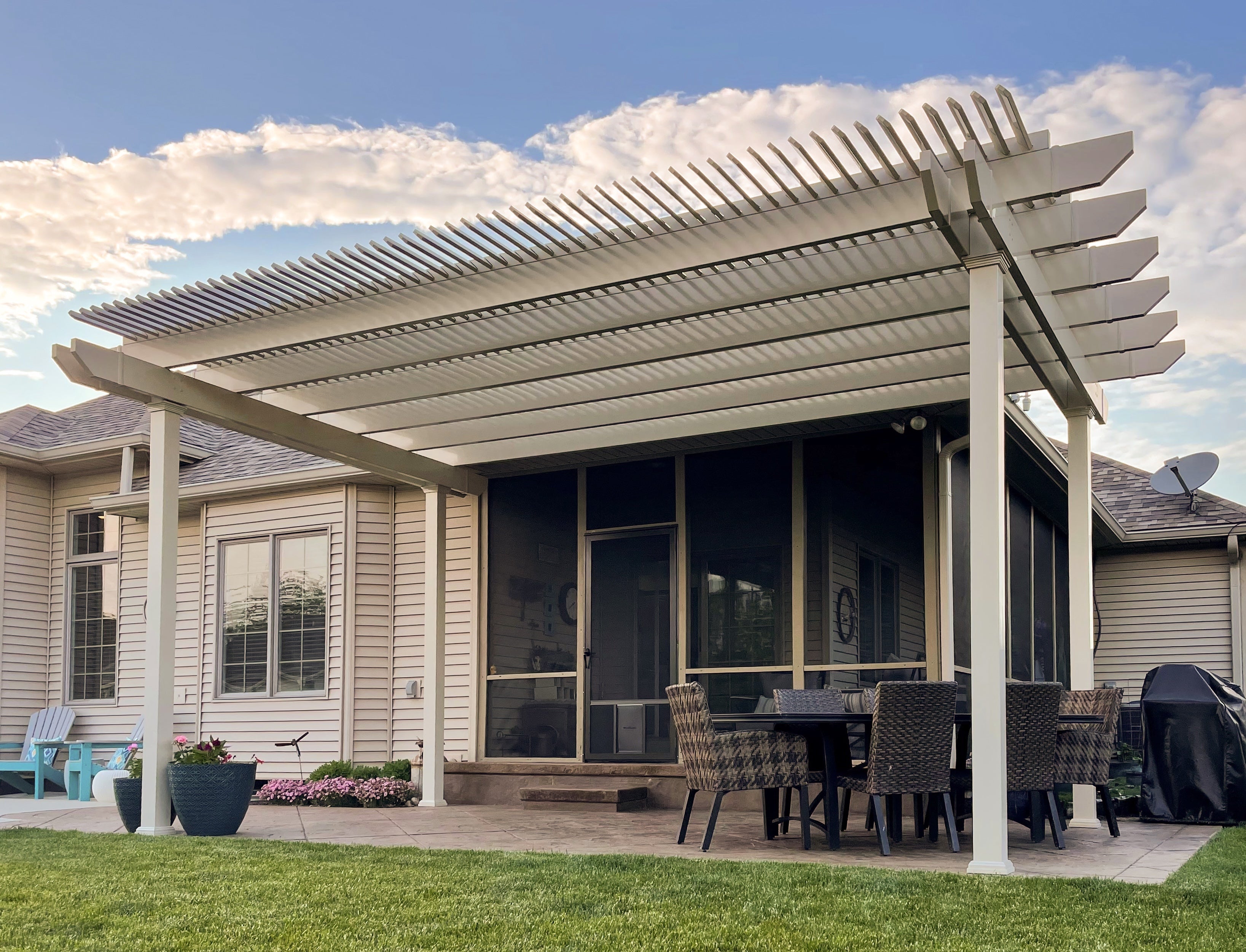 Sunset Pergola Kits' traditional and modern pergolas use aluminum reinforcement inside their weight-bearing posts, beams, and rafters. The aluminum provides structural support, while premium extruded vinyl forms the finished exterior.
This distinction matters because not every product described as a vinyl pergola uses the same internal construction. Homeowners comparing permanent structures should investigate what actually supports the roof and transfers loads into the posts and foundations.
The aluminum reinforcement also allows longer spans between posts, helping preserve usable space beneath the structure.
For a waterfront property, fewer unnecessary obstructions can make it easier to maintain sightlines toward the lake while arranging dining or lounge furniture.
However, aluminum reinforcement does not eliminate the need to verify site-specific wind and snow requirements. The complete structure, connections, and anchoring must be appropriate for the installation.
Traditional wood pergolas can be beautiful, especially alongside lake cottages and wooded landscapes. Their principal ownership tradeoff is ongoing surface maintenance.
Wood may require periodic staining, painting, sealing, or other treatment depending on the species, finish, and exposure.
Sunset Pergola Kits uses premium extruded vinyl colored throughout the material rather than relying on a painted exterior finish. The vinyl does not require routine painting, staining, sanding, or sealing.
For vacation homeowners who spend limited time at their lake property, avoiding recurring refinishing can be especially valuable.
The exterior will still benefit from occasional cleaning, particularly after pollen season or periods of heavy organic debris accumulation.
Great Lakes waterfront properties can expose outdoor structures to moisture, rain, and seasonal humidity.
Aluminum does not rust like ordinary steel, while the vinyl exterior does not rot like untreated wood. These characteristics make the combination appealing where owners want to reduce weather-related maintenance.
That does not mean every component is immune to environmental deterioration. Fasteners, connections, anchors, and surrounding construction still require appropriate selection and periodic observation.
For waterfront projects, particular attention should be given to installation hardware and connections exposed to moisture.
A permanent pergola should be evaluated differently from a temporary seasonal canopy. The structure may remain installed for decades, even if the homeowner primarily uses it between late spring and early autumn.
Sunset Pergola Kits manufactures its structures in the United States using American-sourced materials. Traditional and modern pergolas include lifetime warranties, while rainproof patio covers include a lifetime frame warranty and a 10-year roof warranty.
Another practical distinction is the fixed roof design. There are no motors, adjustable louvers, or retractable mechanisms requiring service.
Homeowners who specifically want adjustable sunlight control may prefer a different type of pergola. For those prioritizing dependable fixed shade and straightforward ownership, the simpler system has advantages.
| Great Lakes Condition or Need | Why Aluminum-Reinforced Vinyl Performs Well |
|---|---|
| Seasonal rain and moisture | Rust-proof aluminum reinforcement and rot-resistant vinyl exterior |
| Cold winters | Permanent aluminum-reinforced construction; site-specific snow-load verification remains essential |
| Lakefront wind exposure | Heavy-duty structural reinforcement; proper engineering and anchoring remain necessary |
| Summer sun | Fixed slatted roofs available with 50%, 75%, or 90% shade coverage |
| Waterfront vacation homes | No routine painting, staining, sanding, or sealing |
| Lake views | Longer spans can help reduce unnecessary post obstructions |
| Rain-sensitive entertaining | Optional solid-roof patio-cover designs provide rain protection |
For Great Lakes homeowners, the most useful question is not simply how much shade a pergola provides. It is which weather conditions should the structure protect against during the months the patio is actually used?
A lakefront lounge intended for sunny afternoons has different requirements from an outdoor dining area where unexpected rain could interrupt a gathering.
Sunset Pergola Kits' 50% shade option uses fixed angled purlins spaced 6 inches on center.
This configuration allows more sunlight through the roof than the denser alternatives.
It can be particularly appealing for patios used during cooler spring and autumn afternoons, garden seating areas, and locations where maintaining a bright outdoor atmosphere is important.
A 50% shade pergola can also help define a waterfront seating area without making it feel heavily covered.
The tradeoff is less shade during the strongest summer sunlight. It is generally better suited to homeowners who prioritize filtered light over maximum shade.
The 75% shade configuration uses fixed angled purlins spaced 4 inches on center.
For many Great Lakes homeowners, this is a sensible starting point because it balances meaningful summer shade with a relatively open pergola experience.
It works well for family seating areas, patios adjacent to the house, and outdoor dining spaces where complete rain protection is not essential.
On a lakeside property, it can make a sunny patio more comfortable while preserving the visual character of an open pergola.
Actual comfort will also depend on the direction of the sun, surrounding shade, wind, and outdoor temperature.
The 90% shade option uses fixed angled purlins spaced 3 inches on center.
This is worth considering for south- or west-facing patios that receive prolonged direct sunlight during the warmest part of summer.
It may be especially useful over lounge seating, outdoor conversation areas, or exposed decks with little surrounding tree cover.
However, greater shade is not automatically better in a region with a relatively short warm season.
If the patio is naturally cool or receives limited direct sunlight, the denser roof may reduce some of the sunlight homeowners would otherwise enjoy.
All three slatted configurations allow precipitation through the roof. None should be described or treated as rainproof.
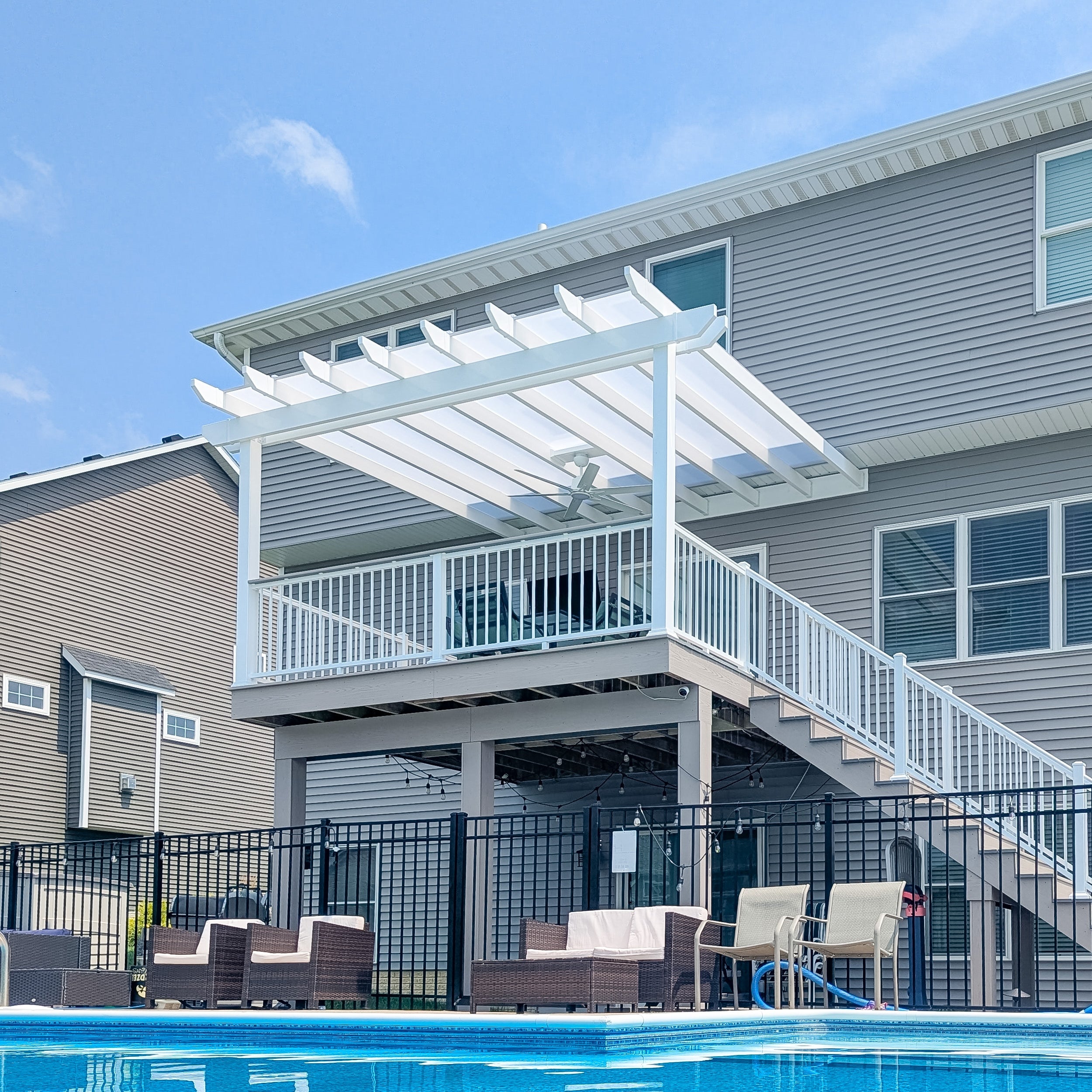 For homeowners who want dependable overhead rain protection, a solid-roof patio cover is the more appropriate choice.
Sunset Pergola Kits offers rainproof patio covers with solid polycarbonate roof panels in white or bronze.
Both roof-panel options provide 100% UV protection and can make the patio up to 15 degrees cooler.
This makes a covered patio particularly useful for summer dining areas, outdoor kitchens, and gathering spaces where keeping precipitation off the activity area is important.
For example, a homeowner near Lake Erie who regularly hosts family dinners may prefer a solid roof rather than repeatedly moving furniture and table settings indoors when rain approaches.
The tradeoff is a more enclosed overhead appearance and less direct sunlight than an open slatted pergola.
In Great Lakes snow country, the solid roof must also be evaluated for applicable snow loads, drainage, and winter conditions. Rainproof performance alone does not establish suitability for heavy snow accumulation.
Great Lakes homeowners should begin by identifying their primary use: summer shade, dependable rain protection, or an architectural feature that complements the home. Traditional pergolas are a strong starting point for classic lake houses and flexible post placement, while modern designs suit contemporary waterfront properties. Solid-roof patio covers are particularly appealing for outdoor dining and entertaining where rainfall would otherwise interrupt use; the final choice should also account for the property's wind exposure, snow-load requirements, and attachment options.
Outdoor living around the Great Lakes is strongly influenced by seasonality. Homeowners often want to make the most of warm-weather weekends, long summer evenings, and time spent with family and friends near the water.
The best pergola designs support these activities without unnecessarily restricting lake views, movement between indoor and outdoor spaces, or access to the surrounding landscape.
For many Great Lakes homeowners, summer entertaining centers around meals outdoors. Whether it's a weekend barbecue at a Lake Michigan cottage or an evening dinner overlooking Lake Erie, a thoughtfully placed pergola can help create a comfortable gathering space.
Start by determining how many people will regularly use the area and how furniture will be arranged. A dining table requires room not only for the table and chairs but also for guests to pull chairs back and move around comfortably.
For a dining area immediately outside the house, an attached structure may provide the most convenient connection to the indoor kitchen.
If rain protection is important, a solid-roof patio cover may be preferable to an open pergola.
Waterfront properties present an interesting design challenge: homeowners want shade without unnecessarily obstructing the scenery that makes the property special.
A freestanding pergola can establish a distinct outdoor lounge while preserving separation from the main house.
Positioning the structure thoughtfully can frame a lake view rather than interrupt it. Post placement, roof height, and the direction of primary sightlines deserve attention early in the design process.
For a west-facing waterfront property, afternoon sunlight may make 75% or 90% shade appealing. However, homeowners who enjoy watching the sunset should consider how the roof and surrounding landscape affect the experience.
One practical approach is to evaluate the pergola from the most frequently used seating position rather than only from the house or yard.
Vacation properties around northern Michigan, Wisconsin, and the Lake Erie shoreline often receive concentrated use during weekends and holidays.
For these homeowners, low-maintenance materials can be particularly valuable. Time spent at the property is better devoted to recreation and entertaining than recurring exterior refinishing.
A permanent pergola can also give an otherwise open lawn or deck a defined purpose, creating a recognizable place for outdoor dining or relaxation.
Owners who are away for extended periods should still arrange appropriate seasonal inspections and maintenance, especially following severe weather.
Not every Great Lakes property is directly on the water. Suburban homes around Chicago, Milwaukee, Cleveland, and Buffalo may use pergolas to create comfortable backyard destinations.
A freestanding structure beside a pool can provide shaded seating without covering the pool itself.
Garden pergolas can establish a quiet seating area among mature landscaping. In these settings, preserving natural light and maintaining appropriate distances from trees may be more important than maximizing shade.
Consider how the space will be used during spring and autumn as well as midsummer. A lighter shade configuration may provide a more versatile experience in naturally cool or heavily landscaped areas.
After choosing the appropriate amount of overhead coverage, the next decision is the structure itself: traditional or modern, attached or freestanding, and sized to the actual activity area.
For Great Lakes properties, placement should balance outdoor comfort, architectural compatibility, lake views, and the practical requirements of permanent installation.
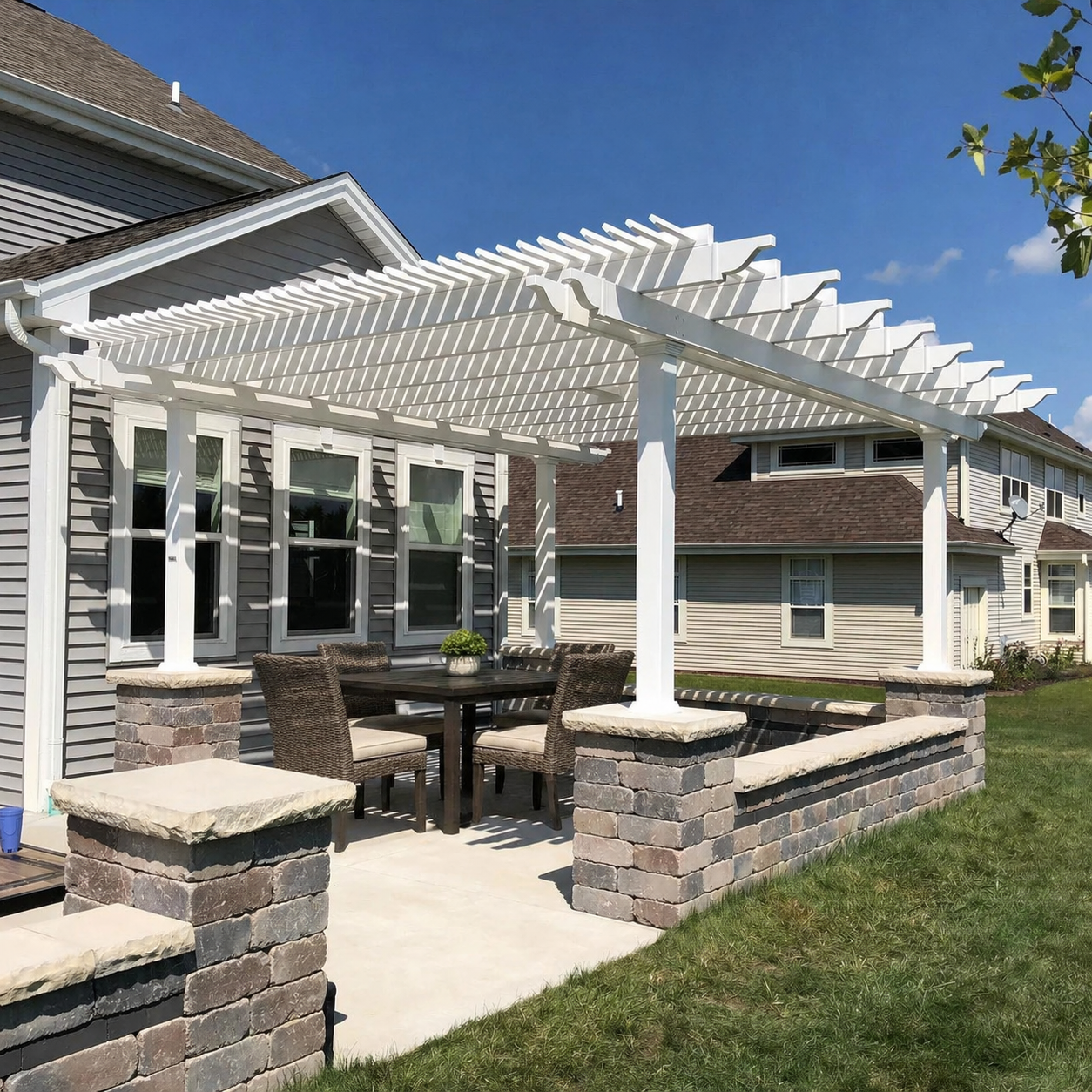 Traditional pergolas are particularly well suited to the architectural character of many Great Lakes cottages, lake houses, and established suburban homes.
Their defining features include decorative beam and rafter ends, optional overhangs, and flexible post-placement options.
Sunset Pergola Kits' traditional pergolas allow beam and rafter overhangs from 0 to 36 inches, with posts positioned at the corners or inset up to 36 inches.
This flexibility can be useful when working around existing patio edges, outdoor furniture arrangements, or desired sightlines.
For example, a traditional freestanding pergola can define a lakeside conversation area without requiring attachment to the house.
Available colors include white, tan, and black. Decorative end caps can be scrolled, beveled, or flat, allowing homeowners to coordinate the structure with their property's architectural details.
Modern Great Lakes homes often emphasize clean lines, large windows, simple roof profiles, and unobstructed views.
A modern pergola can complement this architectural approach through square, flush corners and an uncluttered structural appearance.
Sunset Pergola Kits' modern pergolas have no beam or rafter overhangs, no decorative end caps, and posts located at the corners.
These characteristics create a distinctly contemporary appearance, particularly alongside homes with modern siding, expansive glass, or minimalist landscaping.
However, modern pergolas offer less flexibility in post placement than traditional designs.
If a patio requires inset posts to avoid a walkway or accommodate an existing foundation, a traditional pergola may be the more practical choice.
An attached pergola can create a natural transition between the house and an outdoor living area.
This arrangement is especially useful when the primary patio sits directly outside the kitchen, dining room, or family room.
For Great Lakes homes, the relationship between the new structure and the existing roofline deserves careful evaluation.
Snow accumulation, roof runoff, flashing, structural attachment, and available mounting locations can all influence feasibility.
Not every fascia board, exterior wall, or roof edge is suitable for supporting an attached structure.
Homeowners considering attached pergolas should establish the appropriate structural connection before finalizing the design.
If attachment is impractical, a freestanding structure positioned near the house may provide a similar outdoor-living experience without transferring structural loads into the building.
Freestanding pergolas are particularly appealing for properties with large yards, detached patios, gardens, and waterfront seating areas.
They allow the homeowner to position shade where it is most useful rather than being limited to the home's exterior walls.
A freestanding pergola can also create a destination within the landscape, such as a shaded seating area overlooking Lake Michigan or a gathering space beside a backyard pool.
For properties with substantial open space, the structure should be large enough to accommodate the intended furniture without appearing disconnected from the surrounding landscape.
Sunset Pergola Kits offers freestanding pergolas in traditional and modern styles, with multiple size and post configurations.
Because freestanding structures rely on their own foundations and anchoring, exposed waterfront locations require careful evaluation of wind loads and site conditions.
The most useful starting point for pergola sizing is the activity area beneath it.
For dining, measure the table and chairs in their occupied positions, then allow sufficient space for circulation.
For lounge seating, consider the full arrangement of sofas, chairs, side tables, and walking paths.
A structure that appears generous when empty may feel cramped once furnished.
Traditional four-post freestanding pergolas are available in sizes up to 24 by 24 feet, while larger multi-post configurations can accommodate more extensive outdoor spaces.
Modern four-post freestanding pergolas are available up to 16 by 16 feet, with larger multi-post options available.
Homeowners can explore pergola dimensions and configurations to identify options that fit their available space.
On waterfront properties, it is particularly important to confirm that posts will not interrupt the primary view from seating areas or create obstacles along frequently used paths.
The Great Lakes region includes a broad range of architectural styles, from historic lake cottages and traditional Midwestern homes to contemporary waterfront residences.
A successful pergola should feel like a natural extension of the property's architecture and landscape rather than an unrelated structure placed in the yard.
Many Great Lakes vacation properties feature familiar cottage details such as gabled roofs, porches, painted siding, and traditional trim.
White or tan traditional pergolas can complement these architectural elements without introducing a visually competing style.
Scrolled end caps may suit homes with more decorative trim, while beveled or flat ends can create a simpler appearance.
Post style also influences the visual weight of the structure. Larger posts can create a substantial architectural presence, while smaller square posts may suit more restrained designs.
The objective is not necessarily to match every existing detail. Instead, coordinate the pergola's proportions, color, and architectural character with the house.
Contemporary homes overlooking the Great Lakes frequently emphasize strong horizontal lines and expansive views.
A modern pergola's flush roof profile can complement these characteristics without introducing decorative overhangs.
Black pergolas can provide a pronounced contrast against lighter siding or stone, while white and tan may create a softer visual relationship.
Sunset Pergola Kits' black modern pergolas use 8-inch square posts, while white and tan modern pergolas use 7-inch square posts.
These differences should be considered when evaluating the visual scale of the structure.
Properties around northern Michigan, Wisconsin, and portions of the Lake Superior shoreline often feature mature trees and natural landscaping.
In these environments, a pergola should complement the setting without unnecessarily disturbing established vegetation.
Tan finishes may blend comfortably with natural surroundings, while white can create a classic cottage appearance.
Placement deserves particular attention. Trees can provide beneficial natural shade, but nearby branches, falling leaves, and root systems may complicate installation and maintenance.
Consider whether the pergola should sit within an existing landscaped area or establish a separate outdoor room nearby.
One of the most important design principles for Great Lakes waterfront properties is preserving the relationship between the house, the outdoor living area, and the water.
A pergola should enhance the experience of the view rather than become the dominant visual obstruction.
Before choosing the final dimensions, stand inside the house and look through the windows toward the proposed installation area.
Then evaluate the same structure from the intended outdoor seating positions.
This simple exercise often reveals whether a different post arrangement, placement, or overall size would produce a better result.
For a property with an exceptional lake view, thoughtful placement may be more valuable than maximizing the total covered area.
Permanent pergola projects are most successful when homeowners identify potential problems before ordering materials or preparing foundations.
Several planning mistakes are especially relevant in the Great Lakes region because of its seasonal weather, lakefront exposure, and diverse property conditions.
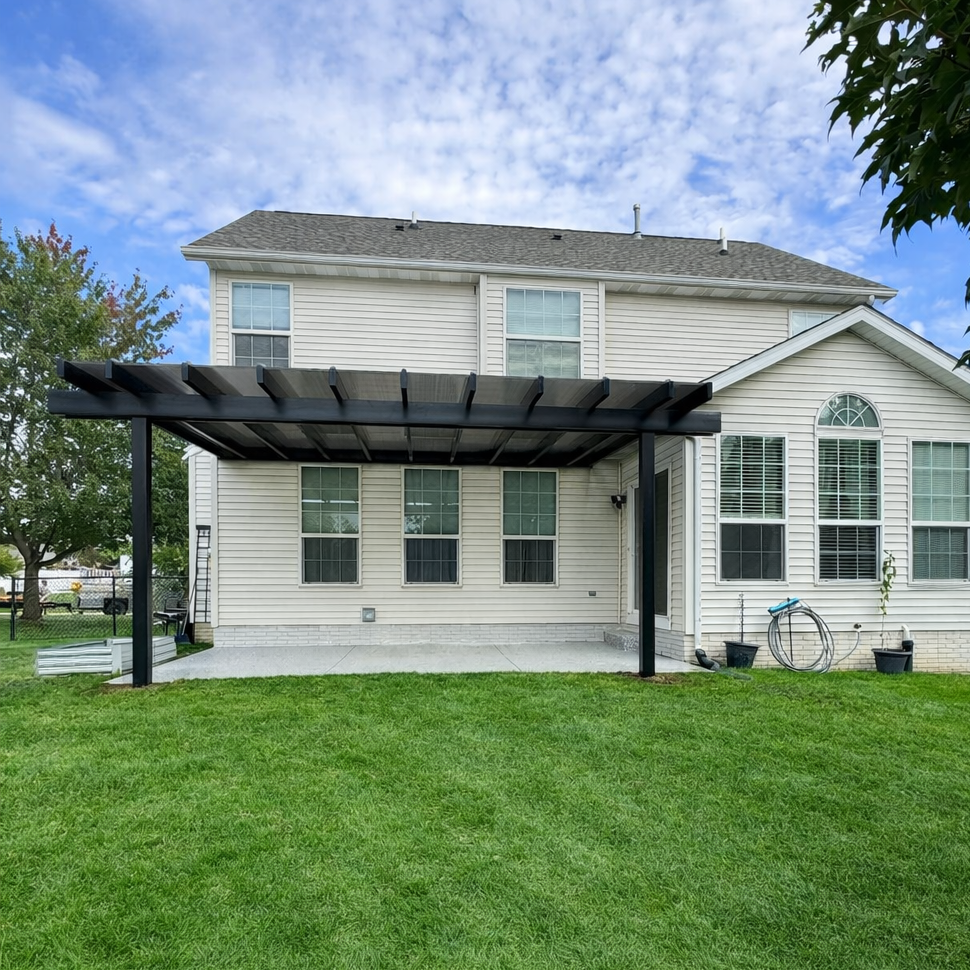 One of the most consequential mistakes is assuming that a pergola suitable for a mild climate will automatically be appropriate for a Great Lakes winter.
Snow-loading requirements vary significantly across the region, particularly in areas affected by lake-effect snowfall.
A structure installed near Buffalo or in a heavily affected Michigan snow belt may face different requirements from one installed in a comparatively sheltered location.
Homeowners should verify applicable structural loads before purchasing a pergola or patio cover.
For attached structures, the interaction between the new roof and the existing building also deserves attention.
Do not assume that a rainproof patio-cover roof is automatically suitable for every local snow condition.
Wind conditions can change dramatically over relatively short distances near the Great Lakes.
A sheltered residential neighborhood and an exposed lakeshore property may require different structural and anchoring considerations.
Homeowners should avoid selecting a structure solely by appearance without investigating the applicable design wind loads.
Where appropriate, ask about available wind-related options and confirm that the complete installation is suitable for the site.
A slatted pergola can provide substantial shade while maintaining an open architectural appearance.
However, even a 90% shade roof is not rainproof.
For homeowners planning regular outdoor dining, this distinction can significantly affect satisfaction with the finished project.
If keeping furniture and dining areas protected from overhead rainfall is a priority, a solid polycarbonate patio cover is generally the more appropriate starting point.
Make this decision based on how the space will actually be used rather than appearance alone.
Waterfront homeowners sometimes focus on covering the largest possible area without considering how the structure will affect views.
Posts positioned directly in front of frequently used seating areas can become a permanent visual distraction.
Likewise, an oversized roof may dominate the outdoor space or obstruct desirable views from inside the house.
Before finalizing dimensions, evaluate the proposed structure from multiple viewpoints and consider whether different post locations or a smaller configuration would improve the result.
Summer shade requirements are not necessarily the same as spring or autumn comfort preferences.
A densely shaded pergola may work beautifully during July but make an already cool patio feel darker during shoulder seasons.
Homeowners should consider the direction of sunlight throughout the year and the times when the outdoor space will receive the most use.
For naturally shaded or north-facing patios, a lighter roof configuration may provide a better overall balance.
Many Great Lakes homes have elevated decks overlooking the water.
Although these decks may appear substantial, they were not necessarily designed to support additional permanent structures.
Adding a pergola can introduce structural loads and connection requirements that the original deck design did not anticipate.
Before installing a pergola on an existing deck, have the deck's structural capacity and proposed anchoring evaluated by an appropriately qualified professional.
This is particularly important for elevated or wind-exposed installations.
Successful installation begins with understanding the property rather than simply selecting a pergola size.
In the Great Lakes region, winter conditions, wind exposure, drainage, and local building requirements can all influence the final design.
Start by measuring the intended outdoor living area and identifying existing site constraints.
Important considerations include patio dimensions, grade changes, nearby landscaping, underground utilities, drainage patterns, and the location of doors and windows.
For waterfront properties, also consider whether the proposed structure sits on an exposed slope, elevated deck, or area with unusual soil or foundation conditions.
Proper anchoring is essential for permanent pergolas. The appropriate foundation and connection details depend on the structure, site conditions, and applicable requirements.
Do not assume that an existing patio slab or deck is automatically suitable for supporting a permanent pergola.
Sunset Pergola Kits offers optional hurricane brackets for traditional pergolas and solid-roof patio covers.
These brackets are recommended when the customer's area ever experiences winds of 80 MPH or higher.
Adding hurricane brackets includes a lifetime wind-damage warranty.
Despite the name, hurricane brackets are not relevant only to coastal hurricane regions. Great Lakes properties can experience severe winds associated with thunderstorms and other weather systems.
However, bracket selection must be based on the actual site's wind exposure and applicable structural requirements.
Hurricane brackets are not available for modern pergolas.
They also do not eliminate the need for proper anchoring, suitable foundations, or compliance with applicable building requirements.
Snow-load considerations deserve particular attention throughout the Great Lakes region.
Local requirements may depend on geographic location, elevation, exposure, roof configuration, and other site-specific factors.
Homeowners should verify the applicable design criteria with their local building department or qualified structural professional.
For solid-roof patio covers, drainage and the potential for snow drifting from nearby roofs may require additional evaluation.
For slatted pergolas, do not assume that the openings between purlins eliminate winter loading concerns.
The appropriate structure and installation should be confirmed before construction begins.
Permitting requirements can vary among Great Lakes municipalities and counties.
Factors that may influence approval include structure dimensions, height, attachment method, location on the property, foundation design, and applicable wind or snow loads.
Waterfront properties may also be subject to shoreline setbacks, environmental restrictions, or other location-specific requirements.
Homeowners should contact the appropriate local building department to verify current requirements for their exact property and proposed project.
Where applicable, homeowners associations may impose additional architectural or placement restrictions.
Do not assume that a structure is exempt from permitting simply because it is sold as a kit.
Sunset Pergola Kits' products are designed to be DIY-friendly, but professional installation may be preferable for certain projects.
A straightforward freestanding pergola on an appropriately prepared site may be manageable for homeowners with suitable construction experience.
More complex projects may benefit from professional assistance, particularly when they involve attachment to an existing house, elevated decks, substantial foundations, challenging site access, or demanding structural requirements.
For Great Lakes waterfront properties, a contractor familiar with local wind, snow, and foundation conditions can be especially valuable.
Homeowners can review assembly information and installation resources before deciding how to approach their project.
Aluminum-reinforced vinyl pergolas offer a relatively straightforward ownership experience.
The vinyl exterior does not require routine painting, staining, sanding, or sealing.
Occasional cleaning can help remove pollen, dust, leaves, and other seasonal debris.
Solid polycarbonate roof panels should be kept free of accumulated organic material and cleaned according to the manufacturer's instructions.
Homeowners should periodically observe accessible anchors, fasteners, and surrounding installation areas for visible problems, particularly after severe weather.
For vacation properties, arranging seasonal inspections can help identify concerns before the next period of heavy use.
Always follow product-specific installation, maintenance, and winter-care instructions.
A well-planned pergola can make a Great Lakes patio, deck, or waterfront gathering area more comfortable and inviting throughout the outdoor living season.
The right choice begins with your property's exposure, intended activities, architectural style, and desired level of shade or rain protection.
Explore Sunset Pergola Kits' traditional, modern, and rainproof designs to find a permanent outdoor structure that complements your home and meets your practical needs. Before purchasing, confirm the applicable wind, snow, foundation, and installation requirements for your specific location.
For many Great Lakes homes, an aluminum-reinforced vinyl pergola is an appealing option because it combines permanent structural construction with a low-maintenance exterior. Traditional pergolas suit classic cottages and homes requiring flexible post placement, while modern pergolas complement contemporary architecture. The best choice also depends on local wind and snow requirements, desired shade coverage, and whether rain protection is necessary.
A permanent pergola may be suitable for year-round installation in the Great Lakes region, but its structural design must be appropriate for the specific location. Snow loads vary significantly across the region, particularly in lake-effect snow belts. Homeowners should verify applicable wind and snow loads and confirm that the selected pergola and anchoring system meet the site's requirements. Aluminum reinforcement alone does not establish winter suitability.
A slatted pergola is generally preferable when filtered sunlight, an open appearance, and summer shade are the main priorities. A solid-roof patio cover is more appropriate when dependable overhead rain protection is important. Both configurations require careful structural and anchoring planning for exposed waterfront properties.
For many sunny Great Lakes patios, 75% shade is a useful starting point. Homeowners wanting a brighter outdoor space may prefer 50%, while west-facing or heavily sun-exposed patios may benefit from 90%. The best choice depends on the patio's orientation, surrounding tree cover, and whether the space is used primarily during hot summer afternoons or cooler spring and autumn weather.
Permit requirements vary by municipality, county, structure size, installation method, and property conditions. Waterfront properties may also have shoreline setbacks or other restrictions. Contact your local building department before installation to verify applicable permits, structural requirements, setbacks, and inspections. HOA approval may also be necessary.
Both materials can be appropriate when properly designed and maintained. Wood offers a natural appearance but may require periodic painting, staining, or sealing. Premium extruded vinyl does not require those routine finishing treatments, while Sunset Pergola Kits' internal aluminum reinforcement provides structural support. For homeowners prioritizing reduced maintenance, particularly at vacation properties, aluminum-reinforced vinyl can be an attractive alternative.
Possibly, but the existing deck must be evaluated for the additional structural loads and anchoring requirements. Elevated waterfront decks can be particularly exposed to wind. A qualified professional should determine whether the deck, its connections, and its foundations can safely support the proposed pergola. Do not assume that a deck designed for ordinary residential use can automatically support a permanent overhead structure.
Sunset Pergola Kits recommends optional hurricane brackets for traditional pergolas and solid-roof patio covers in areas that ever experience winds of 80 MPH or higher. The brackets include a lifetime wind-damage warranty. They are not offered for modern pergolas. Homeowners should verify their property's applicable wind requirements and ensure that foundations, anchors, and structural connections are appropriate for the site.
No. A 90% shade pergola uses closely spaced fixed slats to provide substantial shade, but precipitation can still pass through the roof. For dependable overhead rain protection, choose a rainproof patio cover with solid polycarbonate roof panels. Sunset Pergola Kits offers these panels in white and bronze, both providing 100% UV protection.
Premium extruded vinyl pergolas require relatively little routine exterior maintenance. They do not need regular painting, staining, sanding, or sealing. Occasional cleaning helps remove pollen, leaves, and other debris. Homeowners should also periodically inspect accessible anchors and connections for visible concerns, particularly following severe weather. Solid-roof patio covers require appropriate roof-panel cleaning and debris removal according to product instructions.


