

MADE IN THE USA
with American products
w/ American products


The best modern pergola lighting ideas make an outdoor space comfortable and functional after dark without compromising its clean architectural lines. Whether you're planning a new pergola or improving an existing one, the challenge is choosing where light belongs, how visible the fixtures should be, and how to create a welcoming atmosphere without a cluttered roofline. The following approach focuses on lighting effects, glare control and visual integration rather than simply adding more fixtures.
Start with what you'll actually do beneath the pergola after sunset. A comfortable conversation area, an outdoor dining table and a pathway through the patio do not require the same lighting. Identifying these differences first helps you avoid using one overly bright fixture to serve every purpose.
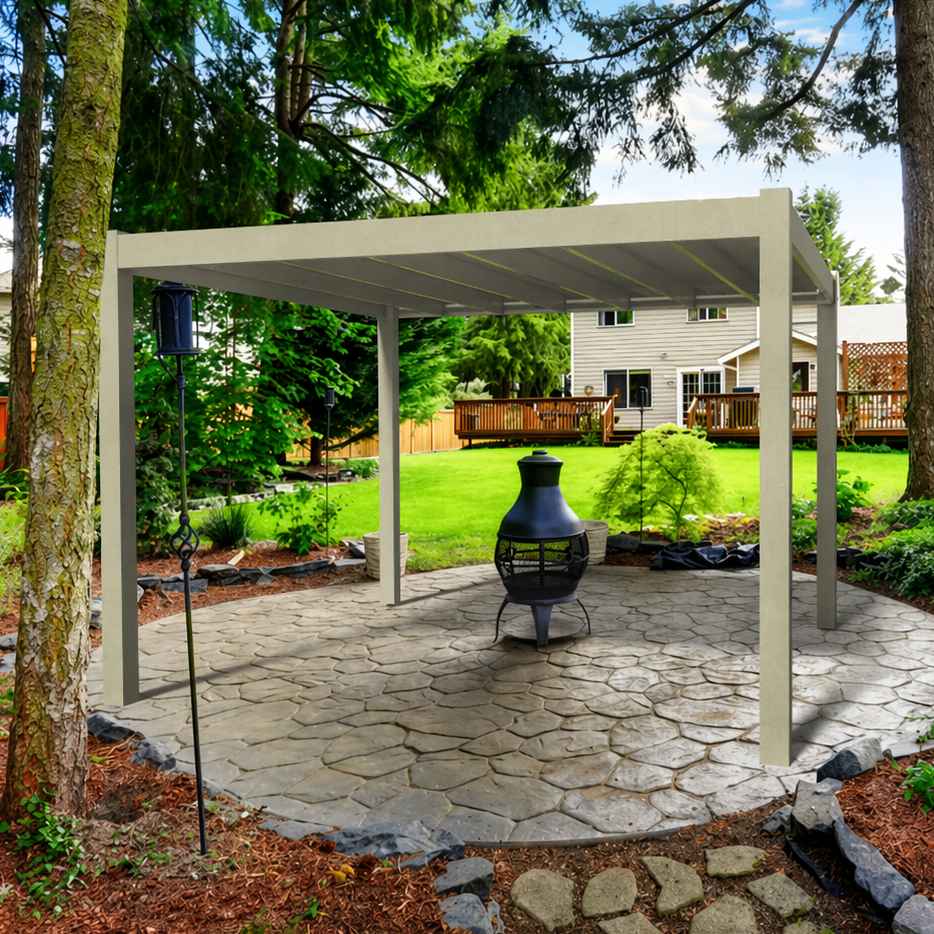 Task lighting illuminates a specific activity or surface. Beneath a modern pergola, that might include a dining table, a reading chair or a countertop used for food preparation.
The important distinction is where the light lands. A fixture that brightly illuminates the surrounding patio but leaves a table in shadow may not provide useful task lighting. Conversely, a focused light can make the table functional without requiring the entire pergola to be equally bright.
Choose the needed light level based on the activity, the fixture's documented performance and the surrounding conditions rather than relying on a universal brightness recommendation.
Ambient lighting provides general illumination and establishes the atmosphere. For conversation areas, it often works best when light is distributed softly rather than concentrated directly above everyone's heads.
Subtle light reaching nearby surfaces, the patio floor or the surrounding seating area can help define the space. The objective is enough visibility for comfort without making the pergola feel like an extension of an intensely illuminated indoor room.
Consider how people approach, enter and move through the pergola. Changes in walking direction, nearby steps and transitions between darker and brighter areas can influence the lighting plan.
Some orientation lighting may already come from the house or surrounding landscape. Evaluate that existing light before adding more fixtures beneath the pergola.
A simple lighting-purpose map might look like this:
| Nighttime Activity | Primary Lighting Need | Design Priority |
|---|---|---|
| Dining or reading | Focused task light | Illuminate the useful surface without shining into seated eyes |
| Conversation and lounging | Soft ambient light | Comfortable illumination with minimal fixture visibility |
| Entering and moving through the space | Orientation light | Clear visibility along the intended route |
Once these purposes are defined, it becomes easier to select a small number of fixtures that perform specific jobs instead of filling every available structural opening with light.
Minimalist pergola lighting is not necessarily invisible. The better goal is to choose fixtures whose shape, scale and light distribution complement the structure rather than competing with it.
Small, directional downlights can provide useful illumination over a table, seating area or other defined surface. Their relatively restrained appearance makes them worth considering when you want the pergola's structure to remain the dominant visual element.
Look beyond the physical size of the fixture. A compact light can still create uncomfortable glare if its bright source is exposed from common viewing angles. Recessed-looking optics, shielding and directional control may help, depending on the specific product.
Any fixture must use a mounting arrangement approved for the pergola. A recessed appearance should not be interpreted as permission to cut into structural members.
Linear fixtures can emphasize the straight geometry of contemporary pergola lighting design. A carefully positioned line of light may visually reinforce a beam or another structural element, producing a more integrated appearance than several unrelated fixtures.
There is an important difference between a continuous illuminated effect and a visibly exposed LED strip. The first can look refined; the second may produce distracting points of brightness, reflections or an overly technical appearance.
Evaluate the fixture's diffuser, viewing angle, light distribution and approved mounting requirements. Do not assume that a pergola kit includes dedicated lighting channels or supports structural modifications to conceal fixtures.
Suspended lighting can also work with modern architecture when its arrangement is deliberate. A simple pendant over a defined activity area may act as one intentional focal point. Similarly, a limited arrangement of string lights can introduce softer decorative light without visually dominating the structure.
The tradeoff is visibility. Suspended fixtures and cords interrupt the otherwise open space beneath the roof, so they generally suit homeowners who welcome a modest decorative element rather than seeking a nearly invisible lighting system.
Avoid multiple competing hanging fixtures or irregular arrangements that distract from the pergola's straight profiles. Confirm suspension approval, weather suitability and clearances before selecting this approach.
| Fixture Concept | Desired Effect | Primary Tradeoff |
|---|---|---|
| Compact downlights | Localized task or general downward light | Bright sources may remain visible from seating |
| Linear lighting | Continuous light emphasizing straight lines | Visible strips or poor diffusion can undermine the minimalist effect |
| Restrained pendants | A distinct illuminated focal area | Suspended hardware becomes part of the composition |
| Simple string-light arrangements | Decorative ambient light | Bulbs and connecting cords remain visible |
All four are design concepts rather than built-in features of a pergola kit. Their suitability depends on verified fixture specifications, mounting compatibility and the appearance you want to achieve.
Good fixture placement balances two objectives: reinforcing the pergola's geometry and directing illumination where it will be useful. A perfectly symmetrical arrangement is not necessarily successful if it creates glare or leaves the main activity area poorly lit.
Modern pergolas typically emphasize clean edges, straight beams and disciplined proportions. Lighting can respect that geometry through consistent alignment, repeated spacing or a limited number of intentional focal points.
 For example, a series of visually coordinated fixtures along a structural line may appear more organized than the same fixtures positioned at unrelated angles. With directional lighting, however, the useful illuminated surface should still take priority over perfect geometric repetition.
Sunset Pergola Kits' modern pergola designs have corner-positioned posts, square or flush corners, and no beam or rafter overhangs. These characteristics provide a clear architectural framework for evaluating lighting arrangements.
The fixed slatted roofs offer 50%, 75% or 90% shade coverage. Because the slats and structural members remain visible, evaluate any proposed lighting against the actual roof layout rather than assuming every position will produce the same appearance or light distribution.
A fixture can look discreet when viewed from the patio entrance yet become distracting when someone sits directly beneath it.
Review the proposed placement from several positions:
Consider both direct glare from the fixture and reflected glare from nearby surfaces. A visible LED source may be uncomfortable even when the surrounding patio seems relatively dim, because the source itself can be much brighter than its surroundings.
A useful principle is to distinguish between seeing the light's effect and seeing the light itself.
For example, illuminating a tabletop without placing a bright source in a diner's normal line of sight may provide better visual comfort than a conspicuous fixture aimed straight downward. A shielded or appropriately directed fixture may achieve that effect, depending on its optics and placement.
Review actual beam patterns and fixture documentation rather than assuming that a fixture described as downward-facing will automatically eliminate glare.
Modern pergola ambient lighting usually benefits from a restrained number of complementary layers. The goal is not to illuminate every available surface but to create a coherent nighttime scene that can adjust to different uses.
A dining area might benefit from focused table illumination accompanied by a softer surrounding layer. A lounge, by contrast, might need little focused lighting and rely mainly on ambient illumination.
These layers do not need identical brightness. In fact, the ability to adjust them separately can be particularly valuable when the space changes from dinner to conversation.
Before adding another layer, ask whether it serves a genuinely different purpose. If two fixtures produce essentially the same effect in the same area, one may be unnecessary.
Color temperature describes whether white light appears warmer or cooler. Warmer-looking light often suits relaxed settings, while other appearances may be preferred for particular tasks or architectural effects.
There is no single color temperature that is correct for every pergola. Evaluate the intended mood alongside the color appearance of nearby house lights, outdoor wall fixtures and other visible illumination.
An extremely warm patio light beside noticeably cooler house lighting may create an unintended contrast. That contrast can be deliberate, but it should be a design choice rather than an accident.
Whenever practical, compare actual fixture samples or reliable manufacturer information under realistic nighttime conditions, particularly when lights from different product families will be visible together.
Dimming provides flexibility without requiring additional fixtures. A higher task-light setting may be useful during a meal, while a lower ambient setting can provide a more relaxed atmosphere afterward.
If the design includes separate task and ambient layers, consider whether independent control would make the space more versatile. Verify that the selected fixtures, drivers and dimming controls are compatible; not every fixture or lighting system supports every dimming method.
The strongest lighting composition is often one that provides several useful scenes from a relatively small, coordinated group of fixtures.
A discreet fixture is only a practical choice if it is suitable for its intended outdoor environment and can be mounted in a manner approved for the structure.
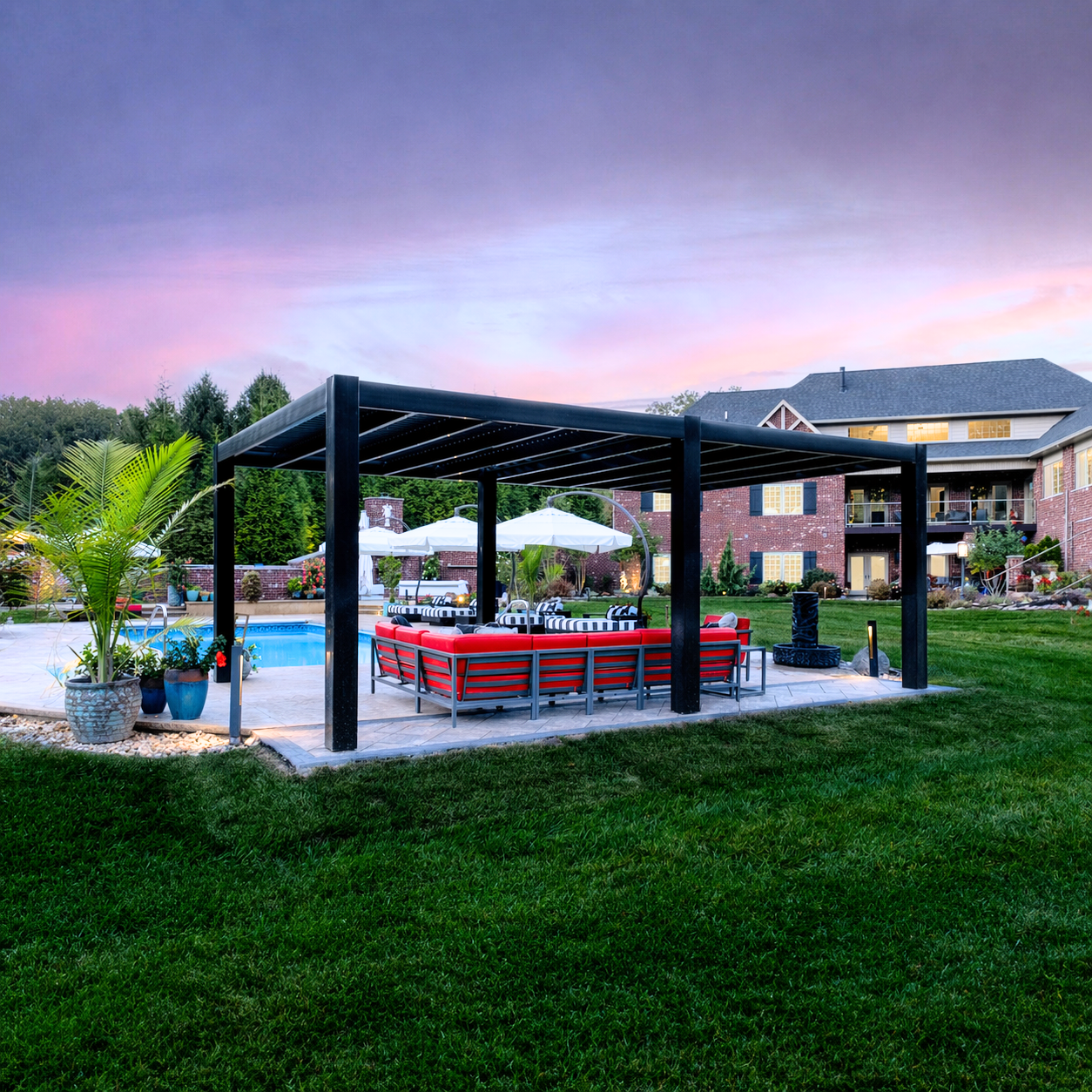 Outdoor lighting may encounter different moisture and weather conditions depending on its location. A sheltered position and a location directly exposed to rain are not necessarily equivalent.
Check the manufacturer's stated outdoor-use rating and the installation conditions associated with it. A fixture being described as outdoor-rated does not automatically establish suitability for every location beneath an open-roof pergola.
Sunset Pergola Kits' modern pergolas use fixed slatted roofs rather than rainproof solid roofs. Even with higher shade coverage, the slatted roof should not be treated as a weatherproof enclosure for lighting equipment.
Modern Sunset Pergola Kits feature aluminum-reinforced structural components with premium extruded vinyl exteriors. This construction does not, by itself, establish that a particular light fixture, mounting bracket or attachment method is approved.
Before finalizing a lighting concept, verify:
An integrated-looking result does not require the lights to come built into the pergola kit, but it does require careful product selection and compatibility review.
A central light fixture may compete with the location intended for a ceiling fan. Suspended lighting can also create a potential clearance conflict with fan blades or other moving parts.
Sunset Pergola Kits offers optional fan mounts for its modern pergolas. If a fan is part of the plan, identify its proposed location before committing to central or suspended lighting.
Verify the relevant fan, fixture and mounting clearances against actual manufacturer requirements. Do not assume that a fan mount automatically accommodates a light fixture or a particular combined fan-and-light product.
Before selecting products or finalizing a pergola configuration, bring your choices together into a simple lighting concept. This makes it easier to distinguish intentional design decisions from unresolved compatibility questions.
Your concept should identify:
For a lounge-focused pergola, the concept might emphasize one soft ambient layer with fixtures that are difficult to notice during normal conversation. Existing lighting from the house or landscape might provide enough surrounding illumination that additional task lighting is unnecessary.
The priority is a calm nighttime atmosphere with limited bright sources in seated sightlines. Extra fixtures should be added only when they solve a specific visibility problem.
For a pergola used primarily for evening meals, the concept might combine focused illumination over the dining surface with a softer ambient layer for the surrounding space.
The task layer provides useful visibility during dining, while adjustable ambient lighting helps the area transition to relaxed conversation. Both layers should work visually with the roof geometry and avoid glare at seated eye level.
These examples illustrate different lighting priorities, not predetermined fixture packages or lighting options included with the pergola.
If you're choosing a new structure, compare the intended lighting composition with verified pergola dimensions, roof profiles, post positions and available mounting options before making final decisions.
For example, a four-post modern freestanding pergola and a larger six-post modern pergola offer different structural layouts to consider. Neither configuration should be assumed to include integrated lighting or dedicated fixture mounting provisions.
Homeowners considering a connection to the house can also examine attached pergola configurations as part of selecting the appropriate structure. Lighting compatibility must still be reviewed for the specific model and proposed fixture locations.
If you already own a pergola, this concept can guide a compatibility discussion without requiring a new structure.
The most effective modern pergola lighting ideas begin with useful illumination, restrained fixture visibility and carefully controlled glare. By choosing lighting effects around actual activities, coordinating the fixtures with straight structural lines, and verifying outdoor and mounting compatibility, you can create a comfortable nighttime setting without sacrificing the pergola's minimalist appearance.
If you're planning a new structure, explore modern pergolas from Sunset Pergola Kits to compare designs and identify a layout that can be evaluated against your lighting concept.
Yes. String lights can complement a minimalist pergola when arranged simply and intentionally. A limited, orderly arrangement generally preserves the structure's clean appearance better than multiple intersecting strands. Consider the visibility of both the bulbs and cords, and verify mounting and outdoor-use suitability.
Not necessarily. Task lighting should provide sufficient illumination for a particular activity, while ambient lighting establishes general visibility and atmosphere. Separate brightness levels, preferably with compatible dimming controls, can make the pergola more versatile.
Yes. A bright LED source can be visually uncomfortable against darker surroundings. Evaluate fixtures from seated eye level and consider appropriate shielding, diffusion or directional optics rather than judging glare solely by how bright the overall patio appears.
Matching or coordinating color temperatures often helps create a cohesive appearance when house and pergola lights are visible together. An intentional contrast can also work. Compare the actual light appearance rather than assuming that all fixtures described as warm white will look identical.
No. An outdoor-use rating addresses specified environmental conditions, not whether the fixture can be mounted to a particular pergola. Verify the applicable exposure rating, approved attachment method, structural restrictions and warranty implications separately.
No. Carefully selected aftermarket fixtures can create an integrated appearance when their placement complements the pergola's structural lines. However, do not assume that modern pergola kits include lighting channels, built-in fixtures or approved locations for every lighting product.
Yes. A fixture that appears discreet while standing may create direct glare when viewed from a chair. Evaluate the proposed lighting from common seating positions, the patio entrance and nearby spaces to identify exposed light sources or distracting reflections.
Yes. A central pendant, downlight or other fixture may compete with a ceiling fan's intended location or clearance requirements. If you're considering a modern pergola with an optional fan mount, coordinate the fan and lighting locations early and verify compatibility with both manufacturers.


