

MADE IN THE USA
with American products
w/ American products


Effective freestanding pergola privacy starts with identifying who can see into your outdoor living area and from where. A detached pergola might feel perfectly secluded on three sides yet leave a conversation area exposed to a neighboring patio or upstairs window. Rather than enclosing the entire structure, you can use targeted screens, curtains, panels, or landscaping to interrupt those specific views while preserving the openness that makes a pergola appealing.
Before choosing privacy accessories, identify the actual sightlines that make your freestanding pergola feel exposed. The goal is to determine which views need blocking, at what height, and from which direction rather than assuming every side requires screening.
 Start by standing where your outdoor furniture will be located and looking toward neighboring properties. Consider what someone might see from an adjacent patio, walkway, driveway, or garden.
Then look beyond ground level. An upstairs bedroom window, elevated deck, or neighboring hillside may create a downward sightline into the pergola that a conventional side screen would not fully interrupt.
These different viewing angles matter because a privacy feature that works at one height may be ineffective at another.
Privacy needs often change depending on how the space is used.
For example, a screen positioned along the neighbor-facing edge might provide excellent seated privacy without needing to extend around the entire pergola. However, that same screen may not prevent someone looking down from an upper-story window from seeing the seating area.
Once you know where unwanted views originate, identify the portion of the pergola perimeter that intersects those sightlines.
A neighboring patio might overlook only one corner of your outdoor sofa arrangement. In that situation, a localized privacy panel or carefully positioned planter could be more appropriate than screening the entire side.
Alternatively, a long property boundary with multiple viewing positions might justify a broader treatment.
The practical rule: Match the location and height of the privacy treatment to the actual viewing problem. Do not select a full-length screen simply because the pergola has a full-length open side.
The most successful open pergola privacy ideas preserve the qualities that made the location attractive in the first place. Those might include a garden view, convenient access to the house, comfortable airflow, or an uninterrupted connection to the surrounding landscape.
Privacy should improve how the outdoor living area feels without unnecessarily sacrificing those benefits.
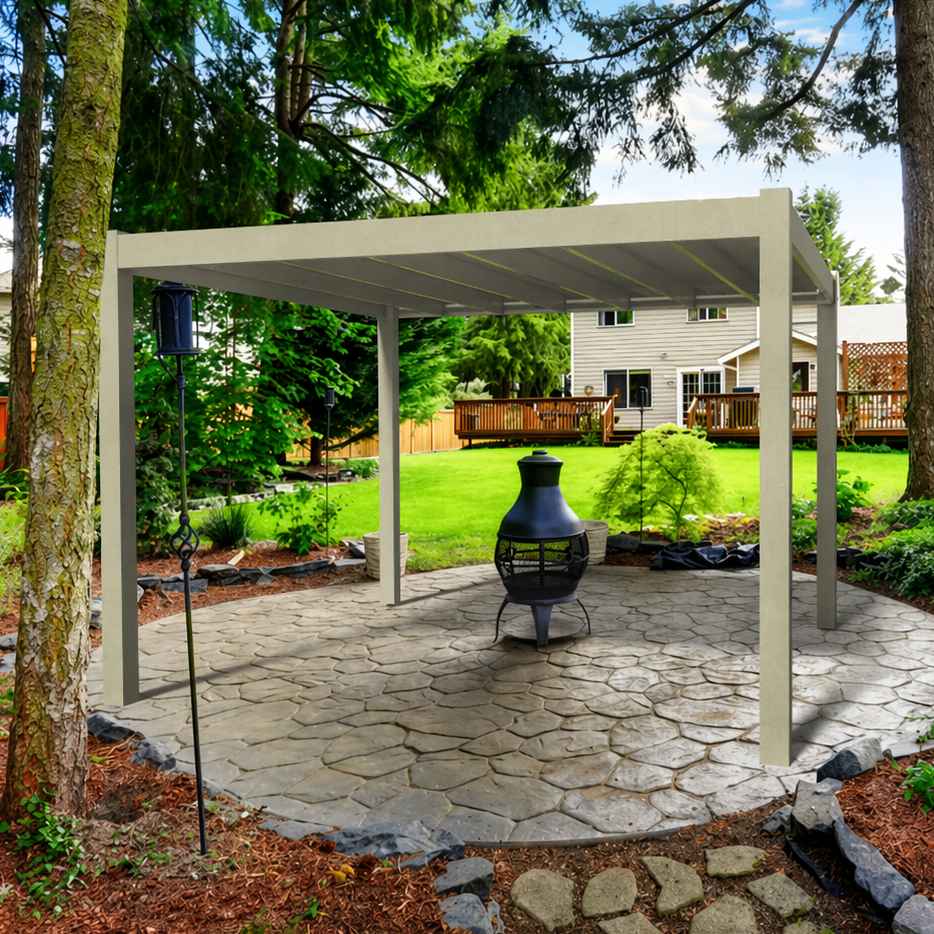 Consider a freestanding pergola positioned between a landscaped backyard and a neighboring property.
The neighbor-facing side may need screening, while the garden-facing side offers an attractive view worth preserving. The remaining sides might provide natural entry points or allow breezes to move through the seating area.
Screening only the exposed side can create a more secluded conversation area without making the pergola feel enclosed.
If privacy is needed from two directions, consider whether two shorter treatments positioned near the seating area would accomplish the goal more effectively than continuous screening around the perimeter.
A privacy feature can solve a visibility problem while creating an inconvenient obstacle.
Before selecting a treatment, identify the routes people naturally use to enter and leave the pergola. Pay particular attention to connections between the seating area and nearby doors, outdoor kitchens, dining spaces, and garden paths.
For example, a freestanding privacy screen positioned near the edge of a lounge area might conceal the furniture from a neighbor while leaving the main walkway completely unobstructed.
A continuous panel across the same side could force guests to walk around the structure instead.
When comparing freestanding pergola configurations, consider how the post arrangement and overall footprint will work with your intended entry points and privacy treatment.
Privacy is not necessarily the same as complete visual separation.
A partially open slatted panel may interrupt direct views into a seating area while allowing some visibility through the treatment. Planting may soften an exposed edge without creating the appearance of a solid wall.
These approaches can be particularly attractive when the pergola overlooks a landscaped yard or another outdoor feature you want to remain visually connected to.
However, filtered screening is not equivalent to complete privacy. Visibility depends on the treatment's spacing, viewing angle, lighting, and the positions of people on either side.
Choose the degree of screening based on how much visibility you actually want to prevent, rather than assuming the most opaque option is always the best.
The best privacy ideas for a freestanding pergola depend on whether you want adjustable coverage, a permanent visual boundary, filtered screening, or a softer landscaped appearance.
Each treatment has advantages and limitations. The following comparison can help narrow the options before evaluating specific products.
| Privacy Treatment | Adjustability | Visual Privacy | Primary Tradeoff |
|---|---|---|---|
| Freestanding privacy screens | Depends on whether the screen is fixed or movable | Can provide partial or fuller screening depending on design | Requires suitable independent support and placement |
| Privacy curtains | Generally adjustable when designed to open and close | Can provide flexible coverage depending on fabric and construction | Wind movement, maintenance, and mounting compatibility |
| Slatted privacy panels | Usually fixed once installed | Filters views according to slat spacing and viewing angle | May remain partially transparent from certain directions |
| Planters and landscaping | Limited once established, although movable planters offer flexibility | Depends on plant density, height, and seasonal growth | Growth time, ongoing care, and changing coverage |
A separately supported privacy screen can be useful when unwanted views come from a particular direction and you do not want to attach accessories to the pergola itself.
Depending on its construction, a screen may provide substantial visual separation or allow filtered views through decorative openings.
One advantage is that the screen can potentially be positioned independently of the pergola posts. This allows its location to be determined by the actual sightline rather than the structure's perimeter.
However, independent placement does not eliminate structural considerations. The screen still needs appropriate support, anchoring, and wind resistance for its location.
Best suited for: Homeowners who want a defined privacy zone along one exposed edge without necessarily modifying the pergola.
Pergola privacy curtains are worth considering when the desired level of privacy changes throughout the day.
For example, curtains might remain open when the neighboring property is unoccupied and close when additional separation is desired.
This flexibility can be valuable when a pergola serves multiple purposes, such as quiet afternoon reading and evening entertaining.
However, curtains introduce practical questions:
Not every outdoor curtain is opaque, and not every pergola is designed to support curtain tracks or hardware.
Best suited for: Homeowners who value adjustable privacy and are willing to accommodate the maintenance and support requirements of a fabric treatment.
Slatted pergola side privacy panels can complement the clean lines of a permanent outdoor structure while providing a more defined visual boundary.
They are particularly useful when you want to interrupt direct views without necessarily installing a completely opaque surface.
However, slat orientation and spacing significantly influence the result.
A panel that appears private when viewed straight on may allow substantial visibility from an angle. Similarly, a design that conceals seated occupants might reveal more of the space to someone standing nearby.
Evaluate the specific panel from the actual observer positions rather than relying exclusively on product photographs.
Best suited for: Homeowners who prefer a consistent architectural appearance and do not need the screening to open and close regularly.
Planting can create privacy while maintaining a natural connection between the pergola and its surroundings.
Large planters, shrubs, and carefully selected landscape plantings may interrupt neighbor-facing sightlines without introducing a continuous hard surface.
However, plant-based privacy requires evaluating both current and mature growth.
A young shrub may provide little screening initially but eventually occupy more space than intended. Seasonal foliage changes may also affect how much privacy the planting provides.
Consider:
Planting near a pergola should also account for future growth around the structure rather than only how the landscape looks immediately after installation.
Best suited for: Homeowners who prefer natural screening and are comfortable with ongoing landscape care and potentially gradual privacy improvements.
Privacy accessories should be evaluated separately from the pergola's structural design. A pergola's ability to withstand wind does not automatically establish that it can support attached curtains, panels, or other screening materials.
Adding a privacy treatment can change how wind interacts with the outdoor space and introduce forces that the original structure was not necessarily designed to carry.
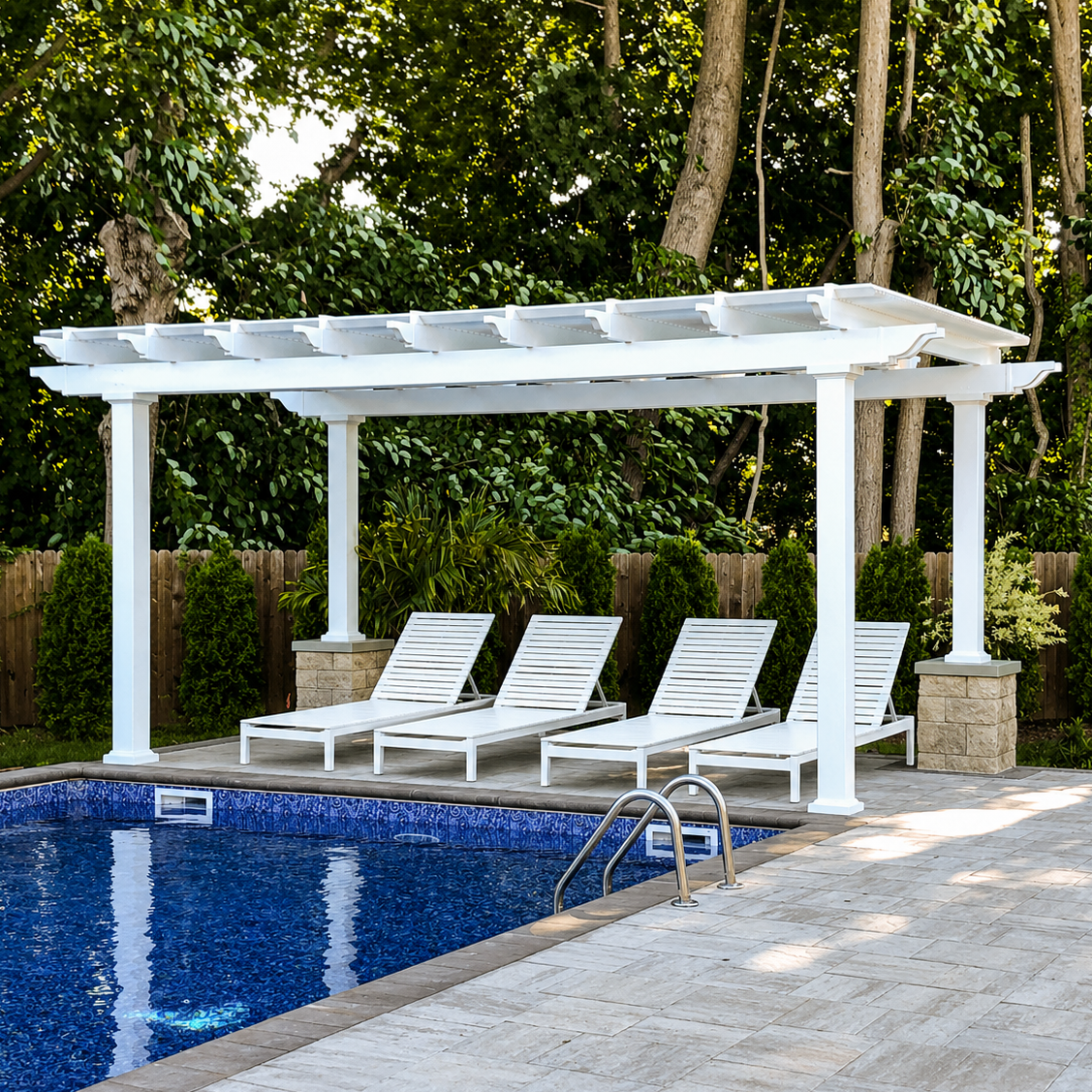 A freestanding pergola benefits from having open sides that allow outdoor air to move through the space.
Adding a solid privacy barrier may reduce airflow from the screened direction. Depending on the surrounding landscape and prevailing winds, that could make the seating area feel more sheltered or less breezy.
Neither outcome is universally preferable.
In an exposed location, reducing an uncomfortable breeze may improve the outdoor experience. In a sheltered backyard, blocking an existing breeze could make the lounge less comfortable during warm weather.
Before choosing a treatment, observe which directions the wind commonly approaches and whether those breezes contribute positively to the space.
Open slats and other partially permeable treatments may preserve more airflow than some solid barriers, but actual performance depends on the specific design and installation.
There are two fundamentally different ways to support a privacy feature:
Independently supported screens may offer more placement flexibility, but they still require suitable anchoring and support.
Pergola-mounted accessories require additional confirmation because their loads and connection details affect the existing structure.
For example, a curtain track mounted to a beam may introduce different forces than a rigid panel attached between posts. Neither arrangement should be assumed acceptable without manufacturer and installer verification.
Sunset Pergola Kits offers permanent freestanding pergolas with aluminum-reinforced structural components and premium extruded vinyl exteriors.
Its traditional pergolas offer optional beam and rafter overhangs and configurable post placement, while modern pergolas feature flush corners and corner-positioned posts.
These differences can influence the space available around the perimeter and the appearance of a proposed privacy treatment.
However, the availability of a pergola configuration does not establish compatibility with a particular privacy accessory.
Before purchasing or mounting any screen, curtain track, panel, or associated hardware, confirm:
Do not assume privacy curtains, side panels, or mounting hardware are included with a Sunset Pergola Kits pergola. Accessory availability and compatibility must be verified separately.
Before committing to permanent screening, test whether the proposed treatment actually blocks the unwanted views while preserving the outdoor experience you want.
A simple, reversible visual mockup can reveal problems that are difficult to recognize from drawings or product photographs.
Use temporary visual markers to represent the intended location and height of the treatment.
Depending on the setting, this might involve a safely supported temporary panel, movable markers, or another nonpermanent visual reference.
The mockup does not need to reproduce the final material perfectly. Its main purpose is to show where the screening would interrupt sightlines.
Avoid attaching temporary materials to the pergola without approval, particularly where they could catch wind or create an unsafe condition.
First, sit in the intended lounge position and look outward.
Does the proposed treatment preserve the garden view? Can you still see the landscape features that make the location attractive? Does the space feel comfortably secluded or unnecessarily confined?
Next, evaluate the arrangement from the relevant outside viewing positions where access and permission allow.
Check whether the screen actually conceals the occupied seating area. Repeat the assessment from standing positions and consider any elevated sightlines.
If an upstairs window overlooks the pergola, do not assume a screen that works at ground level also resolves that elevated view.
For adjustable treatments such as curtains, assess both the open and closed configurations.
When closed, the treatment should provide the intended degree of privacy without blocking essential circulation routes.
When open, consider where the material gathers and whether it interferes with furniture, walkways, or desired views.
Also evaluate whether the arrangement preserves the level of airflow and openness you want during normal use.
Once the screening location has been tested, use that information when evaluating the pergola itself.
A traditional design with inset posts or overhangs may create a different perimeter arrangement than a modern design with posts at the corners.
Neither is automatically better for privacy. The appropriate choice depends on where you want the open sides, how you enter the space, and whether the proposed privacy treatment will be independently supported or attached using an approved method.
For larger outdoor living areas, the number and placement of posts may also influence how furniture and privacy elements can be arranged.
The objective is to select a structure that supports the intended outdoor layout without assuming unverified accessory compatibility.
Adding privacy to a freestanding pergola does not require enclosing every side. The most effective approach is to identify the specific views that feel intrusive, select a treatment that interrupts those sightlines, and preserve the entries, breezes, and landscape views that make the outdoor space enjoyable.
After testing your preferred screening arrangement, explore free-standing pergolas from Sunset Pergola Kits to compare structural layouts that accommodate your intended open sides and seating arrangement. Confirm privacy accessory sourcing, support requirements, and attachment compatibility separately before installation.
Yes. A separately supported privacy screen can be positioned near a freestanding pergola without attaching it to the pergola frame. However, the screen must have suitable independent support and anchoring for its size, location, and wind exposure.
Not necessarily. A screen that blocks ground-level views into a seated lounge area may not interrupt the downward sightline from an upstairs window. Evaluate elevated viewing angles separately before selecting the screen's location and height.
No. A single screened side generally addresses views coming from particular directions. People approaching from other angles may still see into the seating area. Identify the actual observer positions to determine whether one treatment or multiple targeted treatments are needed.
Yes. Curtains designed to open and close can provide adjustable privacy, allowing the space to remain more open when screening is unnecessary. Actual privacy depends on the fabric and construction, while mounting compatibility and wind behavior must be verified.
Yes. Young plants may initially provide limited privacy, while mature plants can occupy more space or interfere with nearby features. Consider current and expected growth, seasonal foliage, maintenance needs, and proximity to pergola posts and overhead components.
Yes. Solid screens or other barriers can reduce airflow from certain directions. Whether this improves comfort depends on prevailing winds and the surrounding environment. Partially open treatments may preserve more airflow, but results depend on their specific design and placement.
Privacy panels are not confirmed as included with Sunset Pergola Kits freestanding pergolas. The company offers permanent aluminum-reinforced vinyl pergola structures, but privacy accessory availability and compatibility must be verified separately. Browse the freestanding pergola collection for structural configurations.


