

MADE IN THE USA
with American products
w/ American products


The best freestanding pergola orientation is the one that puts shade where you need it when you actually use your patio. If your favorite outdoor seating area becomes uncomfortable at 4 p.m., choosing a pergola's direction based only on how it looks at noon could leave you disappointed. The solution is to compare the sun's path, your intended seating positions, and the pergola's actual slat geometry before deciding whether to run the structure north–south, east–west, or at another angle.
Before considering compass direction, identify the specific area your pergola needs to shade. The goal isn't necessarily to maximize the shadow beneath the entire roof. It's to protect the places where people will spend the most time during the hours that matter.
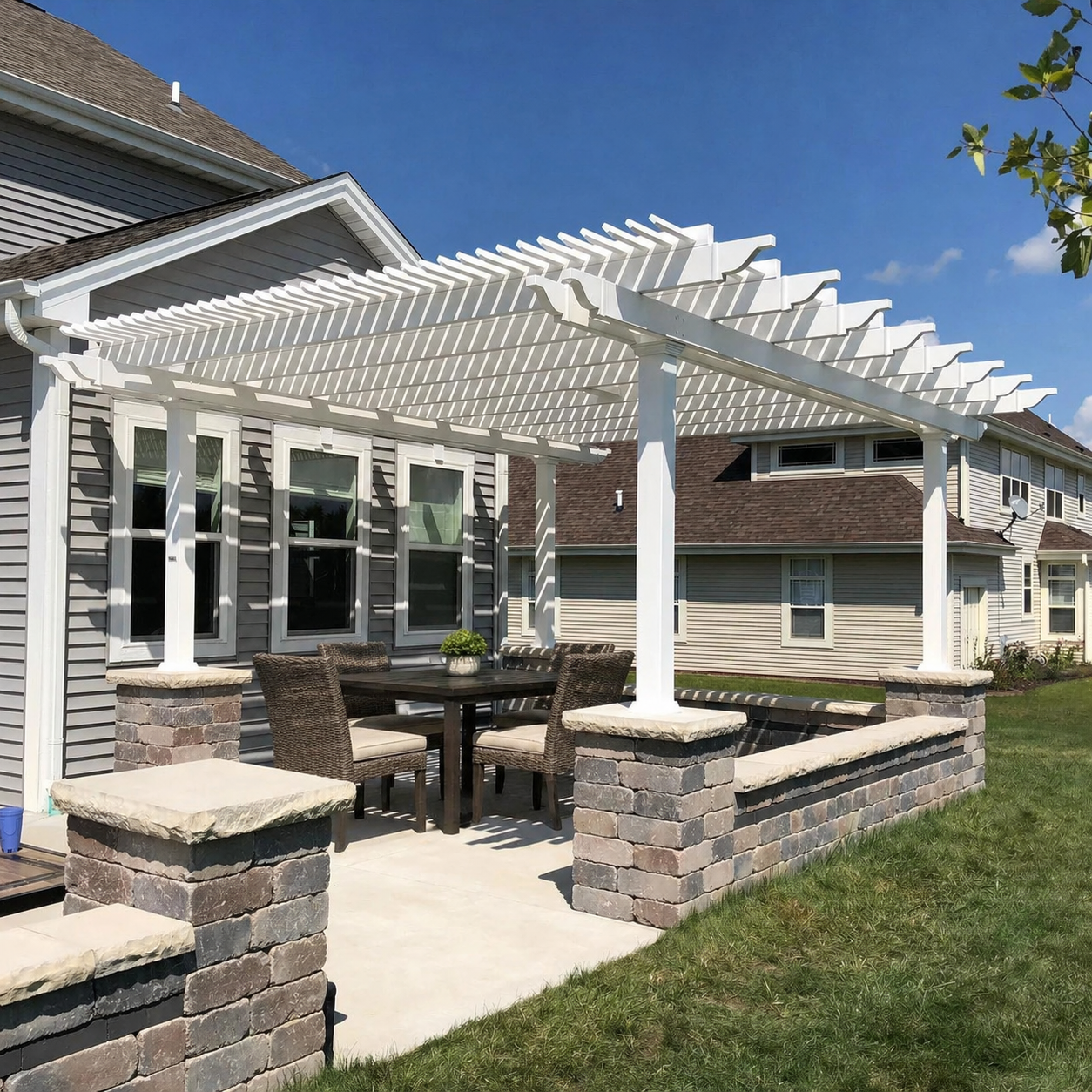 Imagine a spacious backyard patio with an outdoor dining table, a conversation area, and lounge chairs near the pool. These spaces may have very different shade requirements, even when they're located beneath the same pergola.
A dining table used primarily for weekend lunches needs shade at a different time than a lounge area occupied during late-afternoon gatherings. Likewise, a morning coffee spot may benefit from an entirely different shadow pattern than an outdoor kitchen used in the evening.
Identify your priority by answering three questions:
Mark the important seating positions on a simple patio sketch. Rather than treating the entire pergola footprint as the target, outline the occupied area that needs shade.
When shade requirements conflict, prioritize your most frequent or important use times.
For example, suppose your patio receives direct sunlight from midafternoon through early evening. You primarily use the space for outdoor dinners and relaxing after work. An orientation that creates excellent morning shade but leaves your seating exposed during those later hours would not meet your needs.
Conversely, if your patio is mainly used for breakfast and morning relaxation, optimizing the roof for afternoon shade could be unnecessary.
Practical tip: Write down your two or three most important combinations of activity, location, and time. These become the test conditions you'll use to compare pergola orientations.
The sun's position changes throughout the day and across the seasons. Understanding that movement is essential because the shadow cast by a freestanding pergola is not stationary.
In the Northern Hemisphere, the sun generally travels across the southern portion of the sky, rising toward the east and setting toward the west. Its exact position varies with latitude, season, and time of day.
For most locations in the continental United States, the following general patterns provide a useful starting point:
These are directional tendencies, not guarantees about exactly where shade will fall on your patio. Summer sunrise and sunset positions differ from winter positions, and local obstructions can substantially change the sunlight reaching your outdoor space.
Is it better to orient a freestanding pergola north–south or east–west? Neither direction is automatically superior for shade. The answer depends on the roof's dimensions, the direction of its shade purlins, and where the desired shadow must fall.
Consider a rectangular pergola. Rotating it 90 degrees changes which side of the roof faces the afternoon sun and which direction its longer dimension extends. If the shade purlins rotate with the structure, their relationship to incoming sunlight changes as well.
That can alter both the amount and location of shade reaching your seating area.
For a useful comparison, evaluate both orientations using the same patio location, time, and seating target. Don't assume that aligning the longest dimension east–west or north–south will automatically produce better results.
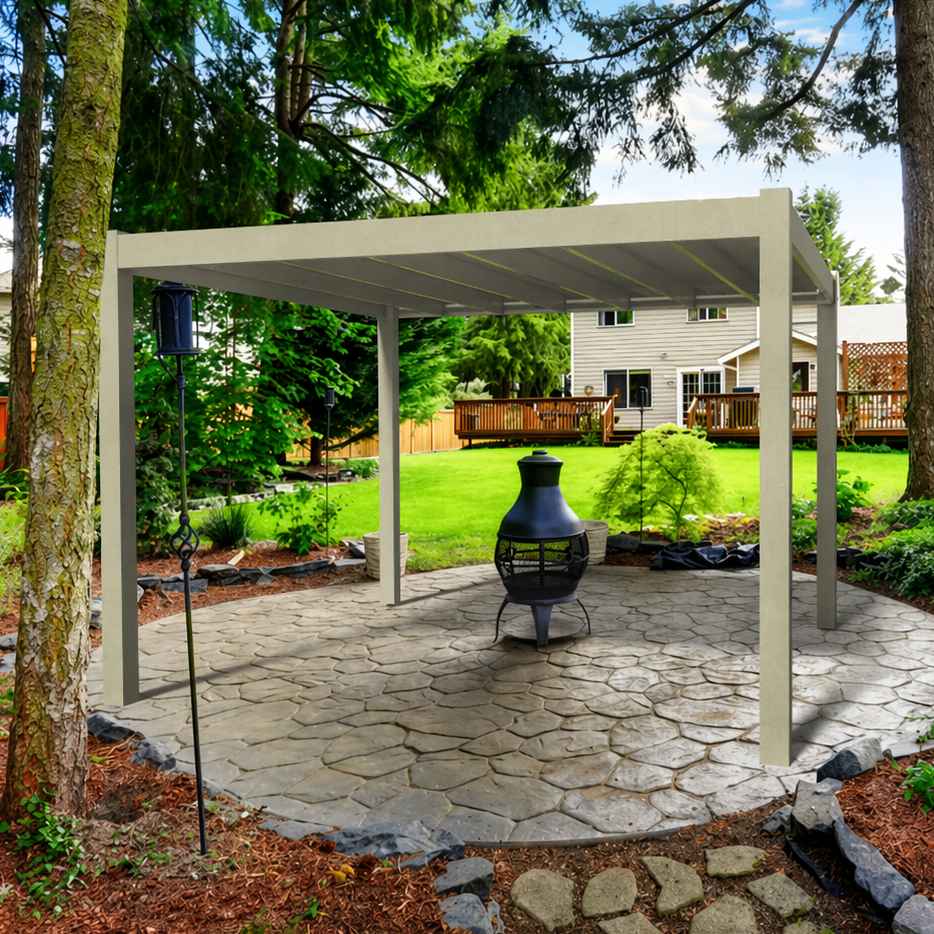 A location-specific sun-path tool can help you understand the sun's approximate direction and elevation at different times of day and throughout the year.
Enter your property's location and evaluate the dates and hours that correspond to your intended patio use. Look at where the sun will be positioned relative to your seating area, nearby structures, and potential pergola roof.
You can also observe existing shadows on your property. Note their direction and length at the times you plan to use the patio.
For a more complete assessment:
Remember that a sun-path diagram describes solar position, not the exact shadow pattern of your particular pergola. That requires the roof's dimensions and slat geometry, which you'll evaluate next.
The direction of a pergola's roof slats can significantly affect how sunlight passes through the roof. This is especially important for pergolas with fixed angled shade purlins.
Sunset Pergola Kits offers pergolas with slatted roofs that use fixed angled shade purlins. Unlike adjustable louvers, these purlins remain in their installed positions, making it important to evaluate the roof geometry before installation.
A slatted pergola roof does not behave like a solid overhead panel. Sunlight can pass through the openings between purlins, creating alternating areas of light and shadow.
With angled purlins, the pattern depends on several interacting factors:
As the sun moves, the angle at which sunlight encounters the slats changes. Openings that admit sunlight at one time may be more effectively blocked at another.
Rotating the pergola can therefore change the shade pattern even when its roof dimensions and purlin spacing remain identical.
One of the most important distinctions in pergola sun path planning is the difference between nominal roof shade coverage and the actual shade reaching a specific location beneath the structure.
Sunset Pergola Kits offers fixed shade-purlin configurations with nominal coverage options of 50%, 75%, and 90%. However, those percentages should not be interpreted as guarantees that the same proportion of every seating position will remain shaded throughout the day.
Even with the same roof configuration, two chairs beneath one pergola can experience different amounts of direct sunlight.
For example, a chair near the western edge of a pergola may become exposed to low-angle afternoon sunlight while a chair farther east remains shaded. At another time, the pattern could change.
The roof's shadow can also extend beyond its footprint, while portions of the ground directly beneath the roof receive sunlight through the slats or from the sides.
The correct test is whether the intended seating area receives adequate shade at the intended time—not simply whether the roof has a particular nominal coverage percentage.
To compare orientations accurately, start with the actual roof design rather than a generic drawing of a pergola.
For each candidate rotation:
If you use a digital shade simulation, make sure it represents the actual purlin geometry rather than treating the roof as a uniformly shaded rectangle.
For an on-site approximation, you can use a temporary layout and shadow observations to evaluate the overall direction of sunlight. However, a simple ground outline cannot reproduce the detailed shade pattern of angled purlins.
Also, don't assume the direction of the roof's rafters tells you everything about the shade purlins. Rafters are structural roof members; shade purlins are the smaller slats responsible for the roof's filtered shade pattern. Confirm how these components are arranged in the specific product.
Even a carefully planned pergola orientation can perform differently once surrounding buildings, trees, and patio boundaries are considered.
These features affect both the sunlight reaching the pergola and the rotations that are physically practical.
Nearby structures can block direct sunlight before it reaches your pergola. A house, garage, privacy wall, or neighboring building may already shade part of your patio during certain hours.
That existing shade should be included in your orientation test.
For example, if your home blocks late-afternoon sunlight from reaching one side of the patio, the pergola may not need to provide as much protection from that direction. Another orientation could better address the hours when the patio remains exposed.
Trees introduce additional variables. Deciduous trees can provide substantial shade when fully leafed out but much less after losing their leaves. Their shadows also change with the sun's position.
When evaluating tree shade, consider the seasons in which the canopy will actually be present. Don't assume that a shaded patio observed in midsummer will receive the same protection in early spring.
If nearby branches or overhead obstacles interfere with a possible rotation, resolve those clearance concerns before committing to the orientation.
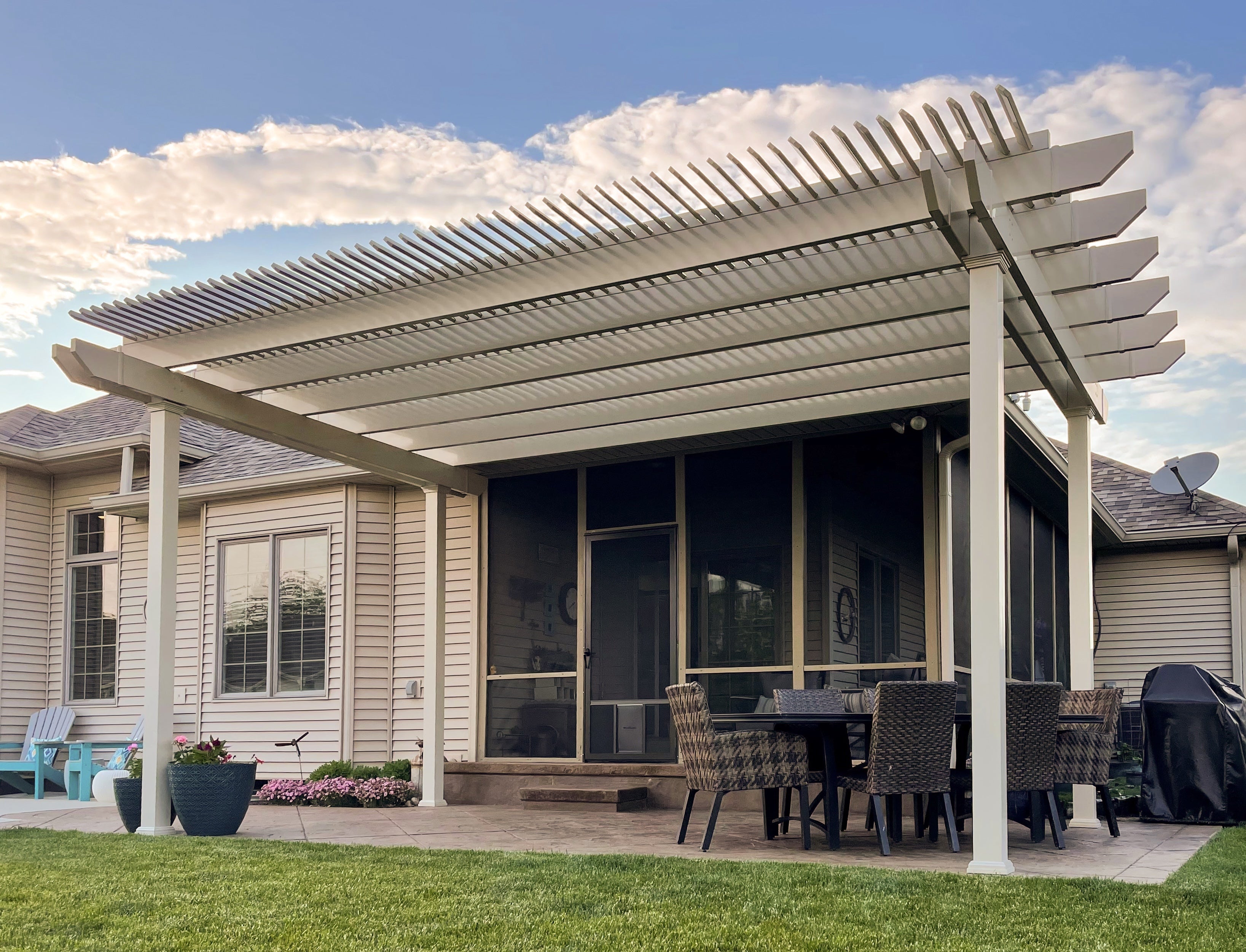 Rotating a rectangular pergola changes how its width and depth align with the patio, even though the total roof area stays the same.
For example, a rectangular structure that fits comfortably with its longer side parallel to the house may extend too far into a walkway or landscape feature when rotated 90 degrees.
Before selecting a preferred direction, verify:
Traditional and modern freestanding pergolas also differ in their structural layouts. Traditional pergolas can include beam and rafter overhangs and inset posts, while modern pergolas have flush corners and posts positioned at the corners.
These differences can affect the space required for a particular rotation. A roof that fits within your patio boundaries in one configuration may not fit identically in another.
Keep the orientation decision tied to the actual dimensions and structural layout of the pergola you intend to purchase.
Once you've identified a promising orientation, validate it against your priority shade requirements and the specific pergola configuration.
The goal is to move from a general compass-direction preference to a defensible installation plan.
Create a simple comparison for your leading orientation candidates.
Use the same activity positions and time periods for each candidate so you're comparing the effect of rotation rather than changing the conditions of the test.
| Test Condition | What to Check | Why It Matters |
|---|---|---|
| Primary activity area | Does shade reach the seats or table positions that matter most? | Prioritizes usable shade over the appearance of the roof shadow. |
| Morning use | Where does eastern sunlight enter the roof or sides? | Identifies potential exposure during breakfast or morning relaxation. |
| Afternoon use | How does western sunlight affect occupied positions? | Reveals possible gaps in shade during later use hours. |
| Seasonal changes | How does the pattern change on representative spring, summer, or fall dates? | Prevents relying on a single seasonal observation. |
| Nearby obstructions | Do buildings or trees block sunlight during relevant hours? | Accounts for existing shade and its seasonal variability. |
| Physical fit | Does the rotated footprint work with the available patio space? | Eliminates orientations that cannot be installed as planned. |
Record whether each orientation provides acceptable shade during your highest-priority periods. If neither rotation meets every requirement, identify which one best serves the activities that matter most.
Sometimes a modest change in orientation can improve shade at one seating position while reducing it elsewhere. The right decision depends on which tradeoff you prefer.
Before finalizing your freestanding pergola orientation, confirm that your planned shade pattern is based on the actual product configuration.
Important details include:
Don't rely exclusively on a product photograph to determine purlin direction or angle. Perspective can make structural relationships difficult to interpret, and photographs may not show the complete roof layout.
If the available specifications don't establish a critical detail, request confirmation before treating your shade simulation as reliable.
You can explore the available freestanding pergola configurations to identify designs that fit your tested footprint and then confirm their roof geometry.
For a pergola intended for use across multiple seasons, repeat your orientation comparison using representative dates from those seasons.
A summer test alone may not reveal how the structure performs when the sun is lower in the sky. Lower solar angles can produce longer shadows and allow more sunlight to enter beneath the roof from the sides.
Pay particular attention to seating near the edges of the pergola, where these changes may be most noticeable.
Separate what you've verified from what remains uncertain. For example, you may know the sun's direction and your patio dimensions but still need confirmation of the purlin angle or installed roof height.
Resolve those uncertainties before making a permanent orientation decision. A well-supported estimate is more useful than an overly precise prediction based on unverified assumptions.
Once you've established the preferred shade pattern, you can refine the placement of dining and lounge furniture within the usable area. The important point is to arrange the occupied spaces around the shade you expect to receive, rather than assuming every location beneath the roof will perform identically.
The best freestanding pergola orientation is the one that shades your intended activity area during the hours and seasons you actually use it. Compass direction provides a starting point, but the sun's changing position, angled shade purlins, roof dimensions, surrounding obstacles, and patio footprint determine the practical result.
Compare candidate rotations under consistent conditions, verify the specific roof geometry, and choose the orientation that best meets your priority shade requirements. With that decision established, browse free-standing pergolas to find a configuration whose dimensions and roof design support your plan.
Yes. As the sun moves westward, the pergola's shadow changes direction and position. With a slatted roof, the pattern of sunlight passing between the purlins also changes. A seating area shaded earlier in the afternoon may receive direct sunlight later.
No. Compass direction identifies how the pergola is aligned, but accurate shade predictions also require the sun's position, roof dimensions, height, and slat geometry. Nearby buildings and trees can further influence the result.
Yes. The sun's elevation and path change seasonally, affecting shadow length, direction, and sunlight entering through the roof or sides. Test representative dates from each season when you expect to use the pergola.
Yes. Sunlight can pass through the slatted roof or enter from the sides, leaving some positions exposed while others remain shaded. Evaluate the actual locations of chairs and tables rather than assuming uniform shade beneath the entire roof.
Yes. Trees may already block sunlight during important use hours, changing the shade your pergola needs to provide. Account for seasonal canopy changes, especially with deciduous trees, before deciding which orientation performs best.
Not reliably. Perspective can obscure the relationship between rafters and shade purlins. Confirm the actual purlin direction, angle, and spacing for your selected slatted-roof pergola before using those details in an orientation test.
Yes. A 90-degree rotation exchanges the directions of the pergola's width and depth. Although the total roof area remains unchanged, the rotated footprint may interfere with walkways, landscaping, or other patio features. Verify the dimensions, overhangs, and post positions before committing.


