

MADE IN THE USA
with American products
w/ American products


Are polycarbonate patio covers noisy in the rain? Yes, rainfall striking a polycarbonate roof produces an audible tapping or drumming sound, but whether it becomes unpleasant depends on the roof construction and how you use your outdoor space. If you envision enjoying conversations, reading quietly, or relaxing beneath your patio cover during a storm, understanding the likely sound is an important part of choosing the right roof. Here's how to evaluate polycarbonate patio cover rain noise without relying on misleading comparisons or unsupported promises of quietness.
There is no single rain-noise level that every homeowner will find comfortable. Some enjoy hearing rain overhead, while others prefer an outdoor retreat where rainfall barely competes with conversation or relaxation.
The most useful starting point is to identify what you want to do beneath the cover and where you expect to hear the rain.
The same rainfall can be enjoyable during one activity and distracting during another:
Ask yourself whether you simply want to enjoy the atmosphere of rainfall or need to carry out activities that require consistently low background noise.
The rain sound on polycarbonate roofing changes with the rainfall itself. A light shower may create scattered, gentle tapping, while a heavy downpour can produce a more continuous and prominent drumming sound.
Wind-driven rain can also change where and how raindrops strike the roof. Consequently, a roof that sounds comfortable during occasional drizzle may feel quite different during an intense storm.
If you expect to use your patio primarily during light rain, that experience may be the most relevant. If your goal is comfortable outdoor living even during heavy rain, evaluate that more demanding situation before buying.
The listening location is just as important as the activity. Consider three distinct positions:
These locations may produce different impressions of the same rainfall. A patio roof that is perfectly acceptable outside could still be noticeable from an adjacent quiet room.
Not every sound heard during rain comes from raindrops alone. The roof panels, supporting structure, and attachment system can influence the overall listening experience.
When raindrops strike a polycarbonate panel, their impacts cause the material to vibrate and radiate sound. The resulting tapping or drumming can be heard beneath the roof.
Roof acoustics are measurable. Research published by BRE examined sound generated by artificial heavy rainfall on several lightweight roofing materials, including a particular polycarbonate roof element. The findings demonstrate that lightweight roof construction can influence rain-generated sound, although results from a tested sample should not be treated as a universal rating for every polycarbonate patio cover.1
How noticeable the sound becomes depends partly on rainfall intensity and the roof assembly, not simply whether the roofing material is labeled polycarbonate.
Polycarbonate roofing comes in different constructions, including solid sheets and multiwall panels. Thickness, internal configuration, stiffness, support arrangement, and the overall assembly may influence vibration and sound transmission.
Roof span and support spacing also deserve attention. A panel's behavior depends partly on how it is supported and restrained, so comparing two roofs solely by material name or overall dimensions can be misleading.
However, it would be inaccurate to claim that a particular panel thickness or configuration is guaranteed to be quieter without comparable evidence.
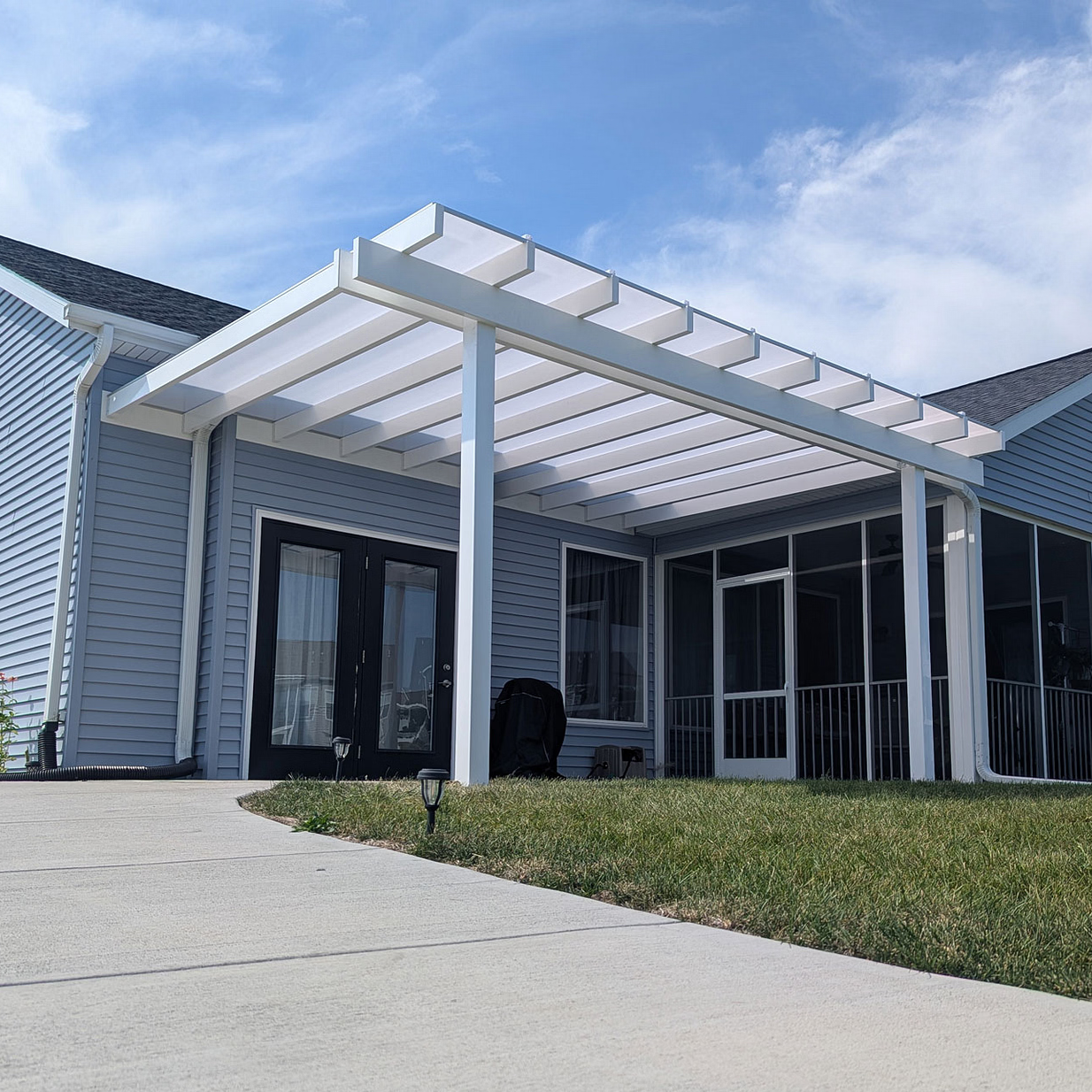
Sunset Pergola Kits offers rainproof patio covers with solid polycarbonate roofing, supported by aluminum-reinforced structural components with premium extruded vinyl exteriors. The roof panels are available in white or bronze.
Those construction details identify the type of system being offered, but they do not establish a tested rain-noise rating. Before drawing conclusions about its sound, confirm the relevant panel construction, attachment details, and any available acoustic information for the specific system.
Consistent tapping that follows the pattern and intensity of rainfall is an expected consequence of raindrops striking a roof.
A distinct rattle, repeated clatter, or new vibration localized to one area deserves separate attention. Such sounds may involve components moving relative to one another rather than ordinary raindrop impacts, although the sound alone cannot establish the cause.
If unusual noises develop after installation, consult the manufacturer's documentation or a qualified installer rather than assuming the roofing material itself is defective. Attachment checks should follow the requirements for that particular roofing system.
A roof does not exist in an acoustically isolated environment. Nearby walls, windows, ground surfaces, and other features can affect what you hear beneath a patio cover.
 Imagine two seating arrangements beneath otherwise similar polycarbonate roofs.
One is a freestanding cover surrounded by relatively open space. The other is attached to a house, with seating positioned near a large exterior wall.
In the open setting, sound can propagate into the surrounding outdoor environment. Near a wall, reflected sound may contribute to what a listener hears. The actual effect depends on the geometry, surface characteristics, and listening position.
That does not mean an attached patio cover is necessarily louder than a freestanding one. It means the surrounding environment is another variable worth considering.
If possible, compare listening experiences at several seating positions rather than assuming the sound is uniform throughout the patio.
The experience inside the home can differ from the experience outdoors.
Whether rainfall noise becomes noticeable indoors depends on several factors, including the patio cover's position relative to windows, the sound insulation of the building envelope, and the existing indoor background noise.
For example, a homeowner reading beside a closed window facing the patio might notice a different sound than someone sitting outside directly beneath the panels.
If the patio cover will extend alongside a bedroom or home office, assess the potential indoor listening experience separately. Do not assume that acceptable outdoor noise automatically means the rain will be inaudible inside.
Soft furnishings, outdoor cushions, curtains, and landscaping can influence the acoustic character of a space, but their effects depend on placement, materials, coverage, and surrounding conditions.
Adding patio furniture or plants should not be presented as a guaranteed method of reducing rain noise from the roof itself.
Instead, consider them part of the overall listening environment. A more enclosed, furnished seating area may feel different from an open, hard-surfaced patio, even when the roofing system remains unchanged.
If acoustic comfort is a major concern, avoid relying on furnishings or landscaping to deliver a specific reduction without evidence for the actual setting.
Listening to real-world examples can be helpful, but only when you understand what the examples represent.
A recording labeled "polycarbonate roof in heavy rain" may sound convincing while telling you very little about how a different patio cover will perform.
 The strongest comparison uses similar rainfall and listening conditions, with the roof assembly clearly identified.
Before drawing conclusions from a recording, look for the following information:
For example, a recording made beneath a small roof during light rain cannot reliably establish how a larger roof will sound during a severe downpour.
A phone recording can communicate the character of rainfall, including whether the sound resembles gentle tapping, steady pattering, or pronounced drumming.
However, microphone sensitivity, automatic volume adjustment, compression, wind, and playback settings can change the apparent loudness. Two independently recorded videos are therefore not reliable evidence that one roofing system is quieter than another.
Sound measurements can provide stronger comparisons when taken with suitable equipment and consistent methods. Standardized acoustic testing is more informative than unrelated measurements collected under different rainfall and environmental conditions.
BRE's research on rain noise used controlled artificial rainfall to compare specific lightweight roof elements, illustrating why clearly defined testing conditions matter.1
Even documented results should be interpreted carefully. A tested roof element is not necessarily equivalent to a complete patio-cover installation.
There is no reliable universal answer covering every polycarbonate and metal roof assembly.
Both materials can produce audible rain-impact sound. Panel configuration, thickness, support conditions, attachment systems, and acoustic treatments may affect their performance.
A comparison involving bare metal and a particular polycarbonate panel cannot establish that all polycarbonate roofs are quieter than all metal roofs, or vice versa.
If rainfall noise is your primary concern, request sound evidence for the actual assemblies under comparable conditions rather than relying on broad material rankings.
If you like the appearance and rain protection of a polycarbonate patio cover but remain concerned about noise, there are practical steps worth considering before purchasing or modifying anything.
 Changing where people sit may change their experience of rainfall without altering the roofing system.
For example, you could evaluate whether a preferred reading chair belongs near the center of the patio or closer to an open side. If the roof is attached to the home, consider whether placing seating farther from a nearby wall changes what you hear.
These are listening-position adjustments, not guaranteed noise-reduction techniques. Their usefulness depends on the particular patio layout.
When possible, try different positions during actual rainfall before making permanent furniture-layout decisions.
Before installation, useful questions for the supplier or manufacturer include:
For Sunset Pergola Kits products, the assembly information and installation resources provide a logical starting point for understanding the system. Confirm any roof-specific details that are not documented there directly with the supplier.
A correctly installed assembly should be evaluated against the manufacturer's actual requirements. Ordinary rainfall tapping should not automatically be interpreted as evidence of poor installation.
It can be tempting to add padding, adhesive layers, insulation, or other materials beneath polycarbonate panels in an attempt to quiet the rain.
However, unapproved modifications could affect panel movement, weather performance, installation compliance, or warranty coverage.
Do not assume that an improvised damping material will provide meaningful noise reduction or remain compatible with the roof system.
Before changing panels, fasteners, or contact materials, obtain confirmation that the proposed adjustment is compatible with the manufacturer's installation requirements.
The most useful final decision is not whether polycarbonate roofing is objectively "quiet." It is whether the likely rainfall sound fits your intended use and listening environment.
Use this checklist before choosing a roof:
Likely a comfortable fit: You generally enjoy rainfall sounds, expect to use the patio for casual outdoor activities, and have no special requirement for unusually quiet conditions.
Worth investigating further: You are particularly sensitive to repetitive sounds, plan to work or read beneath the roof, or will install the cover next to a noise-sensitive room. Seek representative sound evidence before deciding.
Not yet enough information: You have identified an important comfort requirement but cannot verify how the proposed assembly is likely to sound. Keep the decision open rather than assuming the sound will either be acceptable or unacceptable.
If a solid roof otherwise suits your outdoor living plans, you can review the freestanding polycarbonate patio cover or the house-attached patio cover while identifying any remaining sound-related questions for the supplier.
Polycarbonate patio covers do make noise when rain strikes the roof, and heavy rainfall can be noticeably louder than a light shower. Whether that sound is pleasant, tolerable, or distracting depends on the roof assembly, surrounding environment, listening position, and activities you value.
Instead of relying on a universal noise rating, establish what acceptable rainfall sound means for your patio and seek relevant evidence when quietness matters. Once you understand those expectations, browse Sunset Pergola Kits' rainproof patio covers and confirm any remaining assembly or acoustic questions before making your decision.
1. Hopkins, C. (2006). Rain Noise From Glazed and Lightweight Roofing. BRE Information Paper IP2/06. BRE Group. Research examining sound intensity generated by controlled artificial rainfall on selected lightweight roofing elements, including polycarbonate.
Not by itself. Phone microphones, automatic volume adjustments, recording distances, and playback settings can make one roof seem louder than another. Recordings can illustrate the character of rainfall, but reliable loudness comparisons require consistent conditions and appropriate measurements.
Yes. Light rain may create occasional gentle tapping, while heavy rain can produce louder, more continuous drumming. Assess the roof under the rainfall conditions in which you expect to use your patio.
Yes. Walls and other nearby surfaces can reflect sound, changing what listeners hear at different positions. The result depends on the patio's geometry and surrounding materials, so a seat near a wall is not necessarily louder in every installation.
Absolutely. Background rainfall that feels pleasant during casual conversation may become distracting when reading, concentrating, or taking a phone call. Acceptable noise depends on both personal tolerance and the activity.
No. Panel construction, thickness, support conditions, attachment details, and surrounding acoustics can influence rain noise. Compare the specific roof assembly rather than assuming all polycarbonate patio covers sound alike.
No. Furnishings and landscaping may influence the overall sound environment, but their effects depend on materials, placement, and surrounding conditions. Neither should be treated as a guaranteed method of reducing roof rain noise by a specific amount.
Yes. A new or localized rattle may have a different source from normal raindrop impacts. Consult the manufacturer's assembly guidance or a qualified installer to determine whether the roof requires inspection. Avoid altering attachment components without approval.


