

MADE IN THE USA
with American products
w/ American products


Your patio might be perfectly comfortable at breakfast but nearly unusable during late-afternoon gatherings—or the opposite. Getting the most useful attached pergola shade means positioning the structure where its shadow will benefit the people using the space, at the times they actually use it. Before choosing a wall location, consider how your household uses the patio, where your home already casts shade, and how the sun's changing position will affect the area beneath and around a pergola.
The best location for an attached pergola is not necessarily the largest available wall or the most visually prominent part of your home. It is the location that creates useful shade for your outdoor activities.
Begin by identifying the specific area where people spend time. A dining table, outdoor sofa, grilling station, and poolside seating area may occupy different parts of the same patio—and they may need shade at different hours.
Write down your most common patio activities, when they occur, and where people sit or stand. For example:
| Activity | Typical Use Hours | Area That Needs Shade | Priority |
|---|---|---|---|
| Morning coffee | 7–9 a.m. | Breakfast table near the kitchen | Medium |
| Outdoor lunch | Noon–2 p.m. | Dining table and occupied chairs | High |
| Afternoon relaxation | 3–5 p.m. | Outdoor sofa and lounge chairs | High |
| Evening entertaining | 5–8 p.m. | Conversation seating and serving area | High |
These are illustrative activities and priorities, not a recommended schedule. Your household's actual habits should determine which hours matter.
For example, if your family rarely uses the patio before noon, excellent morning shade may provide little practical benefit. A location that shades the seating area during late-afternoon gatherings could be much more valuable.
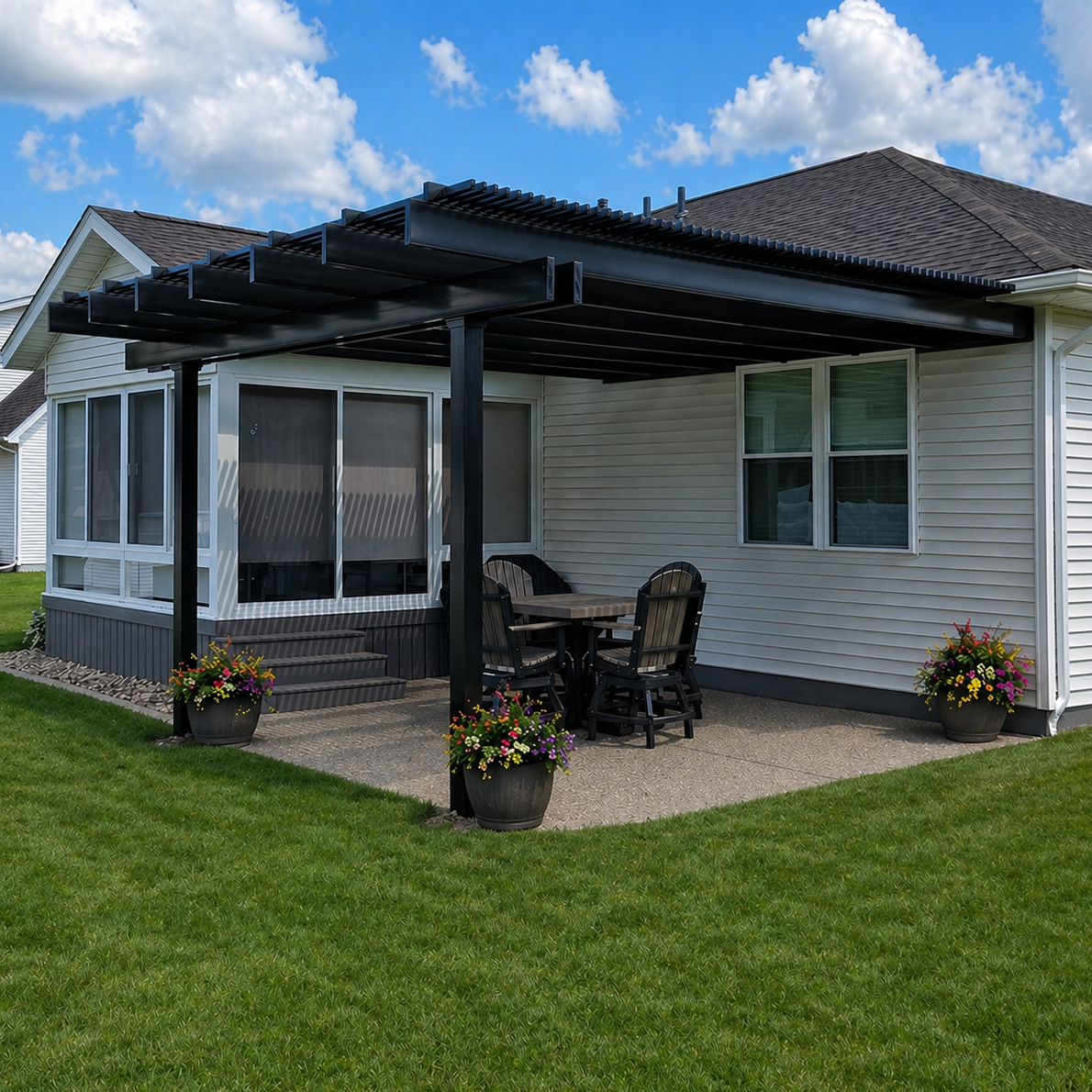 A patio does not need to be uniformly shaded to be comfortable and useful. The important question is whether shade reaches the places where people spend time.
Consider an outdoor dining arrangement. Shade across the center of the table is helpful, but occupants may still sit in direct sunlight if the shadow misses their chairs.
Similarly, a shaded walkway may contribute less to everyday comfort than a shaded sofa where someone spends an hour reading.
Mark the following on a simple patio sketch:
This creates a defined target against which you can compare possible pergola locations.
Before adding overhead shade, determine how much shade your home already creates. Depending on the time of day, the building itself may protect substantial portions of the patio—or leave the most important seating area completely exposed.
On a clear day, visit each possible attachment location during your priority use periods.
Record:
Take photographs from consistent viewpoints and record the date and time. If possible, outline the shadow boundary on a patio sketch.
Important: A photograph documents conditions at one moment. It does not establish where the shadow will fall several hours later or during another season.
Suppose your home already shades an outdoor dining area throughout most of the afternoon. Installing a pergola over that same location might add architectural interest, but it may contribute relatively little additional shade during those hours.
Meanwhile, a nearby seating area might remain exposed until evening. If that is where your family spends the most time, positioning a pergola to protect that area could deliver substantially greater everyday value.
This distinction is particularly important when comparing two workable attachment walls. The wall with the largest available patio area is not automatically the wall with the greatest need for supplemental shade.
Trees can complicate a shade assessment because their shadows change with the sun's position, foliage, and season.
A leafy tree might provide substantial summer shade but much less protection after its leaves fall. Conversely, a tree that shades a patio during a particular afternoon may provide little help earlier in the day.
Record whether each shadow comes from the permanent building or from seasonal vegetation. This helps distinguish dependable architectural shade from shade that may vary throughout the year.
Attached pergola orientation influences where shade falls, but compass direction alone cannot establish which wall will provide the best results.
The sun's apparent path changes with geographic location, time of day, and season. A wall that works well for afternoon shade at one property may perform differently at another.
In the Northern Hemisphere's middle latitudes, including much of the continental United States, the following patterns provide useful starting points:
| Patio Faces | Typical Sun Exposure Pattern | What to Investigate |
|---|---|---|
| East | Often receives more direct morning sunlight, with the house providing increasing shade later in the day. | Whether morning seating needs additional protection and whether afternoon shade already meets your needs. |
| West | Often receives stronger direct exposure later in the day. | Whether low-angle afternoon sunlight enters beneath the pergola roof and reaches occupied seating. |
| South | Often receives substantial sun exposure around midday, particularly when the sun is toward the southern sky. | How seasonal sun elevation changes the location and extent of overhead shade. |
| North | Often receives considerable shade from the house, especially when the sun remains south of the building. | Whether existing shade already meets the need and whether direct sunlight reaches the area during summer mornings or evenings. |
These are general Northern Hemisphere patterns, not universal performance rankings. The sun can rise and set north of due east and west during part of the year, and solar paths differ significantly by latitude. Southern Hemisphere properties require a different directional interpretation.
For an actual installation decision, verify the sun's path for your property's location rather than relying solely on these generalizations.
A west-facing patio can be particularly challenging when the household wants shade during late-afternoon or early-evening hours.
As the sun approaches the horizon, sunlight travels at a lower angle. Even when a pergola has substantial overhead slat coverage, direct sunlight may enter beneath its outer edge and reach furniture or occupants.
This means the shadow cast by the roof may not remain directly underneath the pergola.
For example, a west-facing outdoor sofa might receive useful overhead shade earlier in the afternoon but become exposed to direct sunlight later as the sun drops toward the western horizon.
The correct response is not automatically to reject a west-facing location. Instead, evaluate the shadow during the actual hours when the sofa will be occupied.
For many Northern Hemisphere homes, the sun is higher in the sky during summer and lower during winter.
These changing angles affect the direction and length of shadows cast by a fixed pergola roof.
A south-facing attached pergola might provide useful overhead shade during a summer afternoon but allow sunlight to reach farther beneath the structure during cooler months.
Whether this is beneficial depends on how the patio is used. A homeowner who primarily entertains outdoors in summer may value a different shadow pattern than someone who regularly uses the space during spring and fall.
A reliable shade study should account for both solar azimuth (the sun's compass direction) and solar elevation (the sun's angle above the horizon).
These two measurements help explain why shadows move across a patio and why their lengths change throughout the day.
The National Oceanic and Atmospheric Administration (NOAA) provides solar-position calculation resources that can help establish the sun's direction and elevation for a specific location, date, and time.[1]
For a practical comparison, use verified solar-position information alongside photographs, measurements, or a validated sun-study tool that accounts for the home's actual geometry.
A compass reading and a single photograph are useful starting points, but neither is sufficient to predict shade throughout the day.
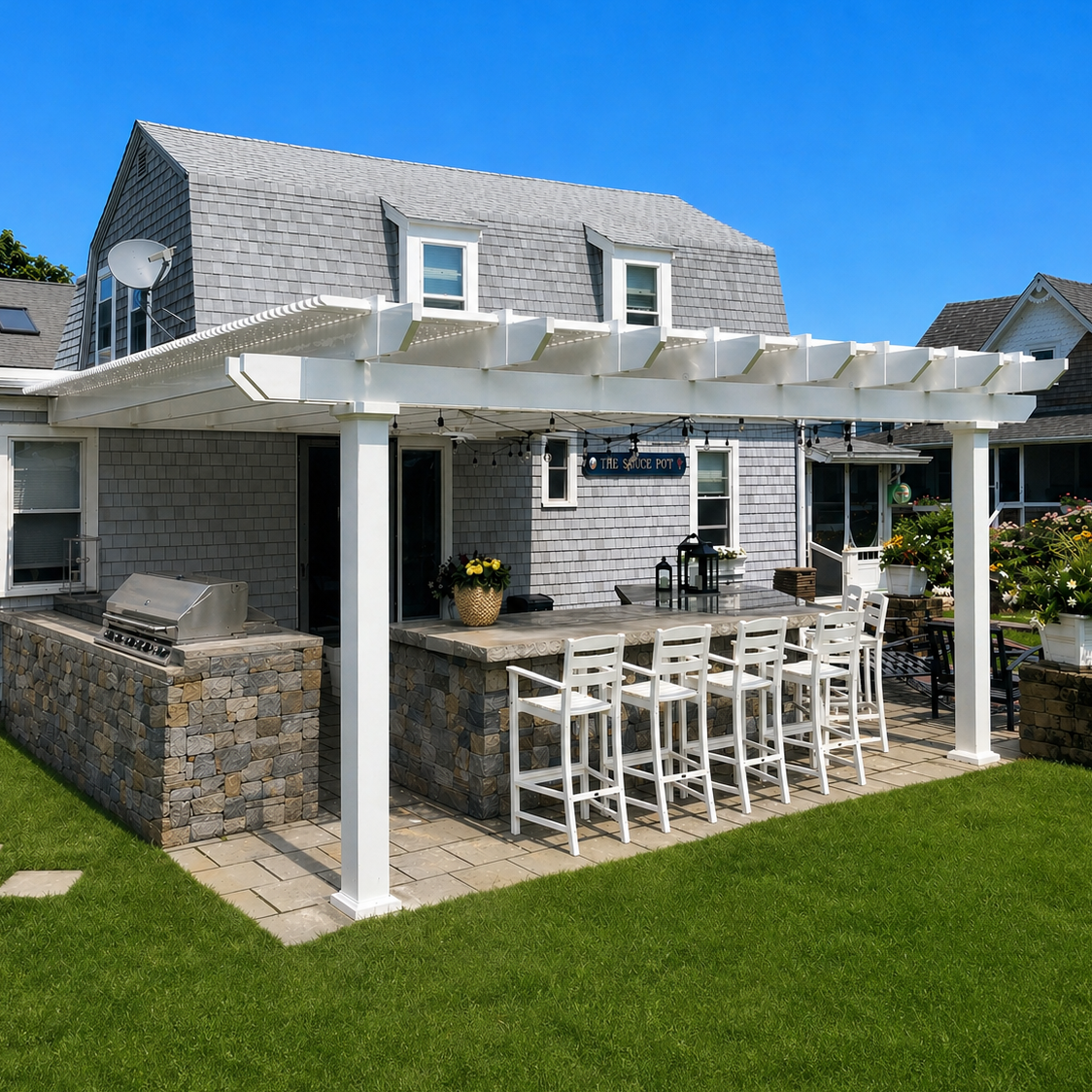 A pergola's roof footprint and its actual shaded area are not the same thing.
The roof footprint describes the area occupied by the overhead structure when viewed from above. The shaded area depends on where sunlight strikes the roof and how its components cast shadows onto the patio, furniture, and people below.
When studying attached pergola shade, examine more than the patio floor.
Someone seated in an outdoor chair may receive direct sunlight on their head, shoulders, or upper body even when the ground nearby is shaded.
For a dining area, consider whether shade reaches:
For a lounge area, evaluate the actual positions of people reclining on sofas or lounge chairs.
This is especially important when the sun is relatively low and sunlight can enter from the side.
Traditional and modern pergolas from Sunset Pergola Kits use fixed, angled shade purlins—commonly called roof slats.
Because the slats are fixed, their shadows change as the sun moves rather than being mechanically adjusted throughout the day.
The direction of the slats, their spacing, their angle, and the overall roof geometry all influence the resulting shadow pattern.
When comparing configurations, request or verify the relevant roof details before assuming that a particular slat arrangement will shade a specific chair at a specific hour.
Sunset Pergola Kits offers pergolas with fixed slatted roofs, including traditional and modern styles. Both offer multiple fixed shade-coverage configurations, but a coverage designation alone does not establish where the shadow will fall on your patio.
The distance a pergola extends outward from the house influences which areas lie beneath its roof and where its shadow may reach.
However, projection is only one input. The sun's position, roof elevation, and actual roof geometry also matter.
For example, extending a structure farther outward may change the area that receives shade, but it does not guarantee protection from low-angle sunlight entering from the side.
At this stage, the goal is not to select a final projection dimension. It is to determine whether a proposed configuration could place shade over your priority seating area during the desired hours.
Before relying on a predicted shadow pattern, confirm the relevant dimensions and construction details of the specific pergola under consideration.
Traditional pergolas can include beam and rafter overhangs, while modern pergolas have flush roof edges without those overhangs. These differences affect the roof geometry that should be represented in a shade study.
You can compare traditional pergola designs and modern pergola designs while keeping your chosen wall location and occupied patio area in mind.
For any configuration, use documented dimensions and roof details rather than treating a generic pergola illustration as an accurate prediction of shade.
A pergola that creates excellent shade on a summer afternoon may cast a noticeably different shadow during spring or fall.
Seasonal sun angles matter because the sun's daily path changes throughout the year. A permanent pergola stays in the same position, but the sunlight reaching it does not.
For each candidate attachment location, compare at least two representative conditions:
For example, a household might compare a July afternoon gathering with an October afternoon gathering. Those dates are illustrative; choose dates that reflect your actual use.
Keep the seating arrangement consistent so you can see how seasonal changes affect the same occupied area.
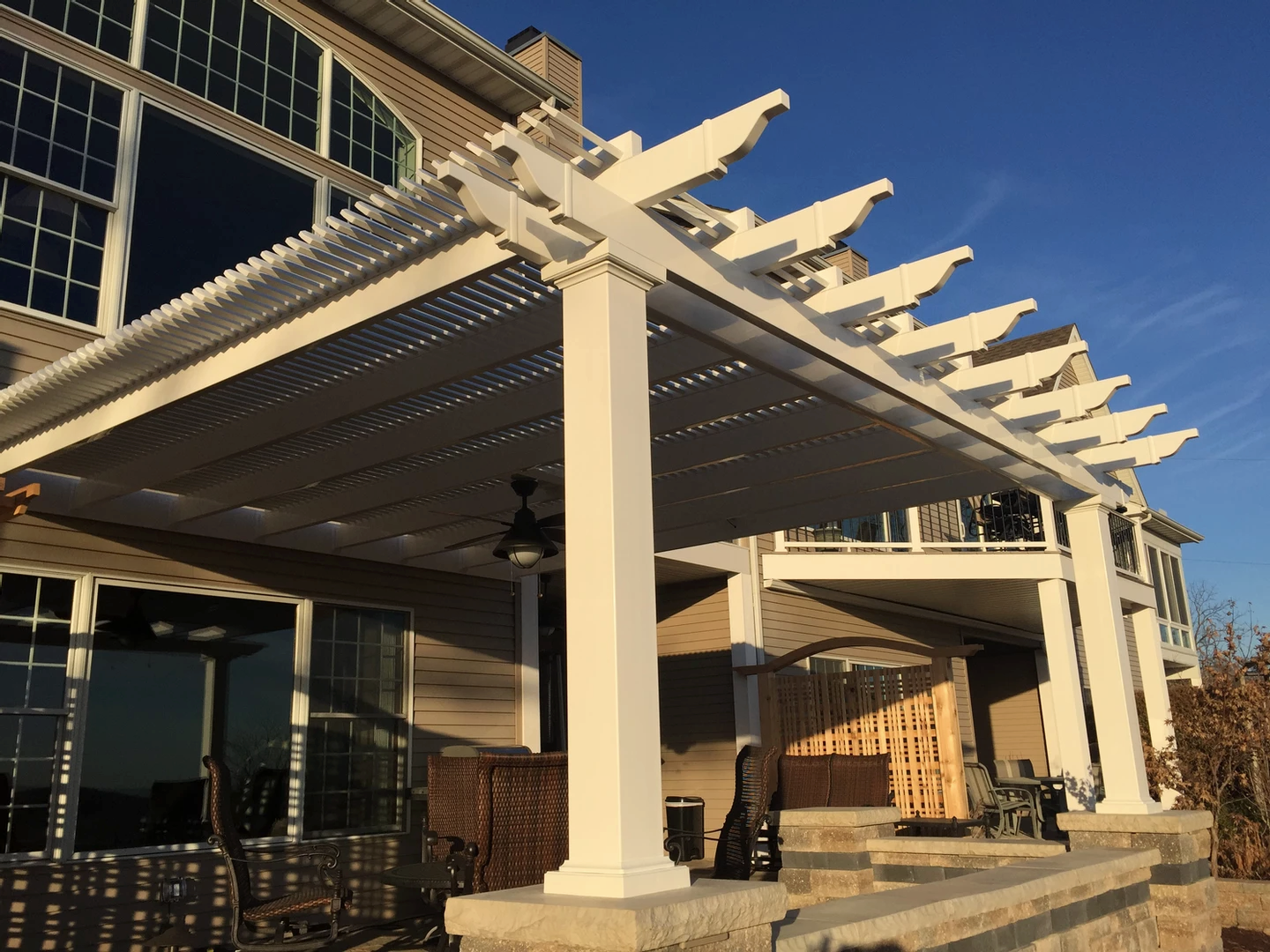 Trees and landscaping can alter the amount of sunlight reaching a patio throughout the year.
Deciduous trees may provide considerable shade when fully leafed out but much less protection during cooler months.
When comparing seasonal conditions, separate the effects of the house and pergola from the effects of vegetation.
This distinction can reveal whether a location needs permanent supplemental shade or already benefits from adequate seasonal protection.
If you cannot observe the patio during every relevant season, a sun-study tool can help compare possible conditions.
For meaningful results, enter or verify:
A basic solar-position calculator can establish where the sun should appear in the sky, but it does not automatically account for the house, landscaping, or pergola roof. A three-dimensional shade simulation must represent those features accurately to predict their shadows.
Label any predicted results as estimates until they have been checked against actual site observations.
Installation elevation also affects the relationship between the roof and the occupied area. Before finalizing a shade study, verify that the assumed elevation is compatible with the home's eaves, doors, windows, and available attachment conditions.
Do not infer year-round shade performance from a single summer photograph or from the pergola's nominal roof-coverage percentage.
Once you have observed the existing shade, compared sun directions, and evaluated the occupied area, you can make a more confident location decision.
The goal is not to find a wall that produces the largest possible shadow at one moment. It is to identify the location that most consistently serves your household's important outdoor activities.
Use a simple comparison table to record the evidence for each workable attachment area.
| Decision Factor | Candidate Location A | Candidate Location B |
|---|---|---|
| Primary activity served | Outdoor dining | Afternoon lounging |
| Most important use hours | Noon–2 p.m. | 3–6 p.m. |
| Existing house shade | Partial during priority hours | Limited during priority hours |
| Expected shade over occupied area | Requires further observation | Promising; verify late-afternoon exposure |
| Shoulder-season usefulness | Not yet evaluated | Not yet evaluated |
| Attachment-site feasibility | Preliminary review completed | Obstacles still need checking |
| Confidence in shade assessment | Moderate | Low until additional observations |
This is an illustrative scorecard, not a comparison of actual properties. Replace the entries with observations from your own home.
A qualitative assessment is often more useful than assigning arbitrary numerical scores. Mark each finding as observed, supported by a verified sun study, or still uncertain.
Suppose Location A provides attractive shade during breakfast, while Location B better protects the patio during afternoon gatherings.
If your family primarily entertains outdoors in the afternoon, Location B may be the stronger choice—even if Location A produces shade for more total hours.
The distinction is between total hours of shade and useful shade during the hours that matter most.
Likewise, if your household regularly uses the patio for breakfast but rarely spends time outside during the afternoon, the priorities could reverse.
A promising shade location still needs to accommodate the actual installation.
Before committing, confirm that the proposed attachment area is suitable for the structure and that physical obstacles have been identified.
Potential concerns include:
These issues do not necessarily rule out a location, but they should be evaluated before making a final selection. Attachment suitability and structural requirements must also be verified rather than assumed from the available wall space.
Before selecting a pergola configuration, prepare a short location brief containing:
This information gives you a much stronger starting point when reviewing attached pergola configurations and determining which options deserve further evaluation.
The most useful attached pergola shade comes from matching the structure's location to your household's actual outdoor-use hours—not simply choosing the largest wall or assuming that overhead coverage guarantees shade throughout the day.
Start with the occupied patio area, document the shade your house already provides, and compare candidate walls using actual sun positions and seasonal conditions. Then verify that the proposed pergola geometry can place shade where people will sit or gather.
With a preferred wall location and a clear understanding of your shade priorities, you can browse attached pergolas with greater confidence and narrow your choices to configurations worth evaluating for your specific patio.
[1] National Oceanic and Atmospheric Administration (NOAA), Global Monitoring Laboratory, Solar Calculation Details and Solar Position Calculator. NOAA provides methods and tools for calculating solar azimuth and elevation based on geographic location, date, and time.
Not necessarily. Morning and evening sunlight comes from different directions, so the pergola's shadow moves throughout the day. If the two areas occupy different parts of the patio, one may receive better shade than the other. Compare both locations during their actual use hours before choosing a pergola position.
Yes. Depending on the sun's angle, a pergola can cast shadows beyond the area directly beneath its roof. The direction and distance depend on solar position, roof elevation, and the structure's geometry. However, shade extending beyond the footprint at one hour may move elsewhere later in the day.
Yes. When the sun is low in the sky, sunlight can travel beneath a pergola's outer edge and reach people or furniture. This is particularly important for patios exposed to late-afternoon western sunlight. Overhead roof coverage alone does not guarantee protection from low-angle sun.
Yes. A patio floor may be shaded while a seated person's head, shoulders, or upper body remain exposed to direct sunlight. Evaluate shade at the actual positions and heights of people using the furniture, especially during the hours when protection matters most.
Yes. Tree shadows move throughout the day, and deciduous trees provide different amounts of shade depending on their foliage. A single observation may not represent conditions during another season. Record the date, time, and vegetation conditions when evaluating existing shade.
Yes. If the house already shades a patio area during its primary use hours, an attached pergola may contribute relatively little additional shade there. Another location with more direct sun exposure may benefit more. Compare the existing shade gap before deciding where the structure will provide the greatest practical value.
No. Compass direction identifies the wall's orientation, while a photograph captures conditions at one moment. Predicting shade at other hours or seasons requires information about the sun's position, roof geometry, installation elevation, and surrounding obstructions. Use repeated observations or a validated sun study to compare locations.


