

MADE IN THE USA
with American products
w/ American products


How much eyebrow pergola shade can you expect over a sunny window, front door, or garage opening? The answer depends less on how much shadow the pergola creates overall and more on whether that shadow reaches the part of the opening you want protected during the hours that matter. A shallow, slatted eyebrow pergola can provide useful localized shade, but its performance changes throughout the day and across seasons. Here's how to evaluate the expected coverage before choosing a kit.
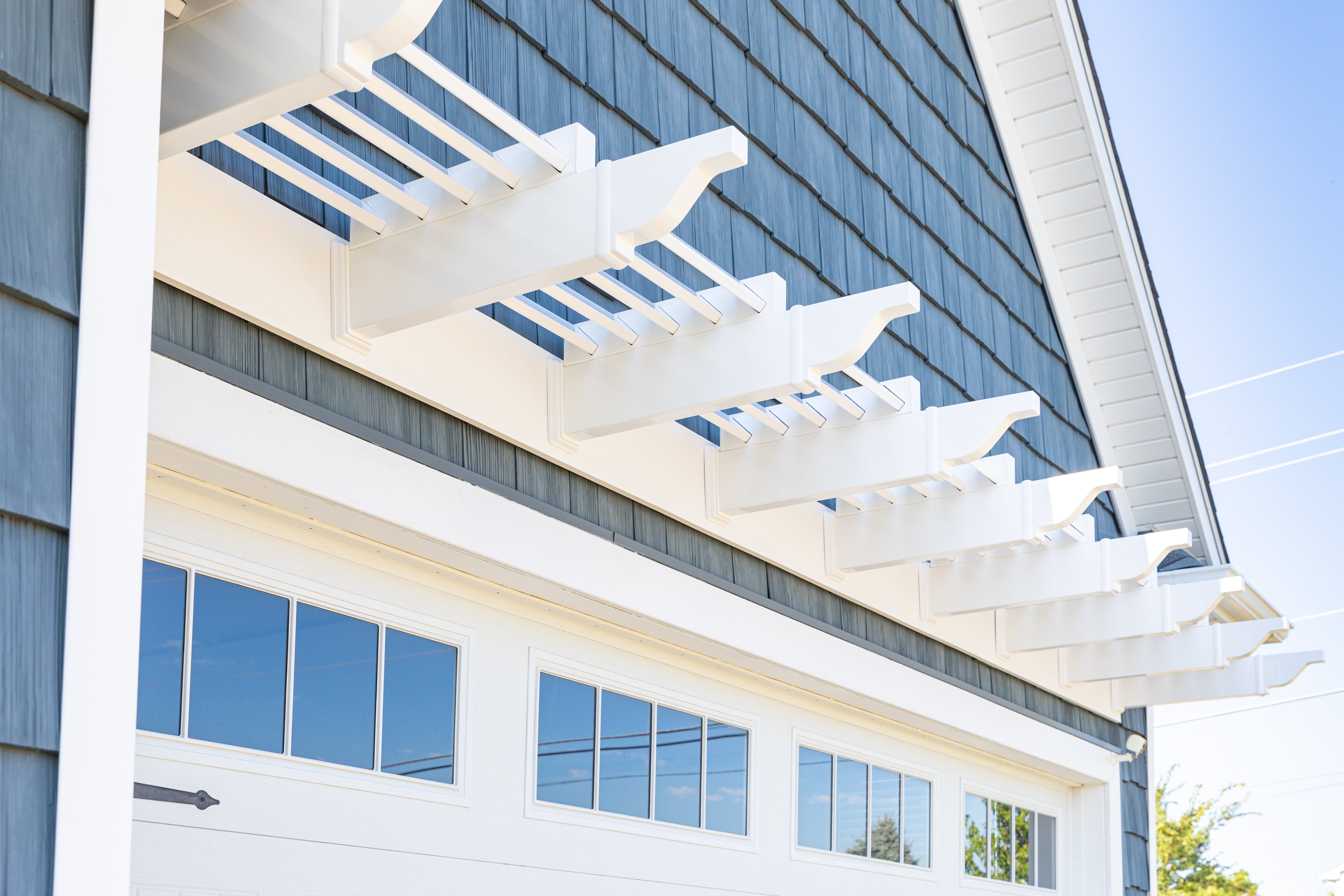 Before evaluating an eyebrow pergola's shade performance, identify exactly where you want its shadow to fall. A pergola can cast a noticeable shadow on a home's exterior without shading the particular surface that prompted the purchase.
For example, a homeowner trying to reduce direct sunlight through a window needs a different result from someone who simply wants a shaded architectural feature above a garage.
Three common targets require slightly different assessments:
Be specific about the required coverage. If your goal is to shade an entire window, a narrow strip of shadow across the upper frame is not enough. If you only need to interrupt direct sunlight reaching the upper glass, partial coverage may be useful.
Eyebrow pergola shade should be evaluated at particular times rather than described as a permanent condition.
Consider two homeowners with identical windows. One experiences unwanted sunlight during a short morning period. The other wants protection throughout a long afternoon. Even with identical pergolas, the first homeowner may have a more achievable shade objective.
Write down:
This establishes a practical standard for success: Does the shadow reach enough of the intended surface during the hours when shade is needed?
Without that definition, even a photograph showing an attractive, clearly visible pergola shadow provides limited evidence of useful performance.
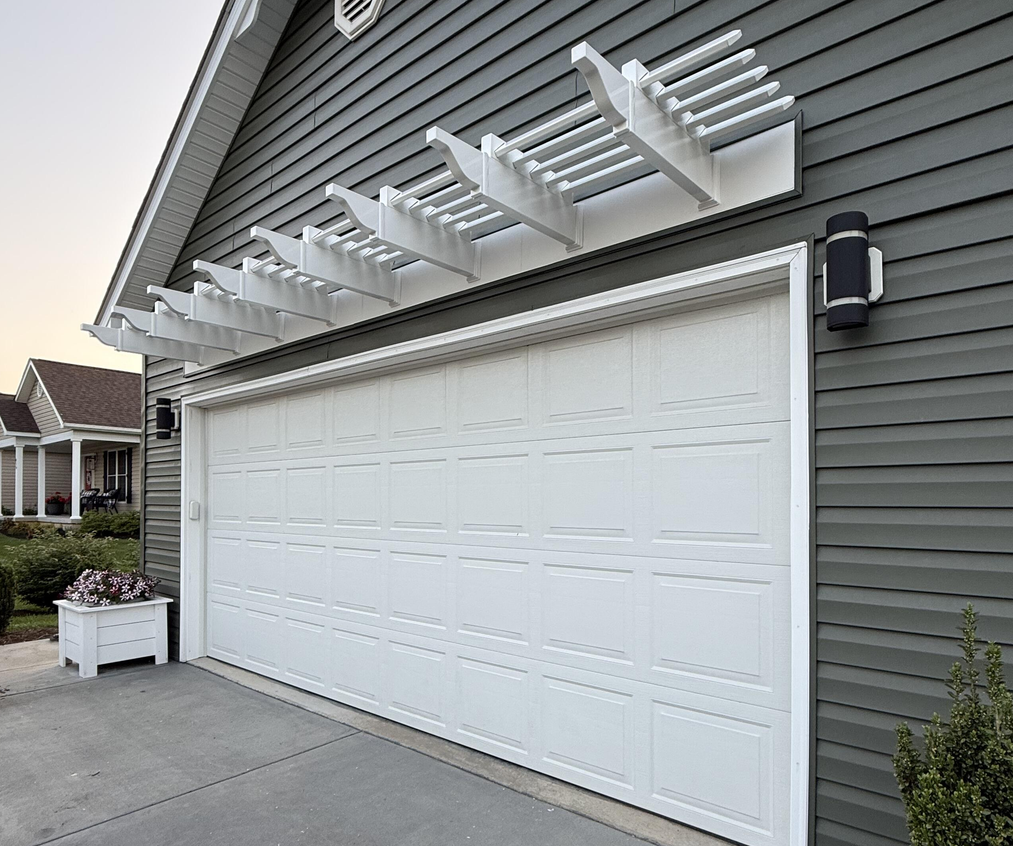 An eyebrow pergola's shade comes from its fixed angled slats intercepting direct sunlight. Because the roof is shallow and contains openings between the slats, it should not be treated as a continuous overhead shade barrier.
The physical configuration establishes what the pergola might shade, while the sun's position determines where its shadow actually lands.
Sunset Pergola Kits' eyebrow pergolas have five fixed angled shade purlins, commonly called slats, and a standard rafter depth of 24 inches.
These characteristics have important implications:
The actual amount of shade depends on the slats' width, angle, spacing, and position relative to incoming sunlight. The number of slats and overall rafter depth alone are not enough to calculate a reliable shade percentage.
For this reason, homeowners should not assume that five slats automatically provide a particular percentage of coverage over the window or door beneath them.
Eyebrow pergolas are available with flat, scrolled, or beveled end caps. Scrolled and beveled end caps add another 9 inches beyond the standard 24-inch rafter depth.
That extension is important when considering the pergola's overall appearance and physical projection, but it should not automatically be counted as additional slatted shade coverage.
Decorative projection and verified shade-producing projection are not necessarily the same measurement.
When reviewing a product drawing, distinguish among the rafter depth, the decorative end-cap extension, and the actual location of the five shade slats.
Those measurements provide a much more useful basis for predicting a shadow than simply treating the pergola as a uniformly shaded structure extending 33 inches from the wall.
Sunset Pergola Kits offers 50%, 75%, and 90% shade-coverage configurations on its traditional and modern full-size pergolas. Those options describe different purlin-spacing configurations for those products.
They are not selectable shade percentages for eyebrow pergolas.
The eyebrow design uses its specified five fixed angled slats. A homeowner should therefore evaluate that actual configuration rather than transferring a coverage figure from another product.
If you are comparing the available design and dimensions, the eyebrow pergola kit specifications provide a starting point for identifying the physical configuration that needs to be assessed.
An eyebrow pergola does not cast one fixed shadow. Its shadow changes as the sun moves across the sky, and the seasonal changes in the sun's path can alter coverage considerably.
This explains why a pergola that appears to shade a window in one photograph may provide very different coverage at another hour or time of year.
When sunlight approaches from a relatively high angle, an overhead projection can intercept rays differently than when the sun is low in the sky.
With a high sun, the shadow may fall closer to the pergola and the upper portion of the wall or opening. With a lower sun, the shadow can extend farther downward, depending on the slat angles and the direction of incoming light.
However, lower sunlight is not automatically better for shade. The fixed slats may allow different amounts of sunlight through as the angle changes, and the resulting shadow may move away from the target.
Consider this hypothetical example:
These are examples of possible shadow behavior, not predictions for a particular home. The actual result depends on the pergola's geometry and the sun's position relative to the wall.
The direction from which sunlight strikes the façade is just as important as its height.
When sunlight approaches more directly toward the wall, the shadow pattern may align more closely with the opening beneath the pergola.
When sunlight approaches from an oblique angle, the shadow can shift sideways along the façade. Depending on the pergola's width and the sun's direction, part of the shadow may fall beside the opening instead of across it.
A pergola can produce substantial visible shade while missing the intended window or doorway.
This is particularly important when the desired shade is concentrated near one end of a long opening.
The sun follows different paths across the sky during different seasons. Consequently, the same fixed pergola can produce different shadow locations and patterns at the same clock time in summer and winter.
For example, a pergola might cast a useful shadow across a window during a particular summer afternoon but leave more of that window exposed during a winter afternoon. The reverse can also occur for particular targets and sun positions.
The correct conclusion cannot be determined from the season alone.
Instead, compare the sun's expected direction and elevation during the months when shade is most important.
A photograph taken during one season is useful evidence of what happened at that moment. It is not proof of year-round coverage.
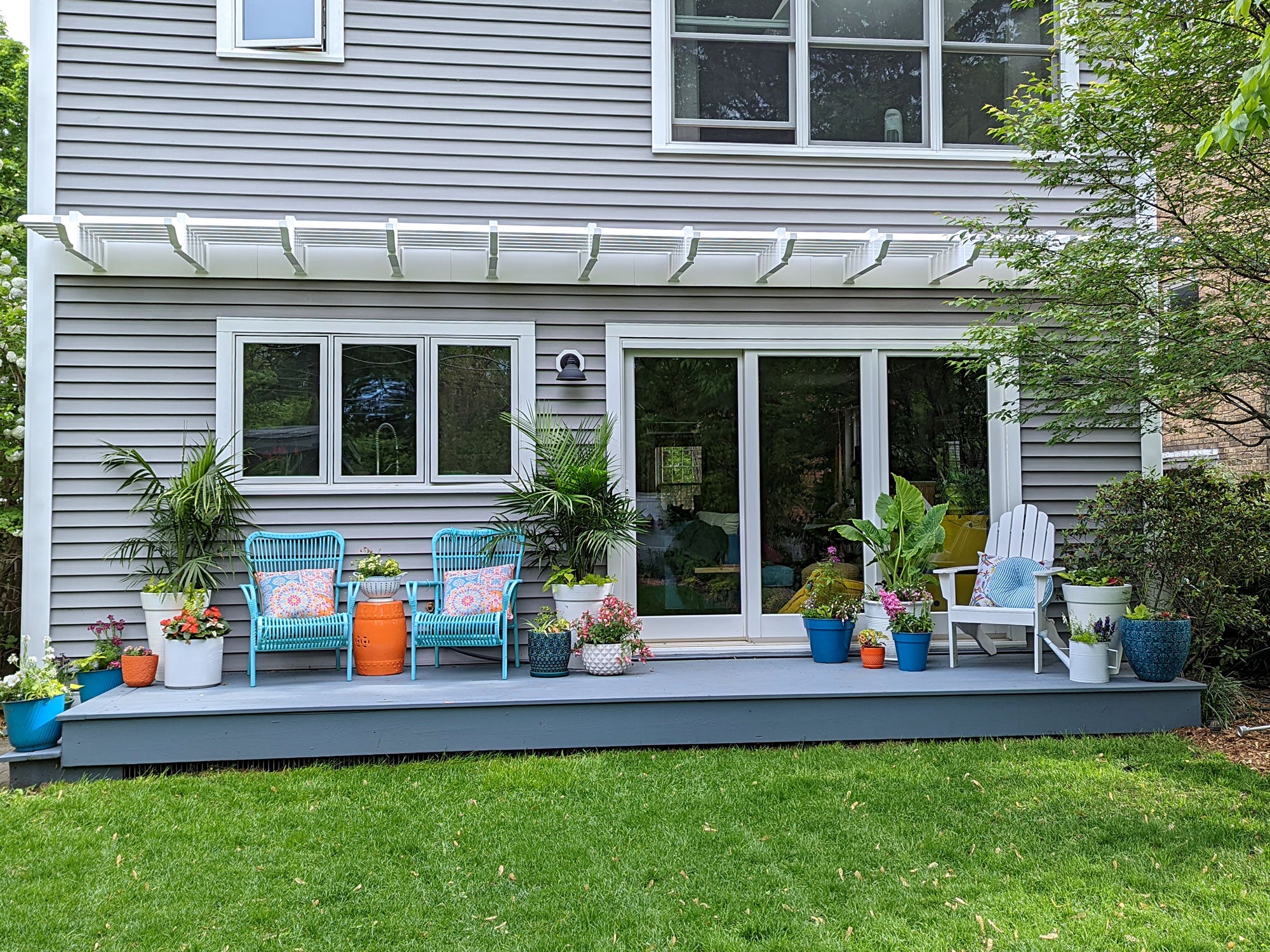 The vertical relationship between the pergola and the opening also affects where shadows land.
A shadow projected from a structure close to the top of a window can reach the glass differently from a shadow projected from the same structure farther above it.
The relevant variables include the pergola's position relative to the opening, its outward projection, and the incoming sunlight angle.
These relationships should be included in a shade assessment, but they do not establish a universally correct mounting height. That decision requires separate consideration of the building and the intended installation.
For a homeowner evaluating eyebrow pergola kits, the useful next step is to compare the actual configuration against the façade and the hours when the opening receives unwanted sunlight.
The most dependable way to evaluate an eyebrow pergola is to combine observations of the actual opening with the product's verified geometry and the sun positions that matter.
You do not need to assign an unsupported shade percentage to make a useful buying decision. You do need enough information to distinguish likely coverage from an untested assumption.
Begin with the opening itself.
These observations establish the existing conditions. They do not, by themselves, show how the proposed pergola will perform.
If nearby trees, roof overhangs, or neighboring structures already cast shadows, record their influence separately. Otherwise, it may be difficult to distinguish the pergola's expected contribution from existing shade.
For a meaningful shade assessment, use the actual dimensions of the eyebrow pergola rather than a generic illustration.
The most relevant information includes:
Sunset Pergola Kits offers eyebrow pergolas in lengths from 4 to 60 feet in 4-foot increments. Selecting a length appropriate for the opening is relevant to lateral shadow coverage, particularly when sunlight approaches from the side.
However, a longer pergola does not automatically solve inadequate downward shade coverage. Width and projection affect different aspects of the shadow.
The eyebrow and garage pergola collection is a useful place to review the available configurations before requesting any additional geometry needed for a shade assessment.
Once the opening and pergola dimensions are known, assess the expected shadow at the specific hours and seasons you identified.
A geometry-based assessment can use the sun's direction and elevation at the property, together with the actual slat positions, to estimate where shadows will fall.
For example, if unwanted sunlight reaches a window during the late afternoon, the relevant assessment is the expected shadow across that window during those afternoon hours—not the pergola's appearance at noon.
A useful evaluation should distinguish three outcomes:
Do not treat an unresolved result as a positive shade prediction.
A photograph of an installed eyebrow pergola can help illustrate the structure and a particular shadow pattern. However, it cannot establish performance at your home without knowing the relevant conditions.
Before using a photograph as evidence, ask:
If those details are unavailable, the photograph should be treated as a visual reference rather than a reliable performance comparison.
For a more rigorous assessment, a dimensionally accurate shadow study can evaluate the proposed configuration at multiple sun positions. Its reliability depends on accurate product dimensions, building measurements, and site information.
An eyebrow pergola may be suitable when the goal is to interrupt direct sunlight reaching a particular window, door, or garage opening.
It is less appropriate when the actual objective is to shade a substantial outdoor seating area, dining space, or occupied patio.
Those applications require evaluation of a different coverage area and should not be inferred from an eyebrow pergola's localized shadow.
If your main goal is a shaded outdoor living space rather than shade on an opening, the larger configurations in the attached pergola collection may be more relevant.
For an opening-level shade requirement, however, the decision remains straightforward: determine whether the proposed eyebrow pergola's shadow reaches the required surface during the required hours.
An eyebrow pergola can provide useful localized shade, but its five fixed angled slats and shallow projection do not guarantee full coverage of a window, doorway, or garage opening. The result depends on the sun's position, the pergola's actual geometry, and the location of the surface you want shaded.
Before ordering, identify your target, document the hours when direct sunlight matters, and compare those conditions with the verified pergola dimensions. If the expected shadow meets your needs—or you have the information needed to verify it—browse Eyebrow Pergola Kits to evaluate the available configurations for your home.
Yes. An eyebrow pergola can cast a visible shadow on siding, trim, or the wall above a window while leaving the glass exposed to direct sunlight. Evaluate shade on the actual glass or other target surface, not simply the presence of a shadow nearby.
No. As the sun changes position, the shadow moves and its pattern changes. A window shaded during one part of the afternoon may receive direct sunlight later, even though the pergola itself has not moved.
No. Seasonal changes in the sun's path affect shadow location and coverage. A photograph documents conditions at a particular moment but cannot establish year-round performance without additional information about the wall orientation, pergola geometry, and seasonal sun positions.
Not necessarily. Scrolled and beveled end caps add 9 inches beyond the eyebrow pergola's standard 24-inch rafter depth, but that decorative extension should not automatically be counted as additional slatted coverage. Verify the actual locations and outward projection of the five shade slats.
No. Those shade-coverage configurations are offered on Sunset Pergola Kits' traditional and modern full-size pergolas. Eyebrow pergolas use five fixed angled slats and do not offer those selectable shade percentages.
No. Visible shade does not establish a particular indoor temperature reduction. The effect depends on how much direct sunlight is blocked from the glass, when that blocking occurs, and other building conditions. No specific cooling result should be assumed from the pergola's shadow alone.
Yes. Trees and other surrounding objects may already shade the opening during certain hours. Record existing shade separately so you can determine whether the eyebrow pergola would provide additional coverage when it is actually needed.


