

MADE IN THE USA
with American products
w/ American products


Can you grow vines on a vinyl traditional pergola? Potentially, but the answer depends on the exact pergola, the climbing plant, and how the vegetation will be supported. If you're considering adding vines to an existing structure, the first step is determining whether the manufacturer permits that use. This guide explains what to verify, how mature plant growth affects suitability, and what additional upkeep a planted canopy may require.
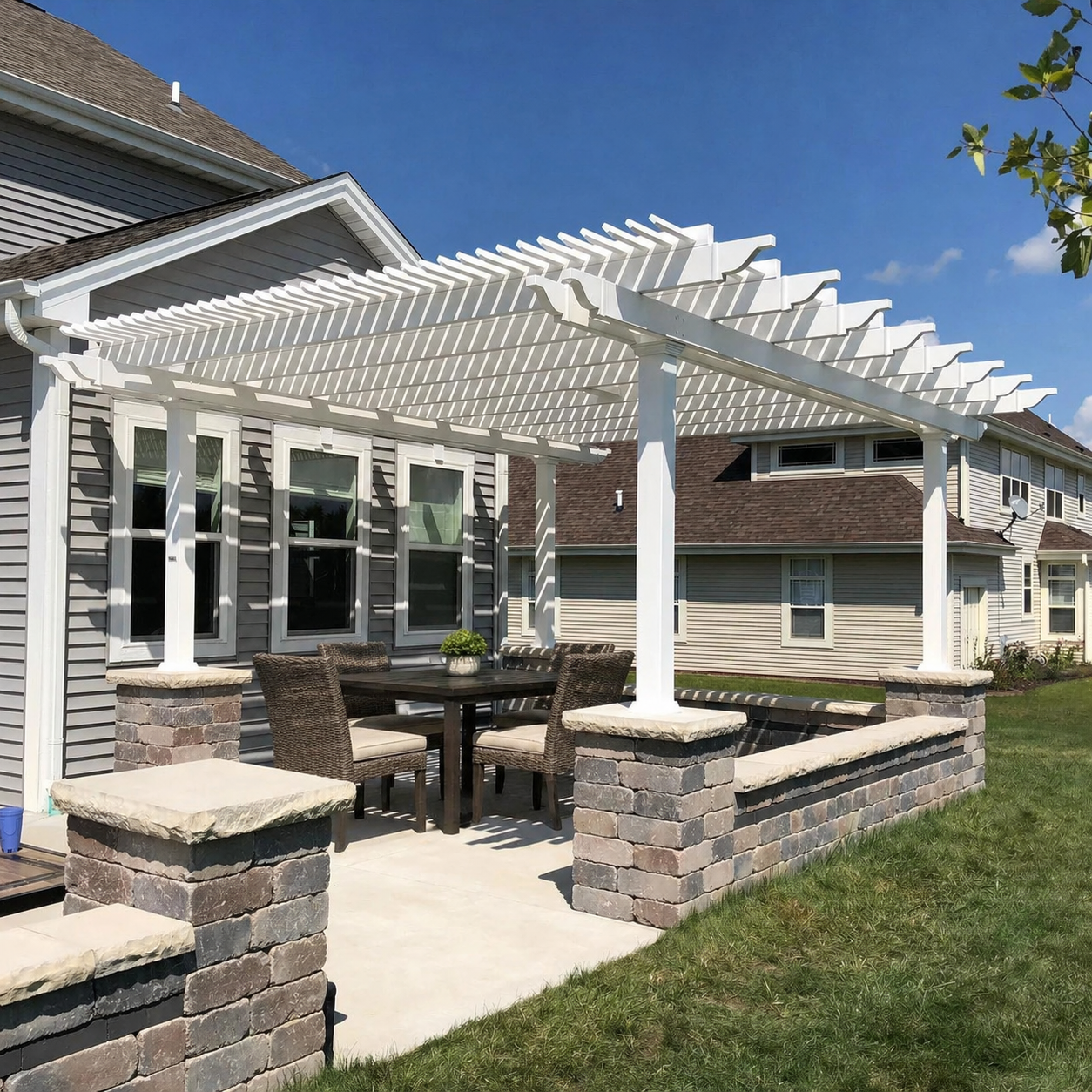 Before training climbing plants on a vinyl pergola, confirm that the manufacturer approves vegetation support for your specific model and configuration.
This distinction matters because a pergola's ability to withstand ordinary structural and environmental loads does not automatically establish its suitability for supporting growing plants.
Sunset Pergola Kits' traditional vinyl pergolas feature aluminum reinforcement inside their weight-bearing posts, beams, and rafters. Their exterior components are made from premium extruded vinyl, eliminating the need for painting or staining.
However, those construction details alone do not establish whether climbing vegetation is an approved use.
The available product specifications do not provide a vegetation load rating, approved vine attachment methods, or confirmation that plant-related damage is covered under the lifetime warranty.
Those details must be verified rather than inferred from the materials or warranty.
Before allowing vines to grow directly on the structure, request guidance covering:
For an existing pergola, have your model and installation details available when requesting this guidance. Prospective buyers should obtain the answers before making plant support part of their planned use.
A climbing plant that looks manageable when purchased may develop very different characteristics as it matures. Its eventual size, growth pattern, and maintenance requirements are more important than its appearance at the garden center.
Before choosing a vine for a vinyl pergola, consult a qualified horticultural professional or reliable plant-specific growing guidance for your local conditions.
Determine the following:
These characteristics should then be reviewed against the pergola manufacturer's requirements. Plant suitability and structural permission are separate questions, and both need satisfactory answers.
Climbing plants do not all interact with supporting structures in the same way.
Some grow by winding stems around nearby objects. Others use tendrils to grasp available supports, while certain climbing plants produce structures that adhere directly to surfaces.
These differences can influence where vegetation contacts the pergola, how difficult it is to redirect growth, and whether components remain visible and accessible.
For example, a vine that wraps around structural members may be harder to remove or reposition than one guided along an approved, separate support. A plant that clings directly to a surface raises different questions about surface contact and removal.
Even if a plant's apparent weight seems modest, its attachment behavior can make it unsuitable for a particular pergola.
The practical rule: Identify the plant's mature characteristics first, then obtain manufacturer confirmation that the proposed growth and support arrangement is acceptable.
 Even when vegetation support is permitted, the method used to train climbing plants matters. A suitable plant does not automatically make every attachment method acceptable.
Homeowners sometimes consider using soft plant ties, wire, clips, adhesive fixtures, or direct wrapping to guide vines across a pergola.
Do not assume any of these methods is approved simply because it appears gentle or unobtrusive.
In particular, obtain express permission before:
The manufacturer should identify acceptable attachment locations and methods, if any. Avoid modifying components or introducing loads that have not been approved.
Traditional pergolas contain multiple structural members and connections that should remain accessible for inspection when needed.
Dense foliage can conceal these areas, making it more difficult to see the condition of connections or identify developing maintenance concerns.
Before establishing a training route, identify areas where vegetation should not be permitted to accumulate.
This is especially relevant around post-to-beam connections, beam-to-rafter connections, mounting hardware, and other locations identified in the manufacturer's instructions.
For house-attached pergolas, also confirm that vegetation will not obstruct any connection or inspection area associated with the attachment to the building.
A vine may eventually need significant pruning, repositioning, or removal. Consider whether that work can be performed without pulling against, damaging, or disassembling pergola components.
A training arrangement that is manageable while the plant is small may become difficult to maintain once stems have intertwined with multiple structural members.
If the proposed growth pattern cannot preserve the required access, reconsider the arrangement before planting.
One of the main advantages of a premium vinyl pergola is its low-maintenance exterior. Unlike wood, the vinyl does not require periodic painting or staining.
However, introducing climbing vegetation creates an entirely separate set of maintenance responsibilities.
Vines need to remain within whatever boundaries are permitted by the manufacturer and appropriate for the plant.
Depending on the plant and growing conditions, maintenance may involve:
The amount and timing of this work depend on the selected species and local climate. Obtain plant-specific guidance rather than assuming a universal pruning schedule.
Plant-related residue can affect the appearance and upkeep of areas surrounding a climbing vine.
Before planting, evaluate whether the selected species produces sap, fruit, flowers, or other material that could leave deposits on nearby surfaces.
Dense growth can also create areas where moisture and organic debris remain in contact with components or are difficult to inspect.
These considerations do not establish that vines will damage vinyl. They do mean that a low-maintenance exterior should not be confused with a maintenance-free planted canopy.
Vegetation may attract or shelter insects depending on the plant, its condition, and the surrounding environment.
Whether this becomes a practical concern is highly site-specific. A local horticultural professional can help identify potential issues associated with the proposed vine.
From a pergola ownership perspective, the important question is whether vegetation will make surfaces, joints, and attachment points harder to inspect or maintain.
Ownership takeaway: Choose climbing plants only if you're comfortable managing their growth and preserving the access required by the pergola manufacturer. The maintenance advantages of vinyl remain valuable, but they do not eliminate plant care.
 Once you've evaluated the pergola, plant, and ongoing maintenance requirements, the decision becomes more straightforward: either establish a manufacturer-approved training arrangement or keep the vegetation independently supported.
Before training vines directly on a vinyl traditional pergola, confirm that every applicable condition has been satisfied:
If any of these conditions cannot be established, do not assume direct vine support is an acceptable use of the pergola.
Separate plant support is worth considering when the manufacturer does not approve direct support, when guidance is unavailable, or when the plant's natural growth habits conflict with the pergola's access requirements.
Possible alternatives include a freestanding garden trellis or another independently supported climbing framework.
However, a separate support is only an appropriate alternative if its design and installation are suitable for the proposed vegetation and it does not transfer plant loads to the pergola.
That includes avoiding arrangements where vines eventually bridge between the independent support and the pergola in a way that imposes loads or creates prohibited contact.
An independently supported planting arrangement may offer some of the visual appeal of a planted canopy without requiring the pergola itself to serve as the climbing framework.
This approach also provides greater flexibility when a particular climbing plant is difficult to control or requires frequent attention.
If you're still choosing a structure, treat vegetation support as a specific purchase requirement rather than an assumed feature of a pergola.
Sunset Pergola Kits offers traditional-style pergolas in freestanding and attached configurations, with fixed shade slats, optional decorative overhangs, and several post styles.
These are useful design choices for creating a permanent outdoor living area, but none independently confirms suitability for climbing vegetation.
Buyers comparing freestanding pergolas and attached pergolas should request plant-support guidance for the actual configuration they intend to purchase.
If supporting vines is essential to your project, resolve that question before ordering rather than planning to add vegetation after installation and seeking approval later.
Growing vines on a vinyl traditional pergola may be possible, but only when the manufacturer approves the proposed use for the exact structure and the selected plant can be supported and maintained within those requirements.
For existing owners, the next step is obtaining configuration-specific guidance before attaching or training vines. If approval is unavailable, consider keeping the vegetation on an independent support.
For homeowners planning a new outdoor space, browse Sunset Pergola Kits' traditional pergola collection with the plant-support checklist in mind. Confirm the intended use before making climbing vegetation part of your design.
No. Aluminum reinforcement provides structural support, but it does not establish a vegetation load rating or manufacturer approval for climbing plants. Confirm plant-support permission for the exact pergola configuration.
No. A young plant's size does not establish its mature weight, extent, or growth behavior. Obtain plant-specific guidance for local growing conditions and have the proposed mature growth reviewed against the pergola manufacturer's requirements.
No. Vinyl eliminates the need for painting or staining, but climbing plants may require pruning, growth management, debris removal, and monitoring to preserve access to pergola components.
No. Even soft ties can create contact points or introduce loads that the manufacturer has not approved. Confirm which attachment materials, locations, and methods are permitted before using them.
No. A lifetime structural warranty does not automatically establish coverage for vegetation-related damage. Review the applicable warranty terms and request written clarification from the manufacturer before training vines.
Yes. Twining stems, tendrils, or clinging growth can create contact with components, obstruct inspection points, or complicate removal. Weight is only one consideration when evaluating plant suitability.
Do not assume that direct vine support is an approved use. Consider an independently supported trellis or other appropriate framework that transfers no vegetation loads to the pergola.


