

MADE IN THE USA
with American products
w/ American products


Choosing among the three vinyl pergola colors—white, tan, and black—is about more than personal preference. The color determines whether your pergola blends into your home's architecture, connects surrounding outdoor materials, or becomes a prominent design feature. The right choice also depends on the structure's size, sun exposure, cleaning considerations, and budget. Here's how to compare all three colors before committing to a permanent addition to your outdoor living space.
The best pergola color depends on the architectural role you want the structure to play. Before comparing individual colors, decide whether your pergola should blend with the house, connect different exterior materials, or create deliberate contrast.
A pergola that matches or closely complements your home's exterior trim often looks like a natural extension of the architecture. This approach is especially effective for attached pergolas, where the structure sits directly against the house.
For example, a white pergola alongside white fascia boards, porch columns, or window trim can create a cohesive appearance without introducing another prominent exterior color.
Best when: You want the pergola to feel integrated with the home rather than become the primary visual feature.
Some properties combine several materials, such as light stucco, tan stone, warm wood decking, and beige pavers. A pergola color that relates to more than one of these materials can help unify the space.
Tan is often particularly effective in this role. It can provide a visual connection between warm architectural finishes and natural landscaping without matching any single surface exactly.
Best when: Your home's exterior contains several complementary warm or neutral colors.
A contrasting pergola becomes a more intentional part of the property's design. Black, for instance, can establish a strong outline against light siding or pale stone, particularly when repeated in window frames, railings, or outdoor furniture.
Contrast can also help define an outdoor dining area, poolside lounge, or seating space within a larger yard.
Best when: You want the pergola to stand out and reinforce existing dark architectural accents.
Before choosing, examine these elements together:
You do not need to match everything. A successful color choice usually relates clearly to one or two dominant elements and looks intentional alongside the rest.
A white vinyl pergola is generally the strongest choice when you want a bright, visually lightweight structure that coordinates with light-colored exterior trim. White is also the most affordable vinyl color offered by Sunset Pergola Kits, although exact price differences depend on the selected configuration and current pricing.
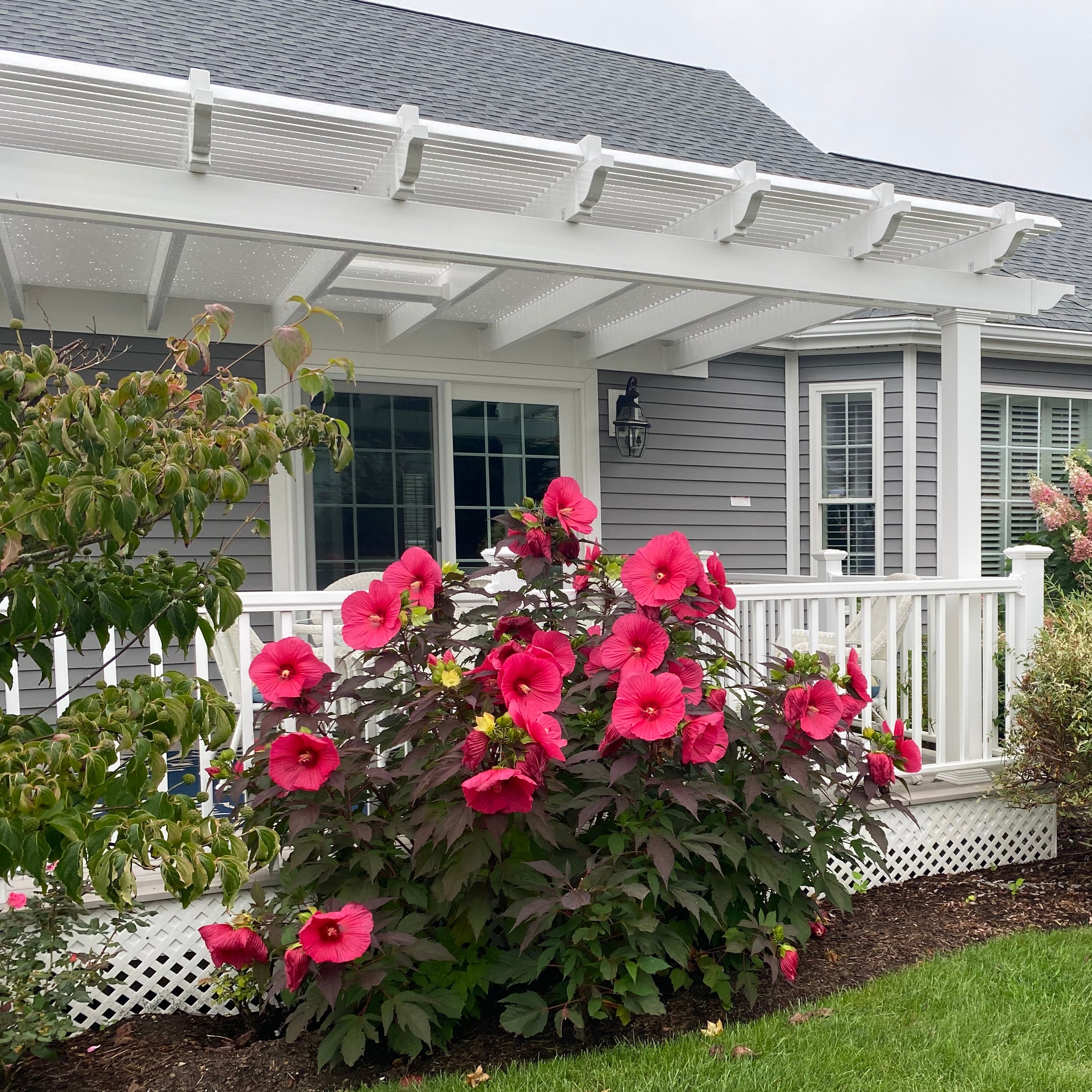 White works especially well alongside homes with white columns, window trim, fascia, or other light architectural details. Repeating the same general color family helps the pergola look like a planned addition rather than a separate structure.
On a traditional home, white can emphasize clean lines, decorative rafters, and architectural details without introducing a competing color. This makes it a natural option for homeowners considering traditional pergolas with decorative beam and rafter ends.
White also works with modern architecture, particularly when the home features light walls and simple geometric forms. It is not limited to traditional designs.
Light-colored surfaces often make a large pergola feel less visually dense. This can be valuable when the structure spans a substantial patio or sits close to major windows.
White beams and posts remain clearly defined, but their relatively light appearance can prevent the overhead structure from dominating the home's exterior.
However, white does not automatically disappear against every light-colored house. On a home with darker siding or masonry, it may create substantial contrast and become an obvious focal point.
White can appear especially bright in strong sunlight, particularly alongside pale concrete or other reflective surfaces. It may also show dark debris, mildew, or leaf stains more readily than tan or black.
These concerns do not necessarily outweigh its advantages, but they are worth considering if the pergola will sit beneath trees or against a highly reflective patio.
For homeowners planning a structure directly against the house, comparing attached pergola configurations can also help reveal how white posts and beams will interact with existing exterior features.
A tan vinyl pergola is often the best choice for homes with warm-neutral finishes, including cream siding, beige stucco, natural stone, and earth-toned patios. It offers a softer alternative to bright white without creating the dramatic contrast associated with black.
 Tan can be especially effective when multiple exterior materials share warm undertones. For example, a home with cream-colored stucco, sandy stone, and brown composite decking may benefit from a pergola color that connects those finishes.
It can also fit comfortably into landscapes with natural stone walls, gravel, warm-colored pavers, and established vegetation.
Unlike an exact color match, this approach relies on harmony. The pergola does not need to duplicate the color of the house or patio to feel cohesive.
Tan is not exclusively a traditional color. A simple, clean-lined tan pergola can complement contemporary architecture that uses warm stone, neutral stucco, or natural wood accents.
For homeowners who prefer understated modern design, a tan pergola can provide architectural definition without the stronger outline of black. Browse modern vinyl pergolas to see how the cleaner geometry works with different exterior color palettes.
The biggest design consideration with tan is undertone. Some tan finishes appear more golden or yellow, while others lean toward beige, cream, or gray.
A tan that looks beautiful next to warm limestone may appear less coordinated alongside distinctly blue-gray siding or cool-toned stone. Conversely, tan can work with gray materials when their undertones are warm or the property includes other beige or natural-wood elements.
Whenever possible, compare a current manufacturer-approved color sample against the actual siding, masonry, and decking. Evaluate the colors together rather than selecting tan solely from a digital product photograph.
A black vinyl pergola is a strong choice for homeowners seeking deliberate contrast, defined architectural lines, and coordination with dark exterior accents. It can look especially striking on contemporary homes, but it deserves careful evaluation on large structures or sun-exposed patios.
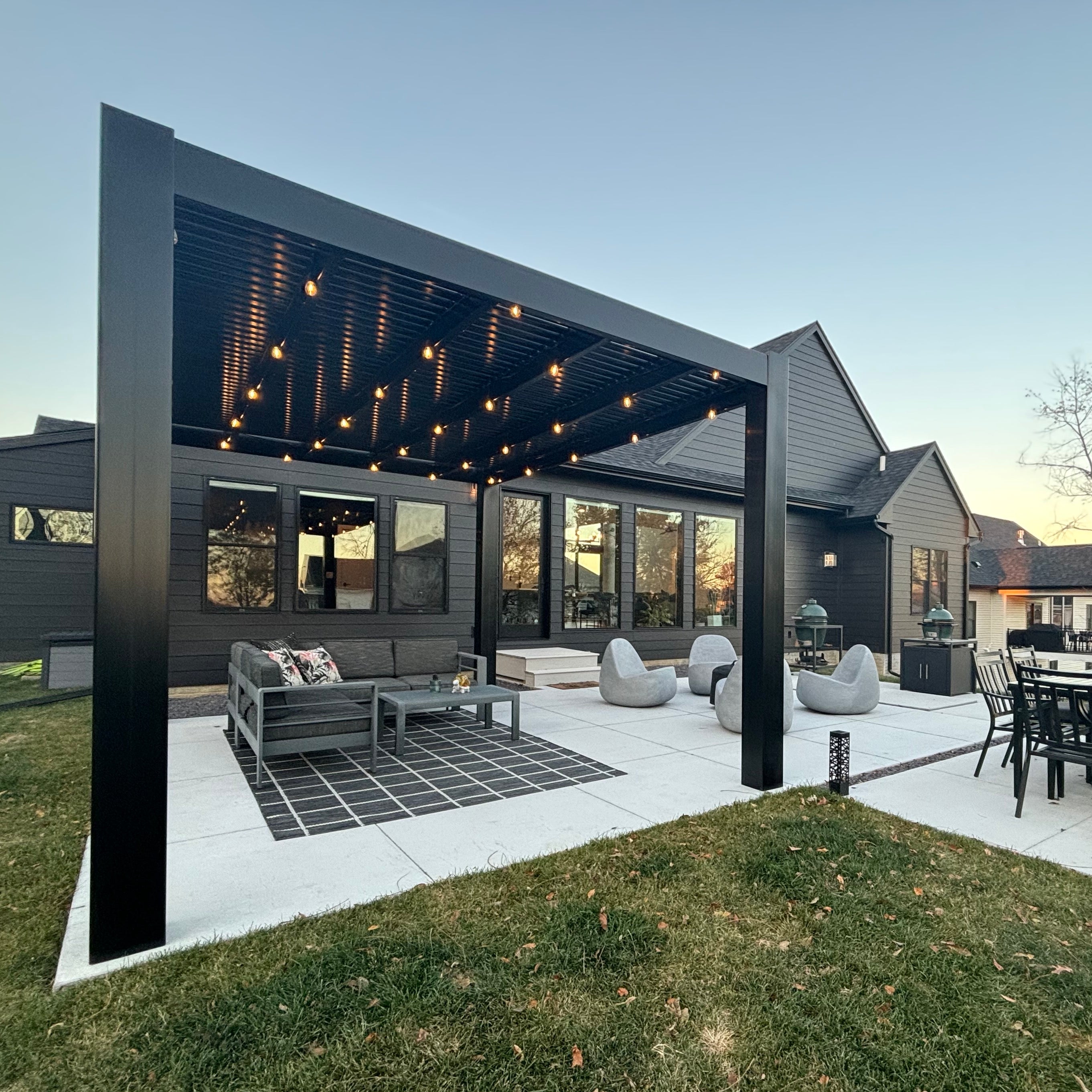 Black works particularly well when the property already includes dark window frames, doors, metal railings, roof details, or exterior light fixtures.
Repeating these accents can make the pergola feel intentional rather than isolated. A black structure against light masonry or siding creates a clear architectural outline that visually defines the outdoor space.
Black can also frame attractive views. Dark beams and posts provide a strong boundary around a seating area while contrasting with bright landscaping, pale hardscape, or the surrounding sky.
A black pergola generally has greater visual weight than an equivalent white or tan design. This difference becomes particularly important when the structure is large or viewed from inside the home.
Overhead beams and slats form a substantial part of the visible design. On a large black pergola, those elements may become as prominent as the posts, particularly against a bright sky.
This effect can be desirable when you want a dramatic architectural feature. However, on a smaller patio or against a dark house, black may create an appearance that feels heavier or more enclosed than intended.
Review the proposed pergola from the windows and doors you use most often. Its appearance from the house may matter just as much as the view from beneath it.
Black surfaces generally absorb more incoming sunlight than comparable white surfaces, making higher surface temperatures a practical consideration in direct sun.
That does not establish a specific temperature difference for Sunset Pergola Kits' black vinyl components. Actual surface temperature depends on sunlight, ambient conditions, airflow, material properties, and surrounding reflected radiation.
If the pergola will receive intense afternoon sun, think about where people might touch exposed posts or other surfaces. Also consider whether a dark overhead structure will create the visual and lighting effect you want.
Black can be an excellent architectural choice, but it should be selected with the property's climate and exposure in mind rather than on appearance alone.
Appearance is the primary reason to choose a pergola color, but everyday ownership considerations can influence which finish makes the most sense. The following comparison summarizes the practical differences among Sunset Pergola Kits' three vinyl color options.
| Consideration | White | Tan | Black |
|---|---|---|---|
| Visual effect | Bright, crisp, visually light | Warm, neutral, understated | Bold, defined, visually substantial |
| Direct sunlight | Generally reflects more sunlight | Intermediate; depends on exact shade | Generally absorbs more sunlight |
| Perceived brightness and glare | Can appear very bright in strong sun | Usually less visually bright than white | Darker appearance with less reflected visible light |
| Light dust and pollen | Often less conspicuous | May blend with earth-colored dust | Often more noticeable |
| Dark organic residue | Often highly visible | Visibility varies with residue | Some dark residue may blend in |
| Hard-water mineral spots | Often less obvious | Moderate visibility, depending on deposits | Light mineral deposits can stand out |
| Bird droppings | Dark staining may stand out | Visibility varies | White deposits may be conspicuous |
| Color pricing | Lowest | Between white and black | Highest |
These are general appearance tendencies, not guarantees. Dirt composition, local conditions, surface exposure, and the exact finish all influence how a pergola looks over time.
Yes, color can influence how much sunlight a surface absorbs and how hot it becomes. All else being comparable, white surfaces generally reflect more sunlight, while black surfaces absorb more.
However, a cooler-colored structure does not automatically produce a proportionately cooler patio. Air temperature, overhead shade coverage, surrounding pavement, reflected heat, and airflow all contribute to comfort.
Sunset Pergola Kits' traditional and modern pergolas use fixed angled roof slats, with selectable shade coverage of 50%, 75%, or 90%. The amount and placement of shade are separate from the color of the vinyl components.
If summer comfort is a primary concern, evaluate both the pergola color and the shade the structure will create. Do not rely on color alone to predict how cool the seating area will feel.
There is no single color that conceals every type of dirt. The most noticeable residue depends on its contrast against the vinyl.
If the pergola sits near sprinklers, consider how often water droplets may dry on the posts. Where irrigation water leaves visible mineral deposits, black may require more frequent attention to maintain a uniformly clean appearance.
Likewise, beneath trees that regularly drop leaves or organic debris, white may reveal certain stains sooner.
Sunset Pergola Kits uses premium extruded vinyl that does not require painting or staining. However, low-maintenance materials still benefit from occasional cleaning. The color primarily changes how quickly you notice certain types of surface residue.
Sun exposure, weather, and environmental deposits should be considered for any permanently installed outdoor structure. Dark and light finishes may reveal changes in appearance differently.
Sunset Pergola Kits' premium vinyl is colored throughout rather than painted, eliminating the need to maintain an exterior paint layer. Its traditional and modern pergolas also carry a lifetime warranty.
Nevertheless, color alone does not establish a precise rate of fading or other material changes. Evaluate current product information and warranty terms rather than assuming every vinyl product performs identically under prolonged exposure.
For Sunset Pergola Kits, the supplied color price order is:
The exact dollar difference should be checked using current pricing for the size, style, and configuration you intend to purchase.
Do not compare a white pergola in one size with a black pergola in another and assume the difference represents the color upgrade. Compare otherwise equivalent configurations for a meaningful assessment.
Color availability should also be confirmed for the specific product. Although white, tan, and black are offered across Sunset Pergola Kits' main pergola categories, individual dimensions, components, and configurations may differ.
The most reliable way to choose a pergola color is to evaluate it in the setting where the structure will actually be installed. A small digital swatch cannot fully communicate how beams, posts, and roof slats will look across a large outdoor space.
If current physical or manufacturer-approved samples are available, view them near the intended installation area in morning light, midday sun, afternoon shade, and evening light.
Colors can look noticeably different as the direction, intensity, and character of natural light change. Warm sunlight may emphasize beige undertones, while shade can alter how white and tan appear against surrounding materials.
When samples are unavailable, use accurate manufacturer-approved product references and compare multiple photographs taken under different lighting conditions. Avoid making a final decision from one heavily edited image or an uncalibrated screen.
Consider the views from your kitchen, living room, primary windows, patio doors, and backyard seating areas.
A color that looks excellent from the yard may have a very different impact when viewed through a large window. For example, a black overhead structure could create a striking outdoor focal point but appear more dominant when seen from the interior.
White may preserve a lighter visual impression, while tan may relate more comfortably to nearby stone or decking.
Think about the structure as a complete architectural element, not merely a set of posts.
Before finalizing, it can also help to review completed installations in the Sunset Pergola Kits photo gallery. Real-world examples provide a better sense of how different vinyl colors interact with entire homes and outdoor spaces.
Once you have selected a color, you can evaluate the remaining design details separately. Post styles, overhangs, and decorative end caps influence the finished appearance, but those decisions should not distract from establishing the right overall color relationship first.
The best vinyl pergola color is the one that supports your home's architecture while meeting your practical priorities. White offers a bright, visually lightweight appearance and the lowest color price; tan connects warm exterior materials with understated elegance; and black creates the strongest contrast and architectural definition.
Choose the role you want the pergola to play, compare reliable color samples in your property's natural light, and verify the current price and availability of your preferred configuration. Then explore Sunset Pergola Kits' vinyl pergolas to find a traditional or modern design that complements your home.
Yes. White is the most affordable vinyl color offered by Sunset Pergola Kits, followed by tan and then black. Exact price differences depend on the selected pergola size and configuration, so compare current prices before ordering.
Black surfaces generally absorb more sunlight than comparable white surfaces and may become hotter to the touch. Actual temperatures depend on material properties, sunlight, airflow, and surrounding conditions. A specific temperature difference for Sunset Pergola Kits' black vinyl should not be assumed without product-specific testing.
Yes, particularly when the gray material has warm undertones or the property includes complementary beige, cream, or natural-wood finishes. Tan may be harder to coordinate with distinctly cool blue-gray materials. Compare actual color samples before deciding.
Tan can conceal some earth-colored dust effectively, while white often makes light-colored dust and pollen less noticeable. Black tends to show pale dust and pollen more prominently. The best choice depends on the color and type of residue common to your property.
Often, yes. Light-colored mineral deposits left by evaporating irrigation water can contrast strongly with black surfaces. They may be less apparent on white or tan vinyl, although visibility depends on water composition, residue buildup, and lighting.
There is no universal rule. Matching exterior trim typically creates a cohesive appearance, coordinating with roofing or window frames can establish deliberate contrast, and relating to stone or decking can unify an outdoor space. Prioritize the architectural elements most visible near the pergola.
Yes. Lighting conditions influence how colors and undertones appear. Compare current manufacturer-approved samples or reliable product references in direct sunlight and shade, preferably at several times of day, before selecting a final color.
Yes. Sunset Pergola Kits offers white, tan, and black across its traditional pergolas and modern pergolas. Both styles are offered in attached and freestanding configurations. Verify availability and current pricing for the specific product and dimensions you want.


