

MADE IN THE USA
with American products
w/ American products


A vinyl pergola for coastal homes can provide permanent outdoor shade without the recurring painting or staining associated with some other outdoor structures. But living near the ocean raises questions that go beyond the visible finish. Salt-laden air, humidity, intense sunlight, exposed hardware, and coastal winds can affect different parts of a pergola in different ways. Here's how to evaluate a coastal vinyl pergola layer by layer—and what to verify before choosing one for your property.
Not every beach house or coastal property experiences the same conditions. A pergola overlooking breaking waves may face substantially more salt deposition and wind exposure than one several miles inland, sheltered by neighboring buildings and vegetation.
Before choosing materials or hardware, identify the conditions your pergola will actually experience.
Salt can reach outdoor structures through direct ocean spray or through fine particles carried inland by the wind. The distinction matters because regular wetting with saltwater can create a more aggressive environment for exposed metal than occasional airborne deposits.
For a home directly facing the ocean, ask whether the proposed pergola location receives spray during ordinary weather or storms. For properties farther inland, examine prevailing winds, nearby surf conditions, and any visible salt accumulation on existing outdoor fixtures.
There is no universal distance from the shoreline at which salt exposure disappears. Coastal geography, wind patterns, and shelter can make two properties at similar distances from the water experience very different conditions.1
In addition to salt, assess the following conditions:
A useful starting point is to describe your site as directly spray-exposed, regularly exposed to airborne salt, or relatively sheltered. This is a practical assessment—not a substitute for a formal corrosion or structural exposure classification.
That description will help manufacturers and installers determine which additional specifications and precautions your project may require.
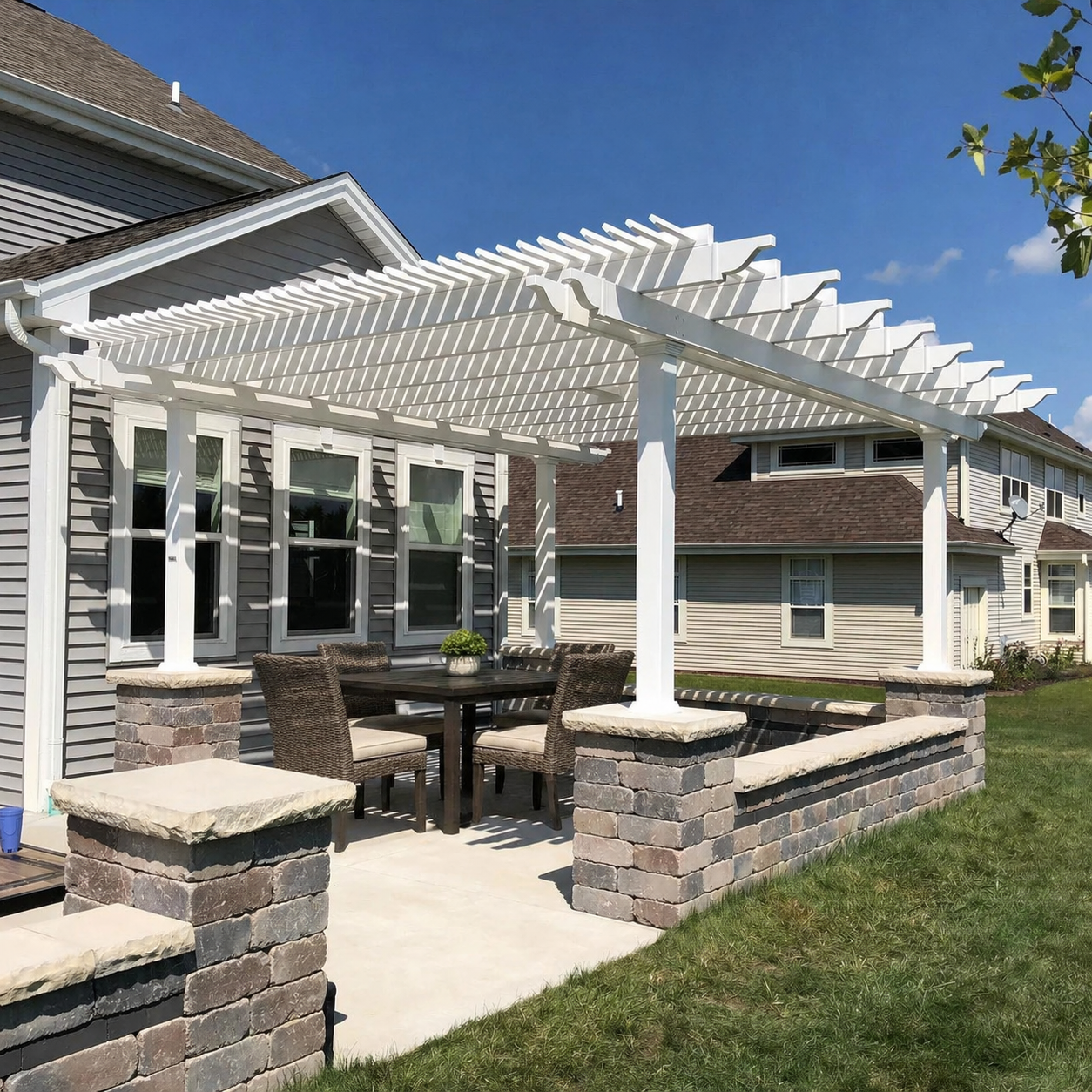 One of the strongest reasons to consider a coastal vinyl pergola is its low-maintenance exterior. Unlike a finish that depends on recurring painting or staining, a premium extruded-vinyl surface eliminates those particular refinishing tasks.
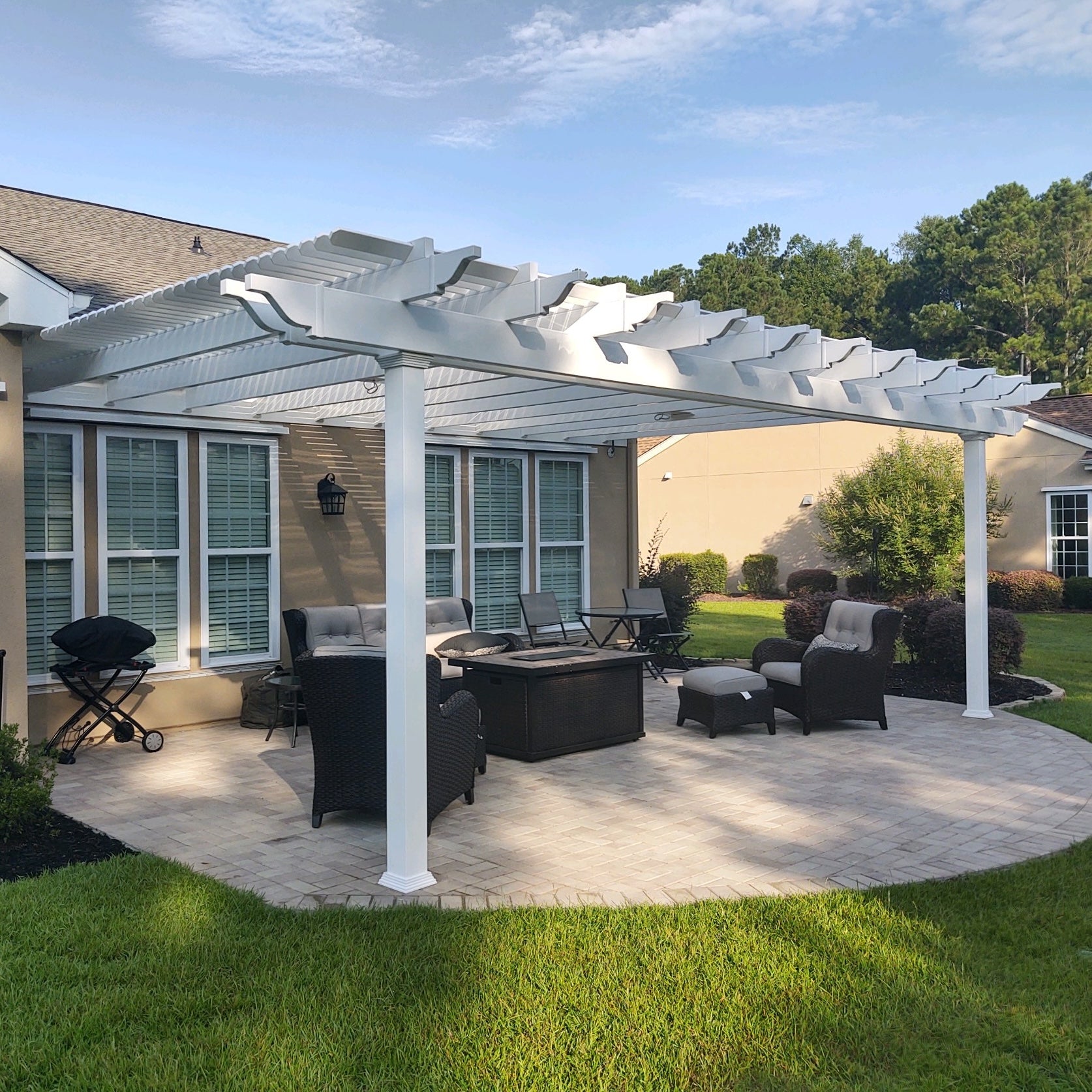
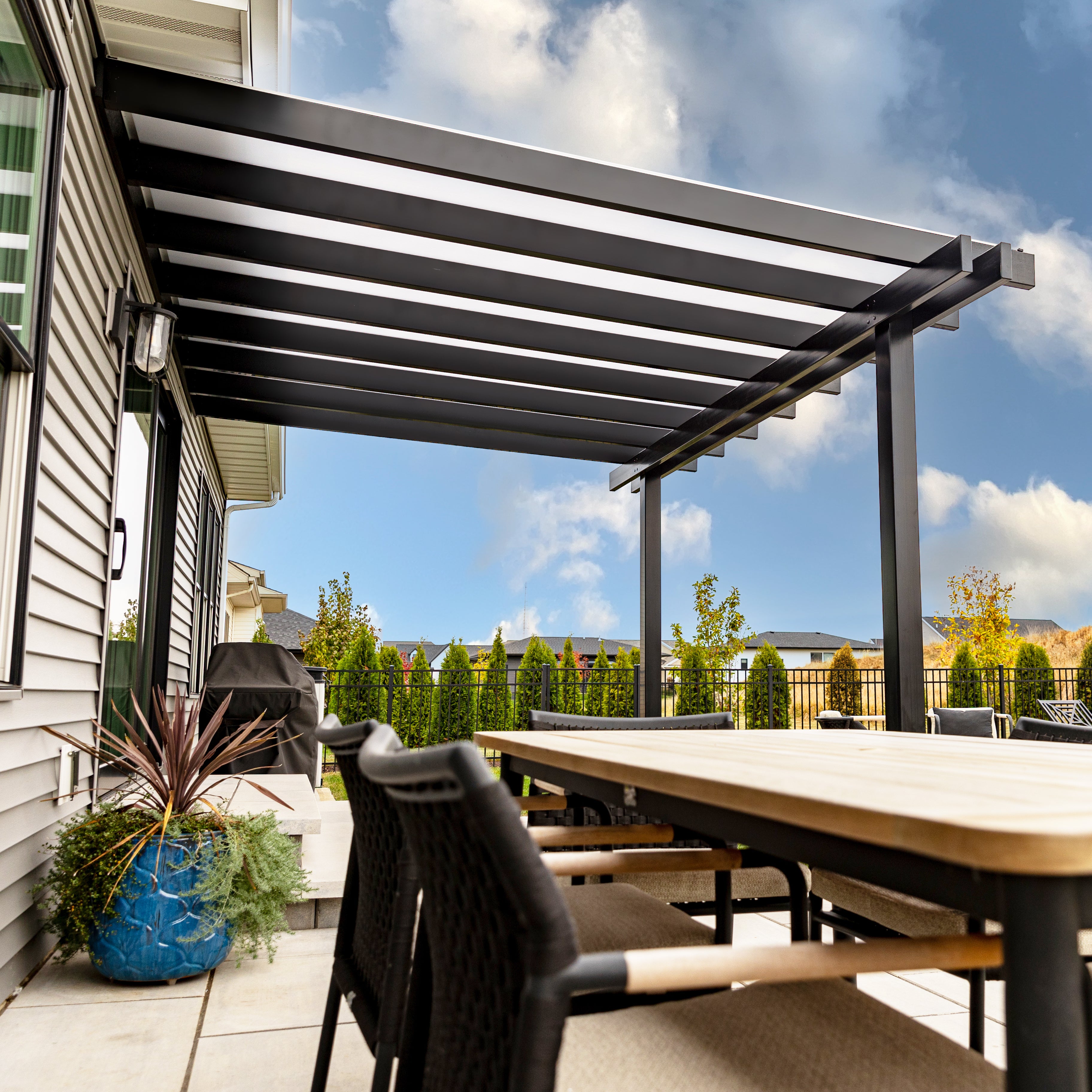
Sunset Pergola Kits uses premium extruded vinyl that is colored throughout the material rather than painted on the outside. Its traditional and modern pergolas also incorporate aluminum reinforcement in the posts, beams, and rafters.
This construction offers two distinct advantages:
For coastal homeowners, that combination can be appealing because the principal visible surfaces do not depend on a paint coating that must periodically be renewed.
Vinyl itself does not rust like exposed steel. However, an exterior vinyl covering does not automatically establish the corrosion resistance of everything behind or connected to it.
Metal inserts, fasteners, structural connectors, mounting brackets, and anchors can have their own exposure and protection requirements. Moisture may also reach certain connection areas depending on the product design and installation.
Consequently, a pergola should not be considered entirely immune to coastal corrosion simply because its exterior is vinyl.
Likewise, colored-through vinyl construction is a meaningful product characteristic, but actual long-term appearance depends on the specific material formulation, manufacturing quality, exposure conditions, and product documentation.
White, tan, and black vinyl pergolas can all be considered for coastal installations, provided the selected product is suitable for the exposure.
Sunset Pergola Kits offers all three colors. Its colored-through vinyl does not rely on a painted outer layer for its color.
However, material formulation and product-specific testing matter when evaluating resistance to fading, discoloration, deformation, or other appearance changes under prolonged sunlight. Do not assume identical surface temperatures or long-term appearance performance across every color without supporting manufacturer information.
For a beach house where appearance is particularly important, request the applicable finish specifications and warranty terms for the exact color being considered.
The concealed and exposed metal components are among the most important items to investigate when selecting a pergola near the ocean.
Even where the visible vinyl remains attractive, corrosion at a structural connection can create a more consequential problem than surface discoloration.
Aluminum offers useful corrosion resistance, but it is not completely immune to corrosion in aggressive marine environments. Salt deposits, retained moisture, crevices, and contact with dissimilar metals can influence its performance.
Sunset Pergola Kits uses aluminum-reinforced structural components, but coastal buyers should request confirmation of the relevant aluminum specifications and any applicable protective treatments or installation requirements.
Useful questions include:
The purpose is not to assume that concealed aluminum will fail. It is to establish that the actual construction is appropriate for the project's exposure.
Fastener selection is particularly important because small metal components can play an essential role in connecting the larger structural members.
For demanding coastal environments, corrosion-resistant stainless steel fasteners or other appropriately protected hardware may be specified. However, stainless steel is not a single material with identical corrosion resistance across all grades.
For example, Type 316 stainless steel is commonly considered for marine applications, but especially severe salt exposure can require additional evaluation.2
That does not mean every pergola should automatically receive a particular stainless steel fastener. Hardware must also be structurally suitable and compatible with the materials it contacts.
When dissimilar metals are in contact and moisture is present, galvanic corrosion can become a concern. Appropriate isolation, compatible materials, protective treatments, and moisture-control details may be necessary.3
Ask the manufacturer or project engineer to confirm:
Avoid substituting hardware based solely on a general claim that it is marine-grade. The replacement must also preserve the connection's intended structural performance.
The anchoring system deserves the same scrutiny as the pergola frame.
For a freestanding structure, examine post bases, anchoring hardware, the supporting foundation, and any locations where water or debris might collect.
For an attached pergola, the connection to the house introduces additional requirements involving attachment hardware, the supporting structure, and moisture management.
These details matter in any climate, but salt exposure makes corrosion protection and inspectability especially important.
Request installation documentation identifying the approved anchors, supporting surfaces, connection details, and any coastal-specific requirements. Have the installer or appropriate design professional confirm that the proposed system is suitable for the actual location.
Homeowners comparing placement options can also review freestanding pergola configurations while keeping in mind that each design requires site-appropriate anchoring.
Salt resistance and wind resistance are different engineering questions. A pergola with a suitable low-maintenance exterior still needs a structural design and anchoring system appropriate for its site's wind conditions.
Oceanfront properties can be particularly exposed to strong winds, but not every coastal location has identical wind requirements. Local building requirements, terrain, elevation, surrounding obstructions, and storm exposure all matter.
A coastal pergola's structural performance depends on more than the strength of its posts and beams.
The complete load path—from roof components through structural connections, posts, anchors, and the supporting foundation—must be appropriate for the design conditions.
Wind-borne debris is another potential coastal storm hazard. No ordinary wind-resistance claim should be interpreted as a guarantee against debris impacts or every possible storm condition.
Before installation, verify the applicable design requirements with the manufacturer, installer, and local building authority. Request supporting engineering documentation for the exact configuration and installation conditions.
Sunset Pergola Kits offers optional hurricane brackets for its traditional pergolas and fully covered rainproof patio covers.
These brackets are recommended for customers whose areas experience winds of 80 MPH or greater. Adding the option also provides a lifetime wind damage warranty, subject to the applicable warranty documentation.
There is an important product distinction:
The 80+ MPH recommendation is a product-selection guideline, not a substitute for determining local code-required wind loads or verifying a structure's engineering.
For coastal homeowners considering modern designs, confirm the available structural documentation rather than assuming that the absence of an optional bracket package establishes either suitability or unsuitability.
Likewise, adding hurricane brackets should not be interpreted as unlimited hurricane resistance. Request the complete wind specifications, approved installation requirements, and wind-damage warranty conditions before purchasing.
A low-maintenance coastal pergola should substantially reduce routine refinishing work, but it should still have a realistic cleaning and inspection plan.
The objective is to prevent salt, dirt, and organic residue from accumulating unnecessarily, while identifying early signs of deterioration at exposed components.
Airborne salt can settle on pergola surfaces even when the structure never receives direct ocean spray.
Gentle freshwater rinsing, where permitted by the manufacturer's care instructions, can help remove deposited salt before it accumulates. More stubborn dirt may require a compatible mild cleaning product and a soft cloth or brush.
Before cleaning, verify the manufacturer's instructions for:
Do not assume that a cleaner suitable for the vinyl finish is automatically compatible with exposed metal hardware or polycarbonate roofing.
There is no single appropriate cleaning interval for every coastal property.
A pergola receiving frequent ocean spray may require substantially more attention than one in a sheltered inland coastal neighborhood. Exposure to salt-laden winds, rainfall, airborne debris, and humidity can change cleaning needs throughout the year.
Use the manufacturer's maintenance guidance as the starting point, then adjust based on observed residue and site conditions.
Practical indicators that cleaning may be needed include:
Rain can remove some exposed surface deposits, but covered connections and sheltered areas may not receive the same rinsing.
In addition to cleaning, inspect accessible areas for signs of trapped moisture, unusual discoloration, loose components, coating damage, or visible corrosion.
Pay particular attention to exposed fasteners, post bases, mounting brackets, and areas where debris can retain water.
For rainproof patio covers, also observe the roof panels and their connections. Sunset Pergola Kits patio covers use solid polycarbonate roofing, available in white or bronze, and should be maintained according to the roof-specific care instructions.
If an inspection reveals deterioration at a structural connection, have the appropriate professional evaluate it rather than simply covering the affected area or substituting hardware.
For homeowners who want shade and rain protection, rainproof patio covers offer a solid-roof alternative to slatted pergolas. Coastal suitability still depends on appropriate structural engineering, roof details, installation, and maintenance.
When comparing pergolas for a beach house or other coastal property, the most useful question is not simply whether the exterior is vinyl. It is whether the entire structure, including its connections and maintenance requirements, is documented for the intended environment.
Use this checklist when reviewing a product with the manufacturer or installer.
| What to Verify | Questions to Ask |
|---|---|
| Site exposure | Will the structure receive direct salt spray, airborne salt, persistent moisture, or unusually exposed winds? |
| Vinyl exterior | What are the vinyl specifications, color construction, cleaning instructions, and applicable finish warranty conditions? |
| Aluminum reinforcement | What structural aluminum specifications apply, and are any additional coastal precautions recommended? |
| Fasteners and brackets | What metals, grades, protective finishes, and compatibility provisions are specified for salt exposure? |
| Connections and anchors | Are the connections, supporting surfaces, anchors, and moisture-management details appropriate for the installation? |
| Wind requirements | What local design criteria apply, and what documentation supports the selected pergola configuration and installation? |
| Hurricane brackets | Is the selected product eligible, are the brackets recommended for this site, and what installation and warranty conditions apply? |
| Cleaning and inspections | Which cleaning products are approved, what inspection guidance applies, and which connection areas remain accessible? |
| Warranty documentation | Are there salt-air, coastal, corrosion, wind, maintenance, or installation exclusions? Which components have different coverage? |
| Installer responsibilities | Who verifies permits, structural requirements, anchoring, approved hardware, and any coastal-specific installation details? |
Sunset Pergola Kits offers lifetime warranties on its traditional and modern pergolas. Its rainproof patio covers have a lifetime frame warranty and a 10-year roof warranty.
Those stated warranty durations are useful starting points, but they do not establish the precise coverage of corrosion, salt exposure, hardware, wind damage, or installation-related issues.
Before purchasing, obtain the current written warranty and verify its component coverage, exclusions, maintenance obligations, claim requirements, and any coastal limitations.
If hurricane brackets are being considered, request the specific lifetime wind damage warranty terms as well.
Do not treat missing documentation as proof that a product is unsuitable—or as proof that a particular coastal requirement has been satisfied.
Instead, identify the outstanding questions and request written answers from the manufacturer, installer, or qualified design professional.
For an especially exposed oceanfront property, unresolved specifications involving fastener corrosion resistance, anchoring, or structural design should be addressed before approving the installation.
Vinyl pergolas can be a very good choice for coastal homes, particularly for homeowners who want permanent shade without ongoing painting or staining. Premium extruded vinyl addresses an important surface-maintenance concern, while aluminum-reinforced construction provides structural support.
However, the best coastal pergola is one whose concealed metal, fasteners, anchors, wind design, and maintenance requirements are also appropriate for the property. Salt exposure and installation conditions deserve as much attention as the visible finish.
With your coastal exposure checklist in hand, you can explore vinyl pergolas from Sunset Pergola Kits and narrow your options based on appearance, shade preferences, configuration, and the technical details that matter for your location.
Salt air does not cause vinyl to rust like steel, making premium extruded vinyl an attractive low-maintenance exterior for coastal pergolas. However, salt residue can accumulate on the surface, and the pergola's metal components still require separate corrosion-resistance evaluation. Follow the manufacturer's cleaning recommendations.
Yes. Although aluminum is naturally corrosion-resistant, aggressive salt exposure, retained moisture, and contact with incompatible metals can contribute to corrosion. Ask the manufacturer to confirm the aluminum specifications, connection details, and any recommended precautions for coastal installations.
Coastal pergolas should use structurally appropriate, corrosion-resistant fasteners selected for the site's exposure and the materials being connected. Type 316 stainless steel is commonly considered for marine environments, but suitability and metal compatibility must be verified. Do not substitute hardware without manufacturer or engineering approval.
There is no universal distance that defines direct salt exposure for every property. Breaking waves, prevailing winds, topography, and nearby shelter influence how much salt reaches a structure. Direct ocean spray is especially important, but airborne salt can also affect properties farther inland.
Cleaning frequency depends on direct spray, airborne salt, rainfall, humidity, and visible residue. A highly exposed oceanfront pergola may need more frequent rinsing than one farther inland. Follow the manufacturer's approved cleaning instructions and adjust maintenance based on actual conditions rather than assuming a universal schedule.
Black and tan vinyl pergolas can be considered for sunny coastal properties, provided their specific materials and finishes are suitable for the exposure. Sunset Pergola Kits offers both colors in premium colored-through extruded vinyl. Request product-specific appearance and warranty documentation rather than assuming every color performs identically.
No. Hurricane-bracket needs depend on the product configuration and applicable wind requirements. Sunset Pergola Kits recommends optional hurricane brackets for traditional pergolas and rainproof patio covers in areas experiencing winds of 80+ MPH. Modern pergolas do not offer these brackets. Site-specific engineering must still be verified.
More frequent inspections may be appropriate where salt spray, high humidity, or persistent dampness increases corrosion risk. Check accessible brackets, anchors, fasteners, and drainage areas for deterioration or trapped debris. Follow the manufacturer's inspection guidance and have potentially compromised structural connections evaluated by a qualified professional.


