

MADE IN THE USA
with American products
w/ American products


Polycarbonate patio cover hail resistance is an important consideration when choosing a permanent outdoor roof in an area that experiences hailstorms. Polycarbonate is known for its toughness, but whether a particular patio cover can withstand hail depends on the roof panels, how they are installed, and the impacts they encounter. This guide explains what evidence to request, how to interpret impact claims, and how to determine whether a covered patio system is appropriate for your property.
The strongest evidence is documented impact testing applicable to the actual roof panels and their intended installation. A general statement that polycarbonate is impact-resistant provides useful background, but it does not establish how a particular patio cover will perform during a hailstorm.
Before relying on a hail-resistance claim, identify the exact roofing material and ask what testing supports that claim.
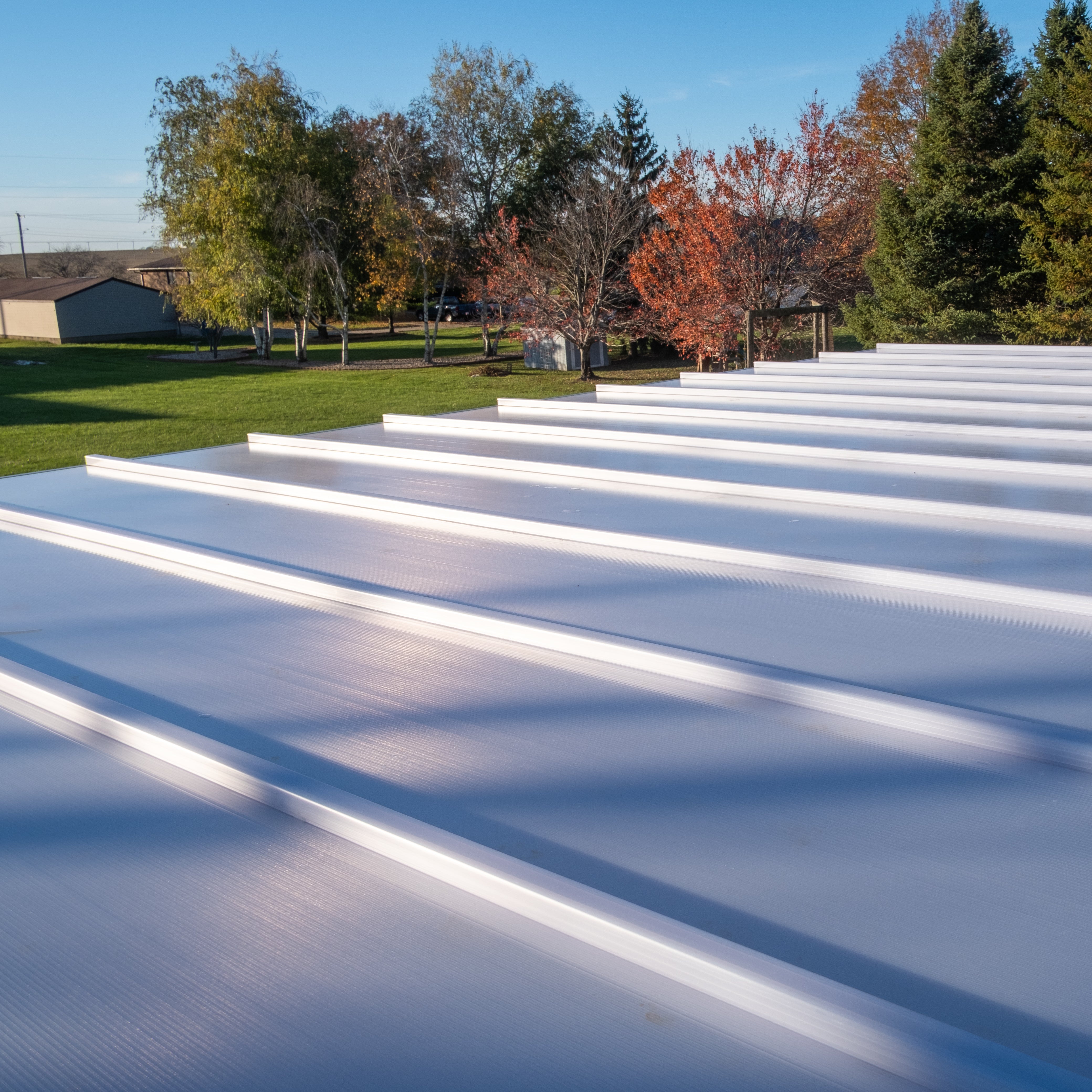 Polycarbonate roofing comes in different configurations, and those differences matter when evaluating impact resistance.
Start by requesting the panel manufacturer's name, product designation, construction, and nominal thickness. These details allow you to determine whether a published test or technical specification applies to the panels being supplied.
For example, an impact test for a particular multiwall polycarbonate sheet should not automatically be applied to a different solid, corrugated, or multiwall panel. Even products made from the same base material may have different construction and performance characteristics.
Sunset Pergola Kits offers rainproof patio covers with solid polycarbonate roofing in white or bronze. However, the available product information does not specify a panel-level hail-impact rating, applicable hail-test certification, or maximum hailstone size. Those details must be confirmed rather than assumed.
A useful impact-test report should identify both the product tested and the conditions under which it was evaluated.
Request documentation addressing:
A laboratory result showing that a panel resisted a particular impact is meaningful evidence. It is not proof that the same panel will survive every real-world hailstorm without damage.
Also distinguish a manufacturer's published test data from a third-party certification. Either may provide useful information, but they are not interchangeable, and a certification should not be claimed unless it has actually been documented.
Polycarbonate is valued for its impact resistance. Manufacturer technical guidance describes polycarbonate roofing products as resistant to impact damage and discusses testing methods used to characterize their performance.1
That supports considering polycarbonate for applications where impact resistance matters. It does not establish a universal hail rating across all polycarbonate products.
If no test results are available for the specified roofing system, the appropriate conclusion is that its hail performance has not been verified—not that the roof is either guaranteed to withstand hail or certain to fail.
A patio roof's response to an impact is influenced by more than the material used to manufacture its panels. Panel geometry, thickness, support conditions, and fastening details can affect how impact forces are distributed through the installed system.
Polycarbonate roofing panels may use different structural configurations, including solid, multiwall, and corrugated designs. Their geometry influences stiffness and how a panel responds when struck.
Thickness is another important specification, but thickness alone does not determine hail resistance.
A thicker panel within one product family may behave differently from a thinner version, but it is not valid to assume that any thicker panel will outperform every thinner panel of another construction.
Compare documented results for the actual panel products rather than relying on thickness as a substitute for testing.
How a roof panel is supported can influence its movement and deformation during an impact.
Support spacing, panel edge engagement, fastening arrangements, and the manufacturer's installation requirements therefore matter when interpreting performance data.
Polycarbonate installation guides provide product-specific support and fastening instructions, illustrating why installation requirements cannot simply be transferred between unrelated roofing systems.2
For a permanent patio cover, ask whether the documented impact performance applies to the support arrangement and fastening configuration specified for your particular kit.
Do not assume that reducing support spacing or adding fasteners will automatically improve hail resistance. Changes to a manufacturer's prescribed installation can create other problems and may affect warranty eligibility.
There is an important difference between testing an isolated panel and testing an installed roof assembly.
A panel-level impact result establishes performance under the conditions of that particular test. It does not necessarily demonstrate the behavior of panel joints, edges, fasteners, or the complete roof system.
If a seller describes a roof as hail-rated, request clarification about whether the rating applies to:
For homeowners considering a permanent installation, evidence covering the intended roof configuration is more directly relevant than a generic material specification.
Even a well-documented impact test represents defined conditions. Actual storms introduce variables that may affect whether a roof experiences cosmetic damage, structural panel damage, or no visible damage at all.
Not every hailstorm produces the same impact conditions.
The characteristics that matter include hailstone size, shape, density, impact velocity, and the angle at which hail strikes the roof. Repeated impacts may also create conditions different from a test involving a limited number of strikes.
For example, a panel that withstands a documented impact under one set of laboratory conditions should not automatically be considered suitable for substantially more severe impacts.
A hail-resistance claim is most useful when the actual test conditions are disclosed, allowing you to evaluate their relevance to your property's exposure.
There is no verified maximum hailstone size available in the supplied Sunset Pergola Kits specifications. Accordingly, no hail-size survival limit should be attributed to its patio covers without additional documentation.
Impact performance can also depend on the condition of the material at the time of the event.
For an outdoor roof, relevant questions include whether testing considered different temperatures and whether performance data addresses panels after outdoor exposure.
An impact result obtained from a new panel under controlled conditions does not necessarily establish identical performance for an older installed panel.
This distinction is especially important when homeowners expect a permanent patio cover to remain in service for many years.
If hail resistance is a deciding factor, ask the manufacturer whether its performance documentation includes temperature-conditioned or weathered-panel testing. Do not infer those results merely from the existence of a general product warranty.
Hail and falling debris are different impact hazards.
A branch, for instance, may strike a roof with a different shape, contact area, mass, and distribution of force than a hailstone. A test intended to assess hail resistance therefore does not necessarily establish resistance to falling branches.
Similarly, a general impact-resistance statement should not be interpreted as proof that a roof can withstand every object that might strike it.
Homeowners with overhanging trees or other potential impact hazards should consider those exposures separately when discussing the suitability of a proposed patio cover.
After a hailstorm, visible damage can provide useful information about the roof's condition. However, a ground-level visual assessment cannot establish that every panel, connection, or concealed area is undamaged.
 From a safe position on the ground or patio, look for changes in the roof's appearance and condition.
Possible warning signs include:
Some marks may be cosmetic, while others may indicate damage affecting the panel's ability to perform as intended. Visual appearance alone may not distinguish between them.
A panel can potentially have localized cracking, edge damage, or connection problems without an obvious hole visible from underneath.
Some roof components may also be difficult or impossible to examine adequately from ground level.
If an impact was severe, the roof appears abnormal, or there is uncertainty about panel or connection integrity, arrange an assessment by a qualified professional familiar with the roofing system.
Do not climb onto or walk across polycarbonate roof panels to inspect hail damage. Follow the manufacturer's safety and inspection guidance, and keep clear of visibly damaged or unstable areas.
Photographs taken from a safe location can help establish the roof's visible condition after a storm.
Record the approximate date of the event, areas of concern, and any noticeable changes such as leaking or displaced roofing components.
Keep the original installation documents, product information, and applicable warranty paperwork available for a professional inspection or potential claim.
Whether a damaged panel can remain in service, requires professional repair, or needs replacement depends on the specific damage and the roofing manufacturer's instructions. Do not assume a panel is serviceable simply because it has not been punctured.
A warranty's duration does not establish that hail damage is covered. The applicable written terms determine what protection is provided, which events are excluded, and what conditions must be met for a claim.
Sunset Pergola Kits provides a lifetime warranty on the frame of its rainproof patio covers and a 10-year warranty on the polycarbonate roof.
Those durations are important product information, but they do not, by themselves, establish coverage for hail-related cracking, punctures, cosmetic damage, or panel replacement.
The supplied product information does not specify whether hail damage is included in the roof warranty. Homeowners should request the current written warranty terms and obtain clarification before treating hail coverage as a purchasing benefit.
Review the applicable roof warranty for the following:
Confirm these details from the written warranty rather than relying on an advertised duration or a general description of durability.
Sunset Pergola Kits offers optional hurricane brackets for its rainproof patio covers, with an associated lifetime wind-damage warranty.
That optional wind-related protection does not establish hail coverage or demonstrate any particular roof-panel hail-impact rating.
Wind resistance and hail impact resistance are different performance considerations. Coverage or testing addressing one should not be assumed to establish protection against the other.
A practical buying decision depends on whether the available evidence addresses the specific roof you intend to install and the exposure you are concerned about.
The following checklist helps distinguish a supported decision from one that still requires documentation.
| What to Verify | Why It Matters | What to Request |
|---|---|---|
| Exact roof panel | Identifies the product to which performance claims must apply. | Manufacturer, model, construction, and thickness. |
| Impact testing | Establishes documented performance under defined conditions. | Test report, impact conditions, and performance criteria. |
| Installed assembly | Clarifies whether tested support and fastening conditions match the proposed roof. | Approved installation details and test applicability. |
| Property exposure | Helps determine whether documented testing addresses the impacts of concern. | Relevant local hail information and manufacturer guidance. |
| Panel condition | Clarifies whether testing applies only to new panels or includes other conditions. | Available temperature and weathered-panel performance data. |
| Roof warranty | Determines contractual coverage independently of impact performance. | Current written terms, hail exclusions, and claim requirements. |
A homeowner can make a more informed decision when the roof-panel identity is confirmed, relevant testing is documented, the proposed installation matches the conditions supported by that documentation, and any remaining limitations are understood.
That does not mean the roof is guaranteed to survive every hailstorm. It means the buying decision rests on identifiable evidence rather than a broad claim about polycarbonate toughness.
If the available documentation does not address the property's expected impact exposure, the evidence is insufficient to establish suitability for that concern.
If the manufacturer cannot identify the panel, provide applicable impact data, or explain how testing relates to the intended installation, those are meaningful unanswered questions.
Homeowners in locations where hail resistance is a major purchasing requirement should not treat missing documentation as proof of adequate performance.
In that situation, request additional technical information or compare another roofing system with documented impact performance relevant to the property.
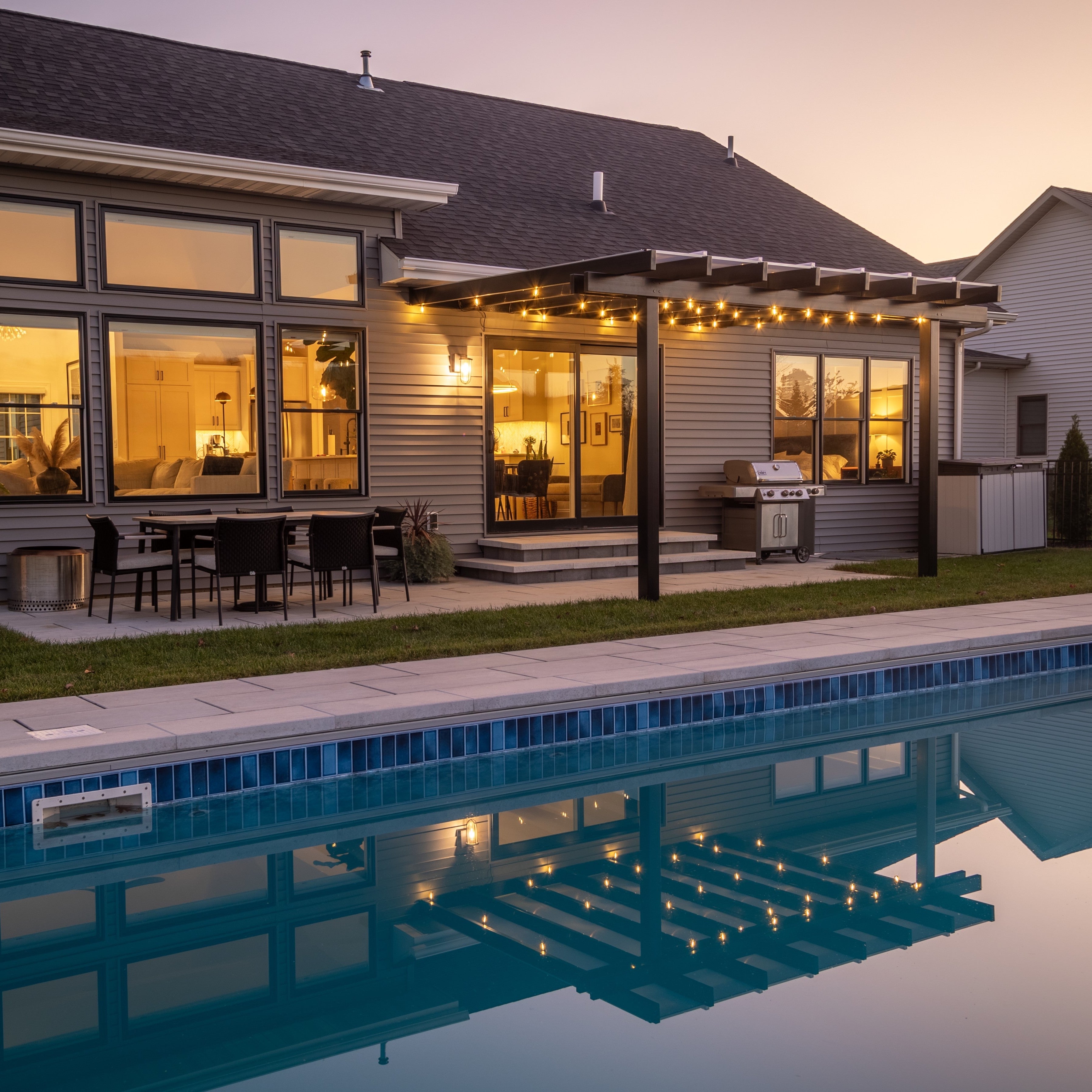
Sunset Pergola Kits offers rainproof patio covers in both freestanding and attached configurations. Its systems combine aluminum-reinforced structural components, an extruded-vinyl exterior, and solid polycarbonate roofing. Buyers can explore the configurations while confirming the specific roof-panel performance evidence applicable to their intended installation.
For example, homeowners planning a separate poolside or garden structure can review the freestanding patio cover, while those seeking coverage directly outside their home can examine the attached patio cover. The decision about configuration is separate from verification of hail resistance.
For an upscale patio or poolside living area, the goal is to select a permanent roof that meets both the property's design needs and its documented performance requirements.
Keep any unresolved hail-related questions in writing before finalizing a purchase. A visually appealing roof and a long warranty period are worthwhile considerations, but neither replaces applicable impact-performance evidence.
Polycarbonate patio covers can offer useful impact resistance, but their ability to withstand hail must be evaluated using evidence for the specific roofing panels and installed assembly. Panel construction, testing conditions, local exposure, and existing panel condition all influence how confidently a hail-resistance claim can be applied.
Before purchasing, confirm the applicable impact documentation and the roof warranty's hail-related terms. Once those questions are answered—or clearly identified as outstanding—you can explore Sunset Pergola Kits' rainproof patio covers and compare configurations without mistaking general durability claims for a hailproof guarantee.
No. Impact resistance describes a material's or product's ability to withstand impacts under particular conditions. It does not guarantee survival of every hailstorm. A meaningful hail-resistance claim should identify the tested roofing panel, impact conditions, and applicable installation configuration.
Not automatically. Different panels may have different construction, thickness, and performance characteristics. Test results should only be applied to another panel when the manufacturer provides documentation establishing that the results are applicable.
No. Support spacing, fastening, and panel edge conditions can affect impact performance. A test conducted using one support configuration does not necessarily establish equivalent results for every installation arrangement.
Yes. Cracking, damage near panel edges, or problems with connections may not be obvious from underneath. If the roof has experienced significant impacts or its condition is uncertain, arrange an inspection by a qualified professional without walking on the roofing panels.
No. Falling branches can differ from hail in weight, shape, impact energy, and contact area. A hail-impact test does not automatically establish resistance to falling branches or other debris.
Sunset Pergola Kits provides a 10-year warranty on the polycarbonate roof of its rainproof patio covers. However, the supplied warranty summary does not establish whether hail damage is covered. Confirm the current written warranty terms, exclusions, and claim requirements before purchasing.
No. Sunset Pergola Kits offers optional hurricane brackets with an associated lifetime wind-damage warranty on its rainproof patio covers. Wind-damage coverage does not establish hail-damage coverage or prove any particular hail-impact performance.


