

MADE IN THE USA
with American products
w/ American products


Home ▸ Square Pergolas
Square pergolas create balanced outdoor rooms for dining, conversation, and comfortable shade. These permanent pergola kits combine rust-proof aluminum reinforcement with a maintenance-free extruded vinyl exterior and are available in traditional, modern, attached, freestanding, slatted-roof, and rainproof configurations. Choose the square dimensions, roof coverage, color, post style, and structural options that fit your patio and how you plan to use it. [read more]


A square pergola has equal nominal width and depth dimensions, creating a balanced footprint rather than an elongated outdoor structure. Common examples include 10x10, 12x12, 14x14, and 16x16 pergolas. The proportional shape works especially well over square patios and centered furniture arrangements.
The defining characteristic of a square pergola is an equal-width layout, such as 12 feet by 12 feet. This creates a symmetrical overhead structure with similar usable dimensions in both directions.
Nominal pergola dimensions and actual post locations are not always identical. Traditional designs can include beam and rafter overhangs, and their posts may be placed in the corners or inset. Account for both the overall roof dimensions and the area between the posts when planning the installation.
These square pergola kits are professional-grade structures intended for permanent installation. They are not lightweight pop-up shelters or decorative structures designed to be moved seasonally.
Aluminum inserts reinforce the weight-bearing posts, beams, and rafters, while premium extruded vinyl forms the finished exterior. The combination provides structural strength without the recurring painting, staining, or sanding associated with wood.
A pergola kit provides coordinated structural components in the selected dimensions, style, and configuration. It can be assembled by an experienced homeowner or installed by a qualified contractor, depending on the site and the buyer’s construction experience.
Available choices include traditional and modern designs, freestanding and attached configurations, and either slatted shade or a solid rainproof roof. Buyers can begin with standard square dimensions or select compatible custom dimensions within the limits of the chosen product line.
Square layouts are particularly suitable for centered dining tables, conversation groups, lounge seating, hot tubs, and balanced poolside arrangements. Their equal sides make it easier to orient furniture in either direction without the space feeling strongly linear.
A square pergola can define one complete outdoor room or provide a central shaded gathering area within a larger patio. The best size depends on the furniture footprint, circulation space, and desired roof coverage.
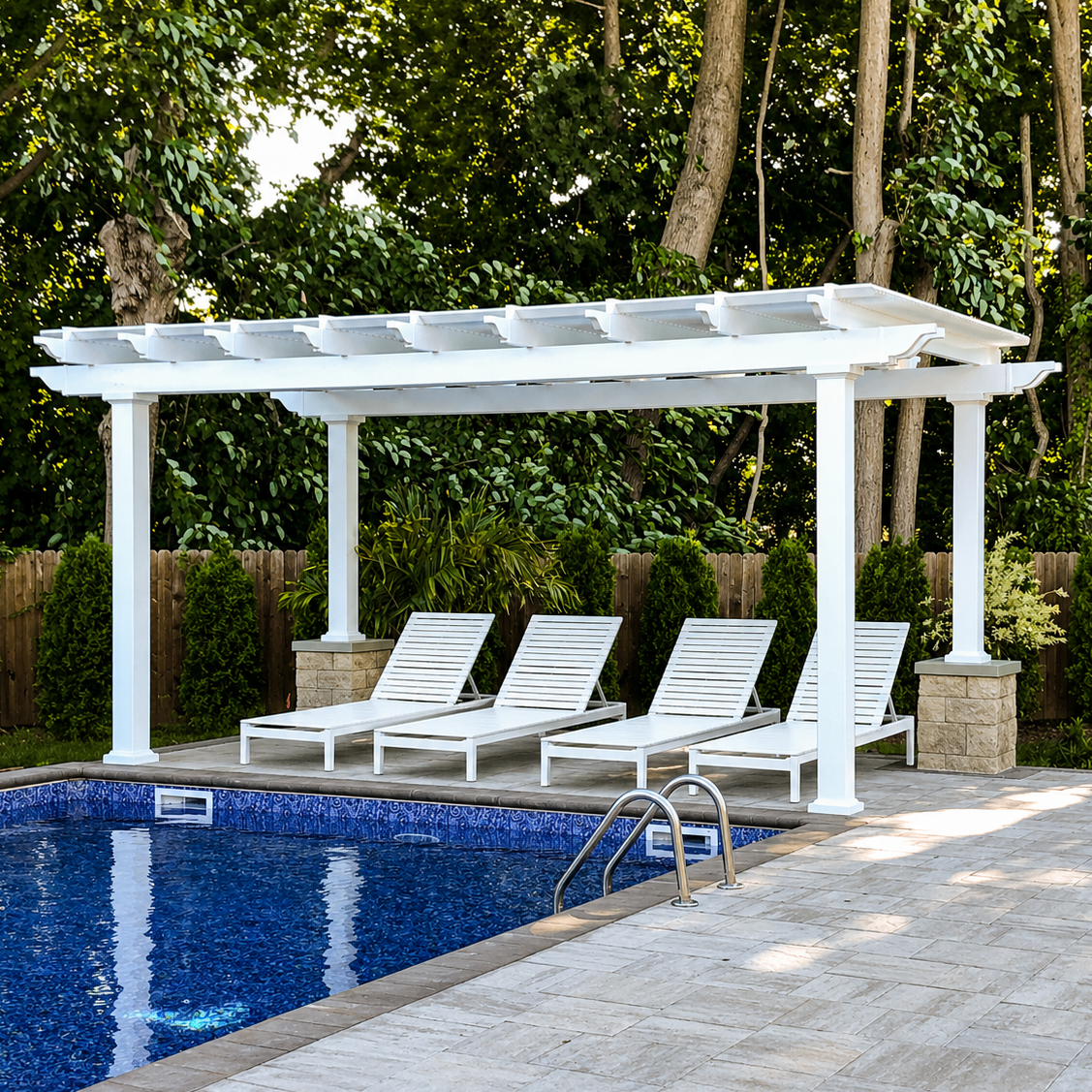
Square pergolas solve a specific design problem: creating balanced coverage over an outdoor space that does not need a long, narrow structure. Their proportions support centered layouts, even visual weight, and flexible furniture orientation.
Equal width and depth help distribute shade across a balanced footprint. With a slatted roof, the selected purlin spacing determines the approximate shade coverage: 50% with slats spaced 6 inches on center, 75% at 4 inches on center, or 90% at 3 inches on center.
The angled slats provide meaningful shade while maintaining an open-air character. Because this is a fixed roof system, there are no motors or moving louvers that require adjustment or eventual mechanical replacement.
A square footprint works naturally with round or square dining tables and centered conversation arrangements. Seating can face inward from multiple sides while maintaining relatively even clearance around the group.
This shape is also useful when furniture arrangements may change over time. A dining layout can often be replaced with a lounge or conversation arrangement without fighting a strongly directional footprint.
Matching a square pergola to a square or nearly square patio can create more consistent roof coverage and margins. It also helps the pergola appear intentionally proportioned to the hardscape rather than undersized in one direction or oversized in another.
The pergola does not have to cover every inch of the patio. Leaving an uncovered perimeter can preserve circulation, grilling space, planting areas, or access to steps and walkways.
A square structure creates clear symmetry, but it is not limited to one architectural style. Traditional pergolas add optional overhangs, decorative end caps, and a wider range of post treatments, while modern designs use flush corners and posts positioned at the corners.
White, tan, and black vinyl color options make it possible to coordinate the structure with exterior trim, siding, masonry, windows, or other architectural details.
A square freestanding pergola can be positioned over a detached patio, poolside seating area, garden terrace, or another open location. An attached version can extend outdoor living space directly from the home while using fewer exterior posts.
Choosing between freestanding pergolas and attached pergolas should be based on the site, desired placement, and whether a suitable structure is available for attachment.
The right size should cover the intended activity area without crowding furniture, doors, walkways, property setbacks, or surrounding landscape features. Begin with the usable space beneath the structure rather than choosing dimensions solely by the total patio size.
Measure the available width and depth at several points, especially when working near an existing house, wall, deck railing, pool, or landscape border. Confirm that the chosen square dimensions fit the site while leaving any required clearances.
Also identify slopes, drainage routes, utility locations, rooflines, windows, doors, and mounting surfaces that could affect placement. Local building requirements may influence anchoring, setbacks, attachment details, or permit needs.
Compact square pergolas are generally best for a small conversation group, bistro table, or limited patio. Mid-size structures can accommodate a full dining table or centered lounge arrangement, while larger square pergolas provide more room for entertaining and circulation.
List the furniture and activities that must fit beneath the pergola before selecting dimensions. A layout intended only for seating needs less room than one that must also accommodate serving furniture, a grill zone, or wide circulation paths.
Measure furniture in its in-use position rather than when chairs are pushed under a table. Dining chairs require space to pull out, and lounge furniture needs room for people to enter and move around the arrangement.
Post locations also matter. A pergola can fit the patio overall while placing a post in an inconvenient circulation path, so evaluate the usable area between posts as well as the outside dimensions.
Traditional square pergolas can have beam and rafter overhangs from 0 to 36 inches, with posts placed at the corners or inset by as much as 36 inches. A pergola’s roof may therefore be larger than the footprint created by its posts.
Modern pergolas have no beam or rafter overhangs, and their posts remain at the corners. Fully covered patio covers can have overhangs from 0 to 24 inches and post insets of up to 24 inches.
Check clearance beneath eaves, gutters, roof projections, tree branches, electrical lines, and other overhead features. For attached installations, the available mounting height and the condition of the supporting structure must also be evaluated.
Height affects both physical clearance and visual proportion. The finished structure should feel appropriate for the home and patio rather than overwhelming a compact space or appearing too low over large furniture.
Traditional square freestanding pergolas range from smaller four-post structures to large nine-post configurations up to 44x44 feet. Modern square freestanding pergolas are available in compatible configurations up to 32x32 feet, while square freestanding rainproof patio covers are available up to 20x20 feet.
Use the pergola size guide to compare available dimensions, then verify that the chosen style, roof, configuration, and post count support the required square footprint.
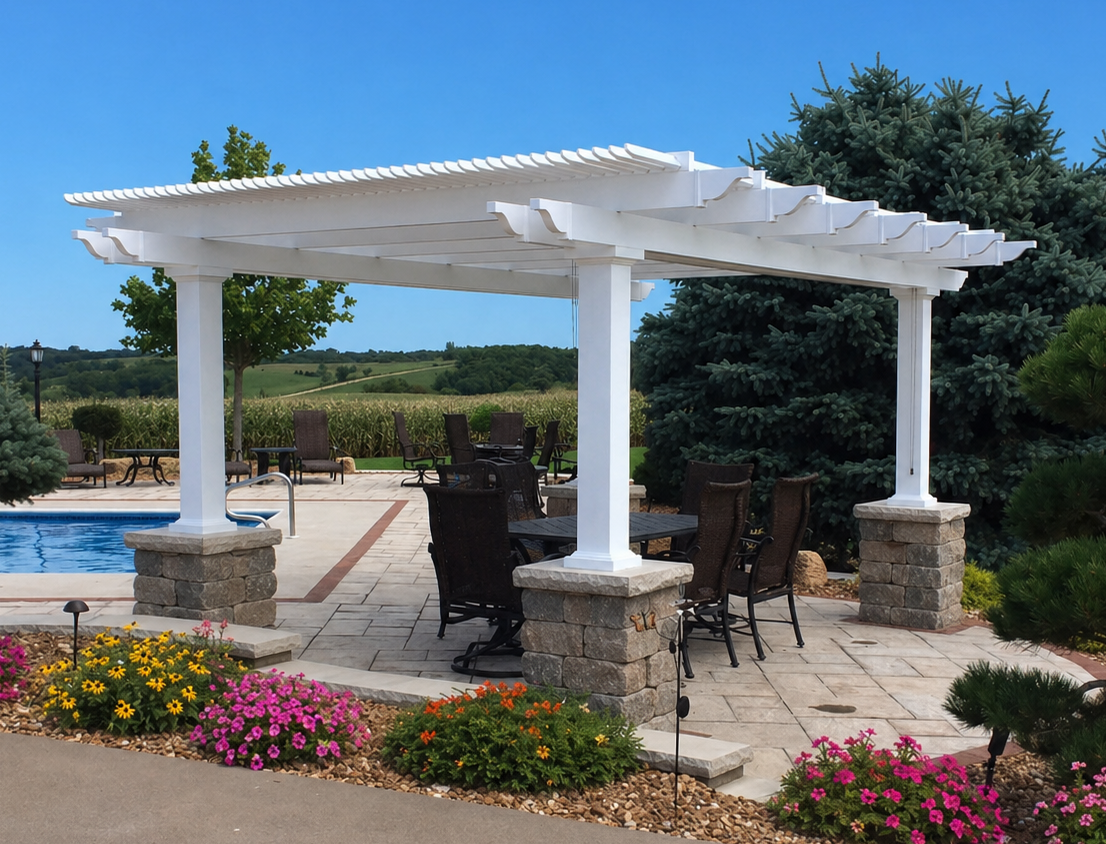
Square pergolas are available across a broad range of dimensions. The best choice is the one that provides enough functional space for furniture and circulation without making the structure disproportionately large for the patio.
An 8x8 pergola covers 64 square feet, while a 10x10 pergola covers 100 square feet. These compact sizes are generally suited to smaller patios, bistro dining, hot tubs, or focused conversation areas.
Furniture should be measured carefully at these dimensions. A large dining set may technically fit but leave insufficient room to move chairs or walk around the perimeter.
A 12x12 pergola covers 144 square feet and offers a versatile middle-ground footprint. It can work well for six-place dining, centered conversation seating, or a lounge arrangement that does not require separate activity zones.
This size is large enough to create a recognizable outdoor room while remaining compatible with many residential patios. Post placement, roof overhangs, and furniture clearance should still be planned together.
A 14x14 pergola provides 196 square feet of coverage. The additional width and depth create more breathing room around a dining table or conversation group and can support larger outdoor furniture.
This size is often appropriate when the goal is a complete square entertaining area rather than a compact shade station. It may also provide more useful perimeter space for occasional chairs, side tables, or serving pieces.
A 16x16 pergola covers 256 square feet and can accommodate a substantial dining or lounge arrangement. Traditional, modern, and rainproof product lines can support this square size in compatible configurations.
At this scale, confirm that the structure remains proportionate to the patio and home. The added area also makes furniture planning and intentional circulation paths more important.
Large square pergolas can create expansive outdoor entertaining rooms or support multiple related furniture groupings. Traditional pergolas can reach 44x44 feet with nine posts, while modern square pergolas can reach 32x32 feet with nine posts.
Large dimensions involve additional posts and structural bays rather than an unsupported span across the entire footprint. Post placement should be incorporated into the layout from the beginning so columns do not interfere with furniture or traffic.
Standard sizes simplify comparison, but a custom square dimension may fit an existing patio more precisely. A 13x13 or 15x15 pergola, for example, can preserve balanced proportions while responding to a site that falls between common nominal sizes.
Custom dimensions must remain within the limits of the selected product configuration. Verify compatibility before finalizing foundations, footings, post locations, or adjacent construction.
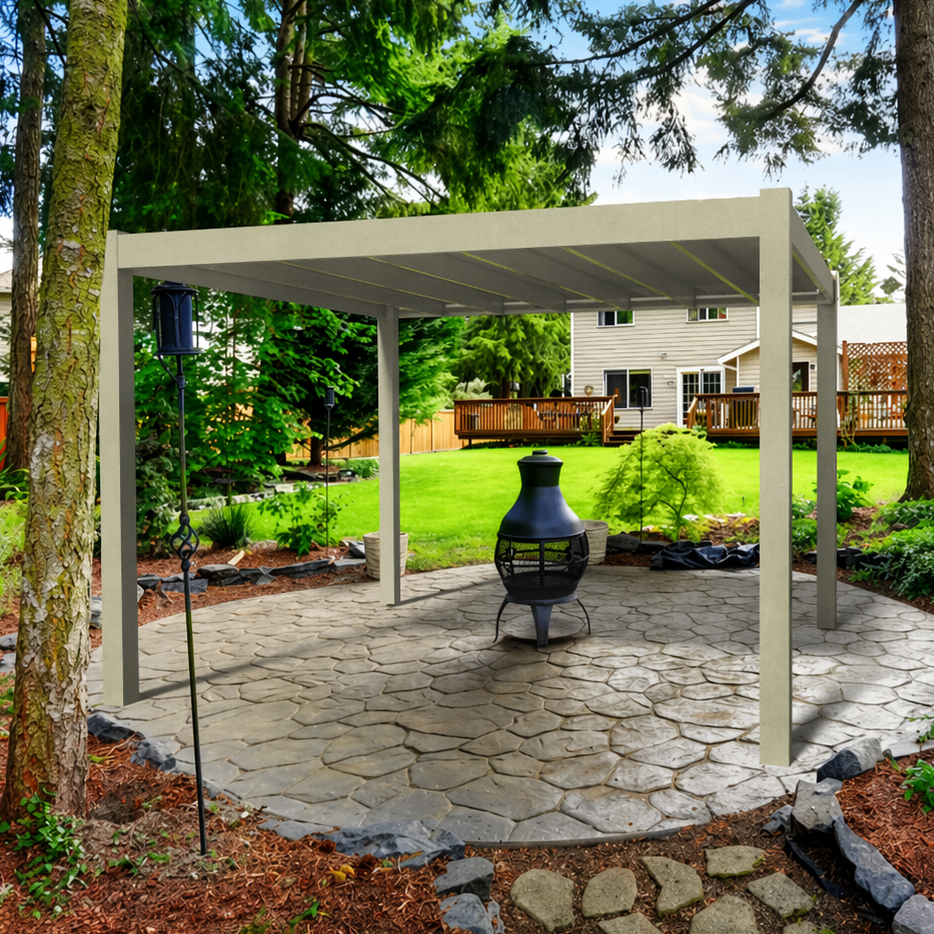
Square dimensions describe the footprint, but style and roof type determine how the pergola looks and performs. The principal choices are traditional or modern styling, freestanding or attached installation, and slatted shade or a solid polycarbonate roof.
Traditional square pergolas can include beam and rafter overhangs, inset posts, decorative end caps, and several post profiles. Overhangs may range from 0 to 36 inches, and posts can be inset up to 36 inches when the selected configuration permits.
Scrolled, beveled, and flat end caps are available. Post choices include 5-inch square, 7-inch square, and 10-inch round profiles with the applicable upper and lower trim-ring treatments.
Modern square pergolas use clean, flush corners without beam or rafter overhangs. Their posts remain at the corners, and the design does not use decorative end caps.
Modern models have 7-inch square posts in white or tan, with a choice of no lower trim ring or a lower trim ring. Black modern pergolas use 8-inch square posts. The streamlined geometry is especially compatible with the symmetry of a square footprint.
A slatted-roof pergola uses fixed angled purlins rather than adjustable louvers. Buyers can select approximately 50%, 75%, or 90% shade coverage based on purlin spacing.
The slats provide real shade while allowing an open-air experience, but this roof is not rainproof. Traditional and modern pergolas both use this fixed system and do not contain motors or moving roof components.
A square pergola with a solid polycarbonate roof is generally described as a patio cover or covered pergola. These rainproof patio covers use white or bronze roof panels that provide 100% UV protection and can make the covered patio up to 15°F cooler.
The frame retains traditional styling and can include 0- to 24-inch overhangs. The roof is backed by a 10-year warranty, while the aluminum-reinforced frame carries a lifetime warranty.
Freestanding square pergolas use posts to support the structure independently of the home. They provide greater placement flexibility and work well over detached patios, pool decks, and garden seating areas.
Attached square pergolas connect to a suitable house or structure and use fewer posts along the attached side. This can create a more direct transition from an indoor living area to the shaded patio, but the attachment surface must be appropriate for the installation.
The primary weight-bearing posts, beams, and rafters contain rust-proof aluminum reinforcement. The substantial aluminum frame supports longer spans between posts and is designed to resist bowing, bending, and damage in demanding outdoor conditions.
The exterior is thick, premium extruded vinyl colored throughout rather than painted on the surface. It does not require painting, staining, or sanding and is designed to resist discoloration, deformation, and cracking over time.
Customization should begin with functional decisions—size, installation type, and roof coverage—before moving to color and decorative details. Available options differ among traditional, modern, and rainproof models, so each choice must be compatible with the selected product line.
For an open-air square pergola, select 50%, 75%, or 90% shade coverage. Wider 6-inch-on-center purlin spacing provides approximately 50% coverage, while 4-inch and 3-inch spacing increase coverage to approximately 75% and 90%.
Choose a solid polycarbonate roof when protection from rain is required. White and bronze panels both provide 100% UV protection; neither is a motorized or retractable roof.
Square pergola frames are available in white, tan, or black. White is the most affordable option, while black is the highest-priced color choice.
Color should be coordinated with permanent exterior elements such as window frames, fascia, siding, masonry, railings, or doors. Because the vinyl is colored throughout rather than surface-painted, routine refinishing is not required.
Traditional pergolas allow beam and rafter overhangs from 0 to 36 inches and posts inset by up to 36 inches. Rainproof patio covers permit overhangs and post insets up to 24 inches.
Modern pergolas have no overhangs, and their posts must remain in the corners. These differences affect both architectural appearance and the amount of usable space between supports.
Traditional pergolas offer 5-inch square, 7-inch square, or 10-inch round posts in compatible trim configurations. Their beam and rafter ends can be finished with scrolled, beveled, or flat caps.
Modern pergolas use square posts and do not have decorative end caps. Rainproof patio covers offer 5-inch and 7-inch square posts with applicable trim options, along with scrolled, beveled, or flat end caps.
Optional fan mounts are available for traditional, modern, and rainproof structures. Fan equipment, electrical requirements, and installation planning should be evaluated separately for the specific site.
Decide on fan placement before installation so the mount can be incorporated into the pergola layout and coordinated with furniture beneath it.
Optional hurricane brackets are available for traditional pergolas and rainproof patio covers and are recommended in areas that may experience winds of 80 MPH or more. Adding the brackets provides a lifetime wind-damage warranty for the pergola.
Hurricane brackets are not available for modern pergolas. Site-specific anchoring, local codes, and installation requirements should still be confirmed regardless of the chosen configuration.
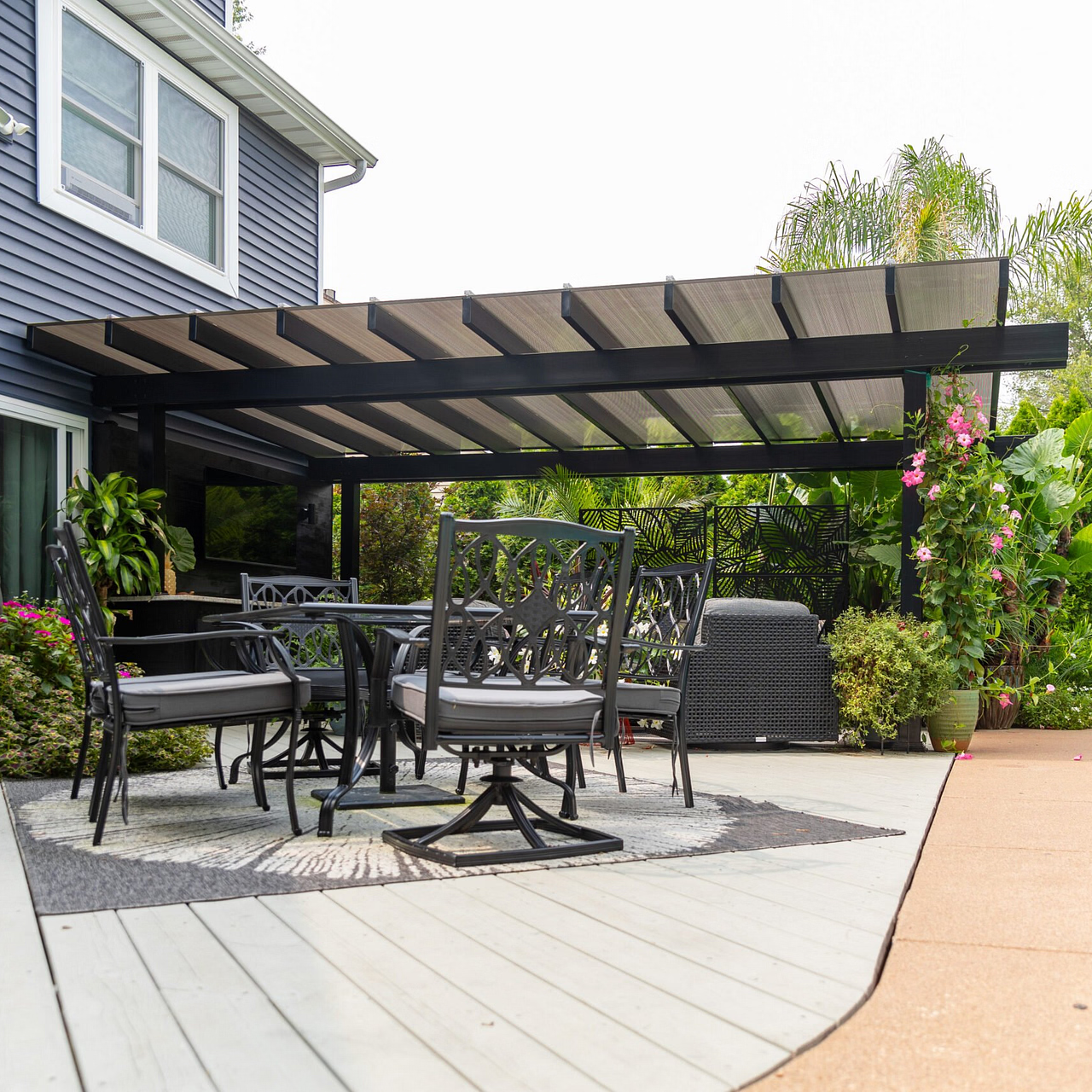
The cost of a square pergola depends on more than its overall dimensions. Style, roof type, color, post configuration, accessories, delivery, site preparation, and installation can all affect the final project cost.
Larger square pergolas require more material and may require additional posts and structural bays. A compact four-post structure will generally cost less than a large six- or nine-post pergola, even when both use the same style and roof coverage.
Square dimensions also increase area quickly. For example, moving from 12x12 to 16x16 increases coverage from 144 to 256 square feet, so comparisons should account for total covered area rather than side length alone.
A slatted pergola and a rainproof patio cover have different roof systems, structural requirements, and pricing. Shade coverage selection can also influence material requirements on traditional and modern slatted-roof models.
Choose the roof based on required performance. A solid roof provides rain protection, while a slatted roof preserves a more open-air environment and fixed partial shade.
White is the most affordable frame color, followed by tan, with black as the most expensive. Post upgrades, trim choices, fan mounts, and compatible hurricane brackets may also affect the total price.
These decisions should be compared according to their functional or architectural value rather than selected only by initial cost. Some options change appearance, while others address shade, airflow, post placement, or wind-related protection.
Project cost may include footings, anchoring surfaces, permits, electrical work, demolition, grading, delivery access, or contractor labor. An attached pergola may also require evaluation and preparation of the mounting surface.
The kits are designed to be DIY-friendly, but professional installation may be appropriate for large structures, difficult sites, or homeowners without suitable construction experience. Review the available assembly information and videos when deciding how the project will be completed.
Extruded vinyl eliminates the recurring painting, staining, and sanding commonly associated with wood pergolas. The aluminum reinforcement is rust-proof, and the fixed roof systems avoid motors, tracks, and moving louvers that can require repair or replacement.
This lower-maintenance construction contributes to long-term value. The structure is intended as a permanent improvement rather than a short-life patio product that must be replaced every few years.
Traditional and modern pergolas include a lifetime warranty. Rainproof models include a lifetime frame warranty and a 10-year roof warranty.
A properly sized permanent pergola can define usable outdoor living space and complement a well-designed patio or deck. Its value is strongest when the dimensions, roof performance, architecture, and installation quality are aligned with the home.
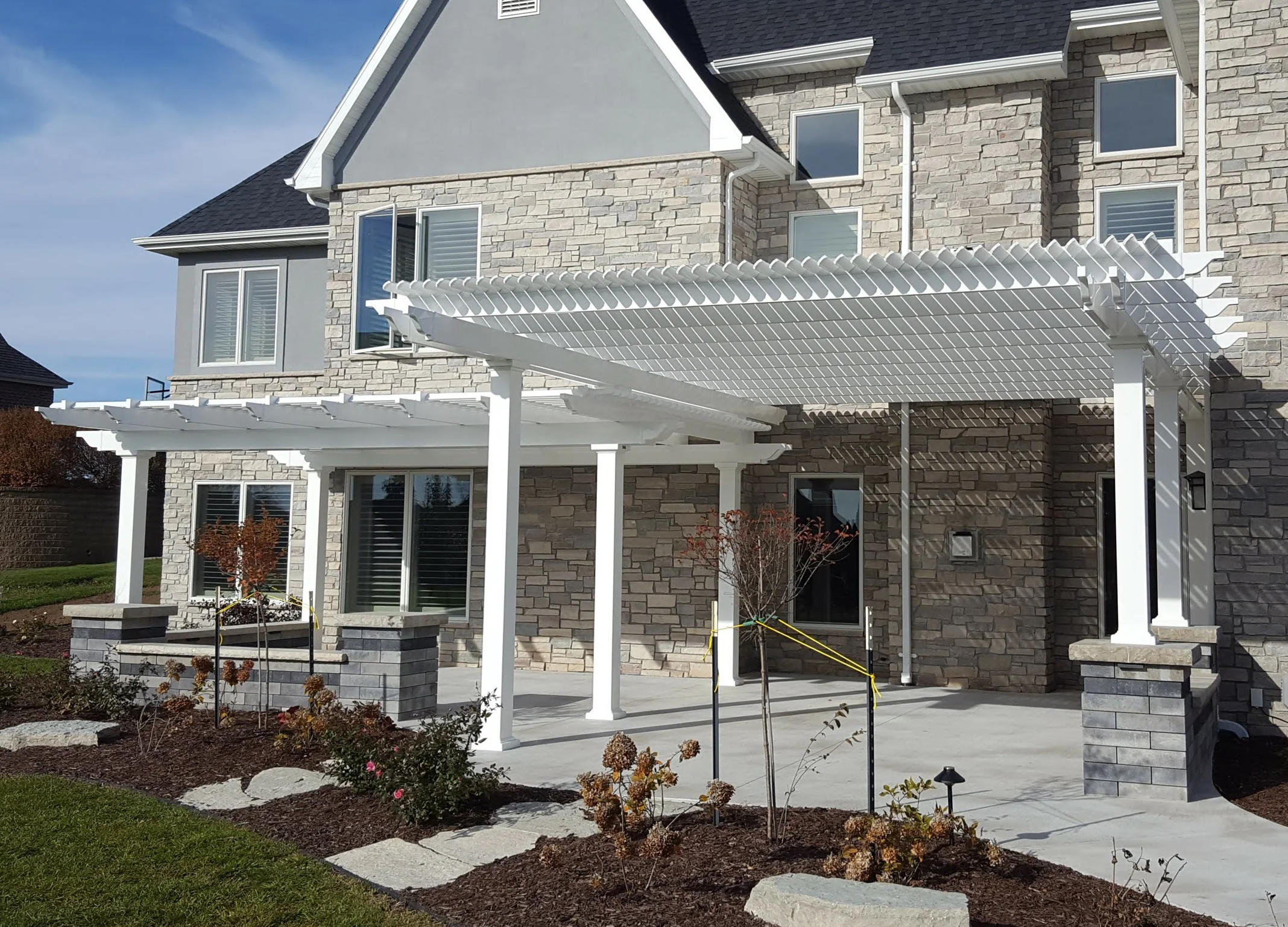
A square pergola is not automatically the best shape for every patio. Comparing its proportions, roof performance, maintenance requirements, and permanence with other structures helps identify where it offers the strongest fit.
Square pergolas are well suited to centered furniture groups, square patios, and balanced outdoor rooms. Rectangular pergolas are often better for long patios, linear dining tables, poolside seating rows, or spaces that need multiple activity zones arranged in sequence.
The decision should follow the patio and furniture footprint rather than symmetry alone. If the available space is substantially longer in one direction, a rectangular structure may use the site more effectively.
A conventional gazebo is commonly associated with a fully solid roof and a more enclosed or ornamental form. A square pergola usually has a cleaner post-and-beam structure and may use either a slatted shade roof or, in the rainproof line, solid polycarbonate panels.
Buyers primarily seeking rain protection should compare rainproof patio covers rather than assuming every pergola roof is waterproof. Traditional and modern slatted roofs provide shade but do not stop rainfall.
“Pergola” usually refers to a structure with an open slatted roof, while “patio cover” more often means a fully covered rainproof structure. Both are available with square footprints, aluminum-reinforced frames, and premium vinyl exteriors.
The practical distinction is roof performance: angled slats provide partial shade, while solid polycarbonate panels provide rain coverage and 100% UV protection.
Temporary canopies are typically selected for portability and low initial cost. A permanent square pergola requires proper installation but offers a substantially different level of structural presence, shade performance, service life, and integration with the property.
These pergolas are intended for homeowners seeking a lasting outdoor improvement. They are not designed to compete with lightweight structures in the $500–$1,500 temporary-pergola category.
These square pergolas do not use adjustable louvers, retractable fabric, canvas canopies, or motorized roof systems. Slatted models have fixed angled purlins, and rainproof models have fixed solid polycarbonate panels.
A fixed system is appropriate for buyers who prefer straightforward roof performance without motors or moving components. Shoppers who specifically require on-demand opening and closing will need a different product category.
A square pergola is a strong choice when the installation area is square or nearly square, the furniture is organized around a central activity, and balanced coverage matters more than extending shade along a long wall or patio.
It is especially well suited to homeowners who want a permanent, made-in-the-USA structure with rust-proof aluminum reinforcement, maintenance-free vinyl, substantial shade or rain protection, and a lifetime frame warranty.
A square pergola has equal nominal width and depth dimensions, such as 10x10, 12x12, or 16x16. It creates a balanced footprint for dining, lounge seating, and other centered outdoor arrangements.
There is no single best size, but 10x10, 12x12, 14x14, and 16x16 are common residential dimensions. The right size depends on the furniture footprint, circulation clearance, patio dimensions, and intended use.
Traditional square pergolas can reach 44x44 feet with nine posts, and modern square pergolas can reach 32x32 feet with nine posts. Square freestanding rainproof patio covers are available up to 20x20 feet.
Yes. Square traditional, modern, and rainproof models can be configured as freestanding or attached structures within their respective size limits.
Only models with a solid polycarbonate roof are rainproof. Traditional and modern pergolas use fixed angled slats that provide 50%, 75%, or 90% shade coverage but do not stop rain.
The weight-bearing posts, beams, and rafters contain rust-proof aluminum reinforcement and are covered with premium extruded vinyl colored throughout. The vinyl does not require painting, staining, or sanding.
Traditional pergola posts can be inset up to 36 inches, while rainproof patio-cover posts can be inset up to 24 inches. Modern pergola posts must remain at the corners.
The kits are designed for DIY-friendly assembly, but installation requires appropriate tools, site preparation, anchoring, and construction ability. A qualified contractor may be preferable for large structures, attached installations, or complex sites.
Traditional and modern pergolas carry a lifetime warranty. Rainproof patio covers include a lifetime warranty on the frame and a 10-year warranty on the polycarbonate roof.
No. The available roof systems are fixed angled slats or fixed solid polycarbonate panels; motorized, louvered, retractable, and canvas roof systems are not offered. Additional product questions are addressed in the pergola FAQs.


