

MADE IN THE USA
with American products
w/ American products


Home ▸ Pergolas With Roof Attached to House
A pergola with roof attached to house creates a permanent outdoor living area directly alongside your home, providing either adjustable levels of shade or a fully covered, rainproof roof. Sunset Pergola Kits offers attached traditional and modern pergolas with aluminum-reinforced frames and maintenance-free extruded vinyl, plus fully covered patio covers with solid polycarbonate roofs. Choose the configuration, dimensions, roof coverage, and finish that best fit your patio, deck, or outdoor living space. [read more]


A pergola with a roof attached to a house is a permanent outdoor structure connected to an existing home or structure to extend usable outdoor space. Depending on the roof design, an attached pergola can provide substantial shade through fixed angled slats or provide complete rain protection with a solid polycarbonate roof.
An attached pergola is supported partly by the house or other structure and partly by posts positioned along the outside edge. Unlike a freestanding pergola, it is designed specifically to connect to an existing structure. Our attached pergolas are available in traditional and modern styles and are designed for permanent installation.
An attached pergola extends directly from a house or structure, making it well suited to patios, decks, and outdoor areas immediately adjacent to the home. A freestanding pergola stands independently and can be positioned elsewhere in a yard or outdoor space. The right configuration depends primarily on where you want the covered or shaded area and how the structure can be supported.
The term can describe either a pergola with a slatted roof or a fully covered structure. Our traditional and modern pergolas use fixed angled shade purlins, commonly called slats, with 50%, 75%, or 90% shade coverage. For complete rain protection, our rainproof patio covers use solid polycarbonate roof panels.
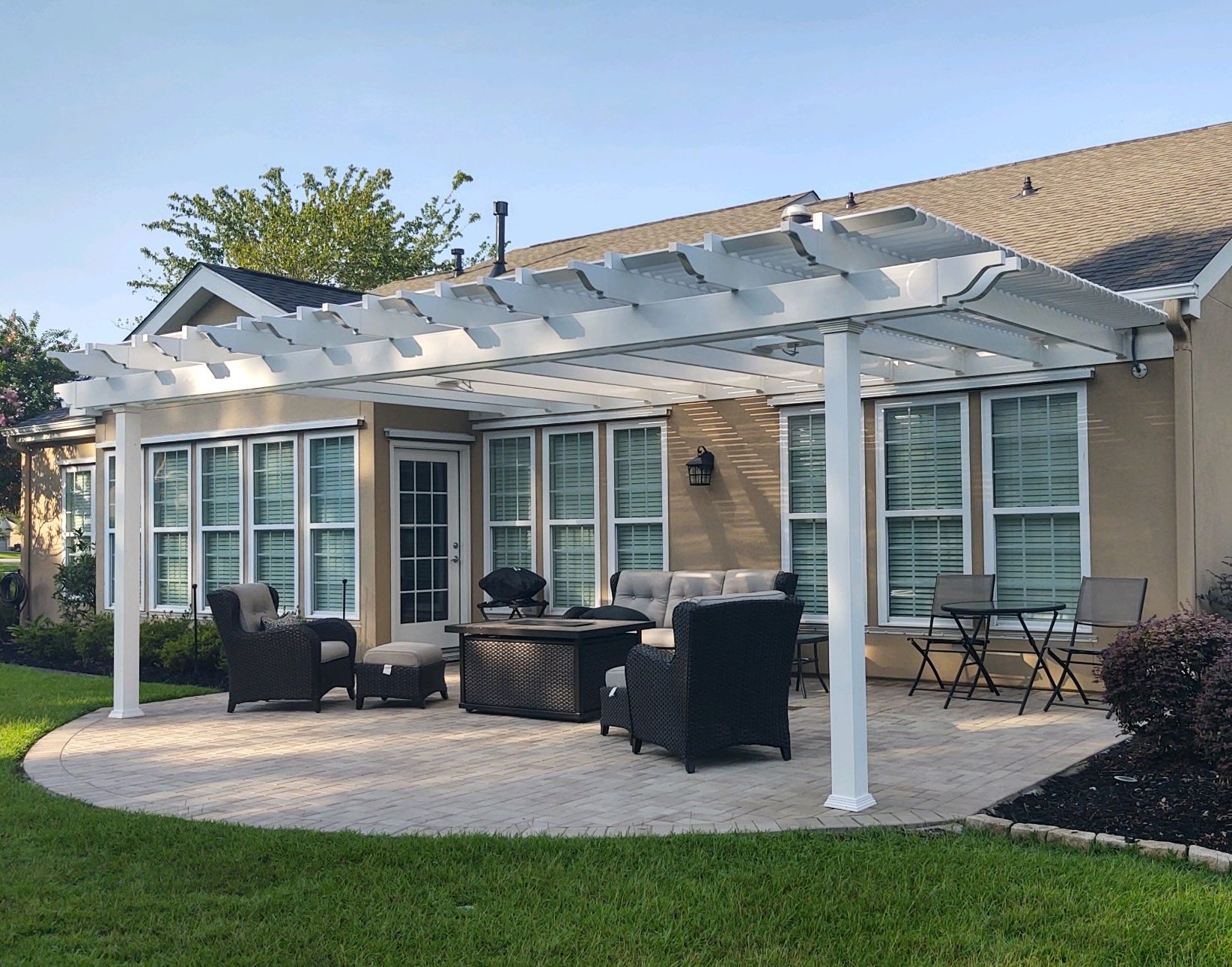
An attached pergola can turn an underused patio or deck into a more functional outdoor living area while keeping the structure visually connected to the home. The choice of roof determines whether the primary goal is shade or full overhead weather protection.
An attached pergola extends the usable footprint of your home without creating a conventional room addition. It can define an outdoor seating, dining, entertaining, or relaxation area immediately outside the house.
Traditional and modern pergolas use fixed angled shade purlins rather than decorative overhead elements alone. Three spacing options provide approximately 50%, 75%, or 90% shade coverage, allowing homeowners to choose the level of overhead shade that suits the space.
When rain protection is the priority, a fully covered patio cover uses solid polycarbonate roof panels instead of open slats. The panels are available in white or bronze, provide 100% UV protection, and can make the patio up to 15 degrees cooler.
The exterior is premium extruded vinyl that is colored throughout rather than painted. It does not require the routine painting, staining, or sanding associated with many wood structures, making it a practical choice for homeowners who want a permanent structure with minimal maintenance.
Choosing between an attached pergola, freestanding pergola, patio cover, or other shade structure depends largely on the type of protection you want and where the structure needs to go. The key distinction is whether you want open slatted shade or a fully covered roof.
An attached pergola connects to the house and is particularly appropriate for patios and decks next to the home. A freestanding pergola is independently supported and can be placed away from the house. Both configurations are available from Sunset Pergola Kits, except for the eyebrow/garage design, which is always attached.
A slatted pergola provides shade while maintaining an open-air character. Our fixed shade purlins are available in 50%, 75%, and 90% shade configurations. A solid-roof patio cover is the better choice when keeping rain off the area is the primary objective.
Traditional attached pergolas feature beam and rafter overhangs, optional decorative end caps, and posts that can be positioned in corners or inset. Modern attached pergolas use clean, flush lines with posts positioned in the corners and no beam or rafter overhangs. Explore traditional pergolas and modern pergolas to compare the two styles.
Sunset Pergola Kits focuses on permanent, fixed structures rather than systems with motors, retractable canopies, or moving louvered components. This approach eliminates moving roof mechanisms that can require replacement or service while providing a durable permanent structure.
The best attached pergola configuration depends on the available patio or deck space, the desired shade level, the architectural style of the home, and whether you need rain protection. Start with the dimensions and attachment location, then select the roof and structural options that fit the space.
Measure the area you want to cover and consider both the dimension along the house and the distance extending outward. Traditional attached pergolas are available in configurations ranging from 8–24 feet along the attached side for two-post designs, with larger configurations available using three, four, or six posts. Modern attached pergolas range from 8–16 feet on the attached side with two posts, with larger configurations available using additional posts.
For more detailed size information, see the pergola dimensions guide.
For an open slatted pergola, choose 50%, 75%, or 90% shade coverage based on how much sunlight you want to filter. The spacing is 6 inches on center for 50% coverage, 4 inches on center for 75% coverage, and 3 inches on center for 90% coverage. If you need a rainproof roof rather than filtered shade, select a solid polycarbonate patio cover.
Traditional pergolas offer more decorative flexibility, including beam and rafter overhangs, inset post placement, and scrolled, beveled, or flat end caps. Modern pergolas have square, flush corners, no beam or rafter overhangs, and posts positioned in the corners for a cleaner contemporary appearance.
The existing outdoor area should be evaluated before selecting a configuration. Consider the available footprint, desired post locations, attachment area, and the relationship between the pergola and doors, windows, walkways, or other features. Attached configurations are designed around specific post counts and dimensions, so accurate measurements are important.
Sunset Pergola Kits uses aluminum reinforcement in the weight-bearing structural components of its traditional and modern pergolas. Hurricane brackets are available as an option on traditional pergolas and rainproof patio covers and are recommended when an area experiences winds of 80+ MPH. Adding hurricane brackets to eligible pergolas adds a lifetime wind damage warranty.
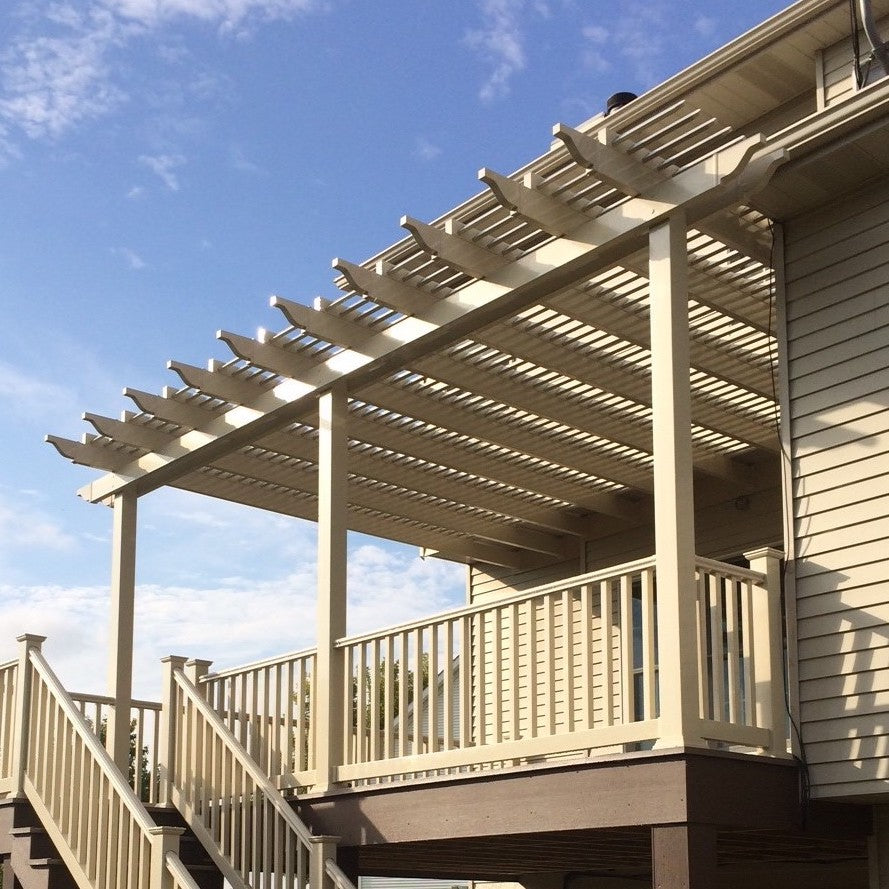
The roof is one of the most important decisions when choosing an attached pergola because it determines how the structure handles sunlight and rain. Sunset Pergola Kits offers fixed slatted shade roofs and solid polycarbonate roofs rather than louvered, retractable, or motorized systems.
Traditional and modern pergolas use fixed angled shade purlins, commonly called roof slats. The spacing can be selected for 50%, 75%, or 90% shade coverage. These roofs are designed to provide shade but are not rainproof.
Fully covered patio covers use solid polycarbonate panels to create a rainproof roof. White and bronze panels are available, and both provide 100% UV protection while helping keep the patio cooler. These structures are often called patio covers rather than pergolas because the roof is fully covered.
The traditional and modern pergola frames use aluminum inserts in all weight-bearing posts, beams, and rafters. The aluminum provides a high-strength, lightweight structural core designed to support longer spans between posts while the exterior uses premium extruded vinyl.
The vinyl exterior is colored throughout rather than simply painted on the surface. Available colors include white, tan, and black. The material is designed to eliminate routine painting, staining, and sanding and to provide a low-maintenance exterior for a permanent outdoor structure.
Traditional pergolas and rainproof patio covers can be configured with optional fan mounts and hurricane brackets. Traditional pergolas also offer multiple post styles, post-placement options, beam and rafter end caps, and overhang configurations. Modern pergolas have a more streamlined set of structural options consistent with their contemporary design.
Attached pergolas can be configured around the dimensions and architectural character of the outdoor space. Traditional designs provide the greatest range of decorative and post-placement choices, while modern designs emphasize clean lines and corner posts.
Traditional attached pergolas are available with two, three, four, or six posts depending on the overall dimensions. Two-post configurations can span 8–24 feet along the attached side and extend 8–24 feet outward. Larger three-, four-, and six-post configurations accommodate substantially wider or deeper spaces.
Modern attached pergolas are available with two, three, four, or six posts. Two-post configurations range from 8–16 feet along the attached side and 8–16 feet outward, while larger configurations can reach 32 feet in the applicable dimension. Modern posts remain in the corners rather than being inset.
White, tan, and black vinyl colors are available, with white being the most economical option and black the most expensive. Traditional pergolas offer several post styles, including square and round options, while modern pergolas use square posts with a clean, contemporary appearance.
Traditional attached pergolas can include beam and rafter overhangs from 0 to 36 inches, along with scrolled, beveled, or flat end caps. Modern pergolas have no beam or rafter overhangs and do not use end caps, keeping the design flush and streamlined.
For homeowners who want a structure designed specifically to connect to the home, the attached pergola collection includes configurations in both traditional and modern styles. You can also compare individual traditional attached pergola options when evaluating sizes and configurations.

The cost of an attached pergola depends on its size, structural configuration, roof type, vinyl color, and selected options. A larger structure with additional posts and a more complex configuration will generally require more material than a smaller two-post installation.
Major cost factors include overall dimensions, the number of posts, traditional or modern styling, roof configuration, vinyl color, and optional features. White vinyl is the most economical color, while tan and black carry higher costs. Solid polycarbonate patio covers also differ from slatted pergolas because they use a fully covered roof system.
The kits are designed to be DIY-friendly or installed by a contractor. Installation cost therefore depends on whether the homeowner performs the work or hires a professional, as well as site-specific requirements such as the existing patio, deck, or foundation conditions.
A permanent pergola is a long-term outdoor improvement rather than a temporary seasonal structure. The aluminum-reinforced frame, extruded vinyl exterior, and low-maintenance design are intended for long-term use, and traditional and modern pergolas include a lifetime warranty. Fully covered patio covers include a lifetime frame warranty and a 10-year roof warranty.
Sunset Pergola Kits uses America-sourced materials and manufactures its pergolas in the USA. The combination of reinforced structural components, thick extruded vinyl, permanent installation, and a lifetime warranty is intended for homeowners seeking a durable outdoor structure rather than a low-cost temporary pergola.
For additional product information and installation resources, see the assembly information and videos.
Yes. Sunset Pergola Kits offers attached pergola configurations designed to connect to a house or other structure. Traditional and modern pergolas are available in attached configurations, while eyebrow/garage pergolas are always attached.
Slatted traditional and modern pergolas provide shade but are not rainproof. For full rain protection, choose a fully covered patio cover with a solid polycarbonate roof.
A pergola typically has an open, slatted roof that provides shade. A patio cover has a solid roof designed to provide overhead weather protection. Sunset Pergola Kits offers both types.
Traditional and modern pergolas are available with 50%, 75%, or 90% shade coverage. The corresponding purlin spacing is 6, 4, or 3 inches on center.
They use both materials for different purposes. The structural components are aluminum-reinforced, while the exterior is premium extruded vinyl. The vinyl is colored throughout rather than painted.
Yes. Depending on the style and configuration, options include dimensions, vinyl color, post style, post placement, roof coverage, overhangs, end caps, and selected accessories.
Maximum dimensions depend on the style and number of posts. Traditional attached configurations can reach 44 feet in applicable dimensions, while modern attached configurations can reach 32 feet in applicable dimensions.
Yes. Traditional designs feature optional overhangs, decorative end caps, and flexible post placement. Modern designs use flush corners, corner posts, and no beam or rafter overhangs.
No. The premium extruded vinyl exterior is designed to be maintenance-free and does not require routine painting, staining, or sanding.
Traditional and modern pergolas have a lifetime warranty. Fully covered patio covers have a lifetime warranty on the frame and a 10-year warranty on the roof.


