

MADE IN THE USA
with American products
w/ American products


Home ▸ Pergolas Over Swimming Pool
A pergola over a swimming pool can create permanent shade over the water, pool edge, or surrounding deck while helping define the pool as part of a finished outdoor living space. Sunset Pergola Kits are built with aluminum-reinforced structural components and a maintenance-free vinyl exterior, with slatted roofs providing 50%, 75%, or 90% shade coverage and solid-roof options available for rainproof coverage. Choose from freestanding or attached configurations in traditional or modern styles to fit the layout and architecture of your pool area. [read more]


A pergola over a swimming pool is a permanent outdoor structure positioned to shade all or part of the pool, the pool edge, or the immediately surrounding deck. Unlike a lightweight canopy or temporary shade structure, a properly designed pool pergola becomes a structural part of the outdoor living area and can be sized and positioned around the specific pool layout.
The phrase can describe several layouts. A pergola may extend directly over part of the swimming pool, span the edge where swimmers enter and exit, or cover the adjacent deck while projecting toward the water. The defining feature is that the pergola is positioned closely enough to the pool to provide useful shade where people swim, sit, or move around the water.
Sunset Pergola Kits are permanent structures with aluminum reinforcement inside the weight-bearing posts, beams, and rafters, wrapped in premium extruded vinyl. This construction provides the strength needed for larger outdoor installations while eliminating the painting, staining, and sanding associated with wood.
Yes. A pergola can be designed so part of its roof extends over the water, provided the structure can be properly supported and anchored without interfering with the pool shell, plumbing, utilities, or required clearances. The exact feasibility depends on the pool, deck, footing locations, pergola dimensions, and local building requirements.
 A freestanding pergola is often useful around a pool because its placement does not depend on the location of the house. Traditional freestanding models can be configured as large as 44' x 44', depending on the required number of posts and layout.
A poolside pergola usually shades a deck, seating area, outdoor dining area, or lounge space beside the pool. A pergola that extends over the water shifts more of the roof coverage toward the pool itself. Both configurations can improve shade, but they solve slightly different problems.
For many properties, a hybrid layout works well: part of the structure shades the deck while part projects over the pool edge. This can provide shade where people congregate without requiring the pergola to span the entire pool.
Attached pergolas connect to the home or another suitable structure and use fewer exterior posts. They can be a natural choice when the swimming pool sits directly beside the house and the desired shaded area begins at an existing patio or rear wall.
Freestanding pergolas can be located independently elsewhere on the pool deck. That flexibility can be especially valuable when the best shade location is several feet from the home or when the pergola needs to align with the pool rather than with the house.
A pergola can make a pool area more comfortable and usable by providing permanent, predictable shade rather than relying on umbrellas or temporary coverings. It also gives the pool deck architectural definition and can visually connect swimming, seating, dining, and entertaining areas.
The primary benefit is shade. Sunset's traditional and modern pergolas use fixed angled roof slats with three available spacing options: 50% shade with slats spaced 6 inches on center, 75% shade at 4 inches on center, or 90% shade at 3 inches on center.
This lets homeowners determine whether they want a lighter filtered-shade effect or substantially denser coverage. Because the roof slats are fixed rather than retractable or motorized, there are no moving roof components to operate or eventually replace.
A swimming pool may be comfortable while someone is in the water but much less comfortable on a sun-exposed deck. Placing a pergola over a lounge, conversation, or dining area gives people a shaded place to sit between swims and can make the pool area usable for more than swimming alone.
For homeowners building a long-term outdoor living space, the pergola can serve as the architectural structure that defines the shaded portion of the deck while leaving the rest of the pool open to sunlight.
Not every pool area needs maximum shade. A 50% roof can preserve a brighter, more open feeling, while 75% or 90% coverage provides progressively more shade for areas exposed to intense sun. Choosing the right level depends on the pergola's orientation, the amount of afternoon sun, and whether the priority is filtered light or stronger shade.
Homeowners who want a traditional open-roof appearance can explore pergolas with slatted roofs rather than moving or retractable roof systems.
A permanent pergola does more than cast shade. Its posts, beams, rafters, and roof plane visually establish a distinct outdoor room within a larger pool deck. That can make a large patio feel more intentional while creating a natural place for furniture, dining, or poolside entertaining.
Because the structure is intended for permanent installation and carries a lifetime frame warranty, it is better suited to homeowners planning a finished long-term outdoor environment than to buyers looking for a temporary seasonal canopy.
The best pergola for a swimming pool depends on what needs to be shaded, where structural supports can be placed, the size of the pool deck, and whether the pergola will attach to the home. Roof coverage, style, and overall dimensions should be selected around the site rather than chosen independently of it.
Start by identifying the part of the pool area where shade provides the most value. That may be the shallow end, steps, tanning ledge, pool edge, lounge furniture, dining area, or a combination of water and deck space. A pergola does not need to cover the entire swimming pool to create a meaningful shaded zone.
In many layouts, covering only a portion of the water and adjacent deck creates a practical balance between shade and open sky. Planning the shaded footprint first makes it easier to determine the required structure size.
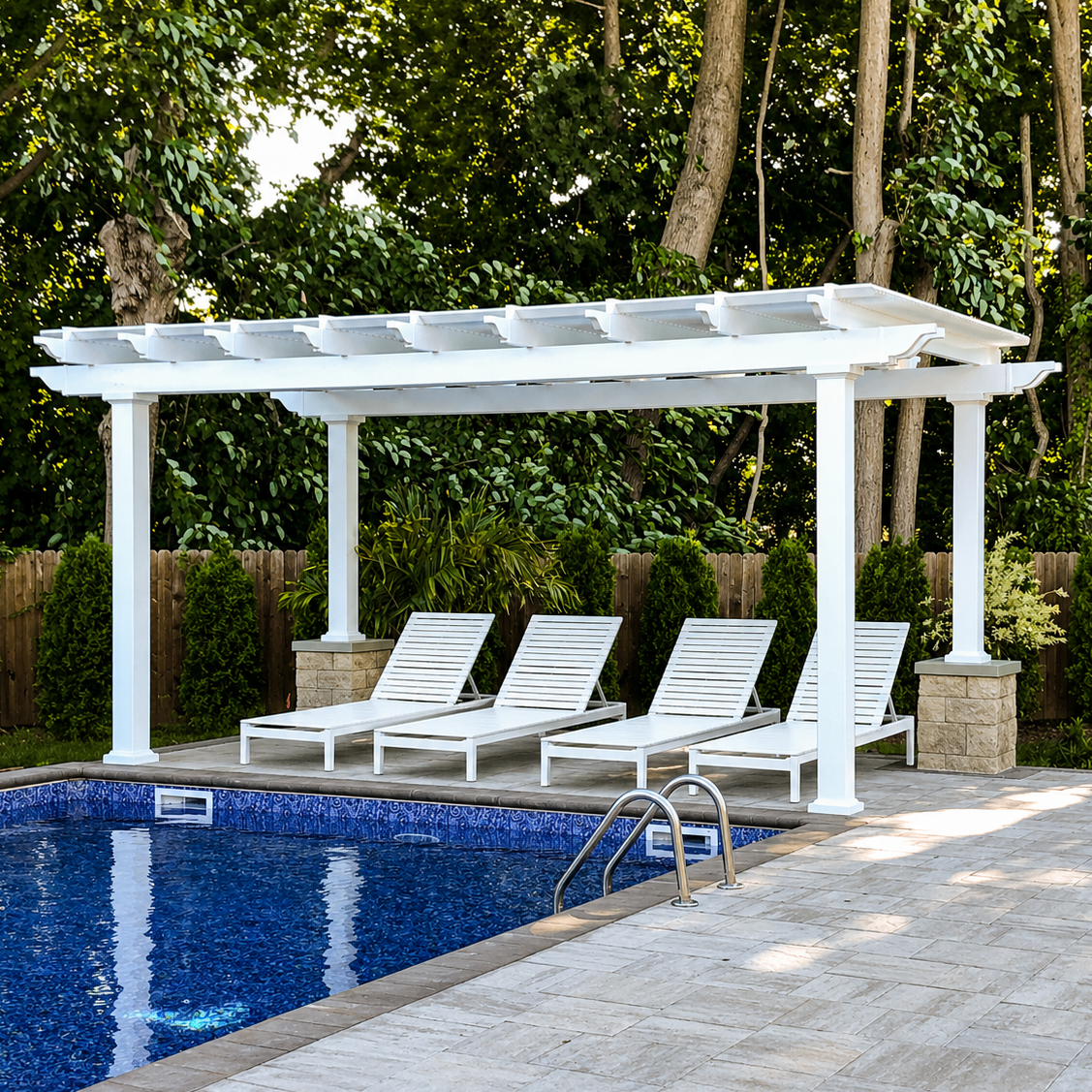 Traditional pergolas offer the widest size range. Four-post freestanding models are available from 8' x 8' through 24' x 24'; larger six-post and nine-post configurations extend up to 44 feet in one or both directions. Traditional attached designs can also reach up to 44' x 44', depending on post configuration.
Modern pergolas are available in more compact modular ranges, from 8' x 8' four-post structures through configurations up to 32' x 32'. Homeowners comparing footprints can use the pergola size guide to narrow the available options.
Shade percentage should reflect how the pool is used and the intensity of the site's sun exposure. Fifty percent shade is the most open of the three slatted-roof configurations, 75% provides a middle ground, and 90% creates the densest shade available with the slatted roof system.
These percentages describe the roof configuration rather than a guarantee that the ground below will be shaded by exactly the same percentage at every hour. The sun's angle changes throughout the day and season, so pergola orientation also affects where shadows fall.
A freestanding design generally provides more freedom to align the structure with the pool, while an attached pergola can create a direct transition from the interior of the house to the swimming area. Attached designs may be especially appropriate when the pool deck begins immediately outside the back door.
The choice should be based primarily on site geometry, structural attachment conditions, and the desired location of the shaded footprint. Both traditional and modern pergolas are available in freestanding and attached configurations.
Traditional pergolas can include beam and rafter overhangs, decorative scrolled, beveled, or flat end caps, and posts positioned at the corners or inset up to 36 inches. These details create a more architectural, classic pergola profile.
Modern pergolas use square, flush corners with posts located at the corners, no beam or rafter overhangs, and no decorative end caps. The result is a cleaner, more contemporary appearance that can work particularly well beside modern pools and homes.
The roof has the greatest influence on how a pergola over a swimming pool performs. Sunset offers fixed slatted roofs in three shade densities and solid polycarbonate roofs for homeowners who need rain protection as well as shade.
The 50% shade configuration spaces the fixed angled roof slats 6 inches on center. It is the most open of the available slatted roof options and allows more sunlight through while still creating a meaningful shaded pattern over the pool or deck.
This configuration can suit homeowners who want the architectural effect of a pergola without making the covered portion of the swimming area feel heavily shaded.
The 75% option reduces slat spacing to 4 inches on center. It provides substantially more shade while retaining the characteristic appearance of an open, slatted pergola roof.
For many pool environments, this middle option can balance sun reduction with an airy outdoor feel, particularly over seating or transition areas adjoining the water.
The 90% configuration uses 3-inch on-center spacing, producing the greatest amount of shade available from Sunset's slatted pergola roof. It is intended for homeowners who prioritize stronger shade but still want a slatted roof rather than a fully covered structure.
Like the 50% and 75% versions, the roof is fixed. Sunset does not offer motorized, louvered, canvas, or retractable roof systems.
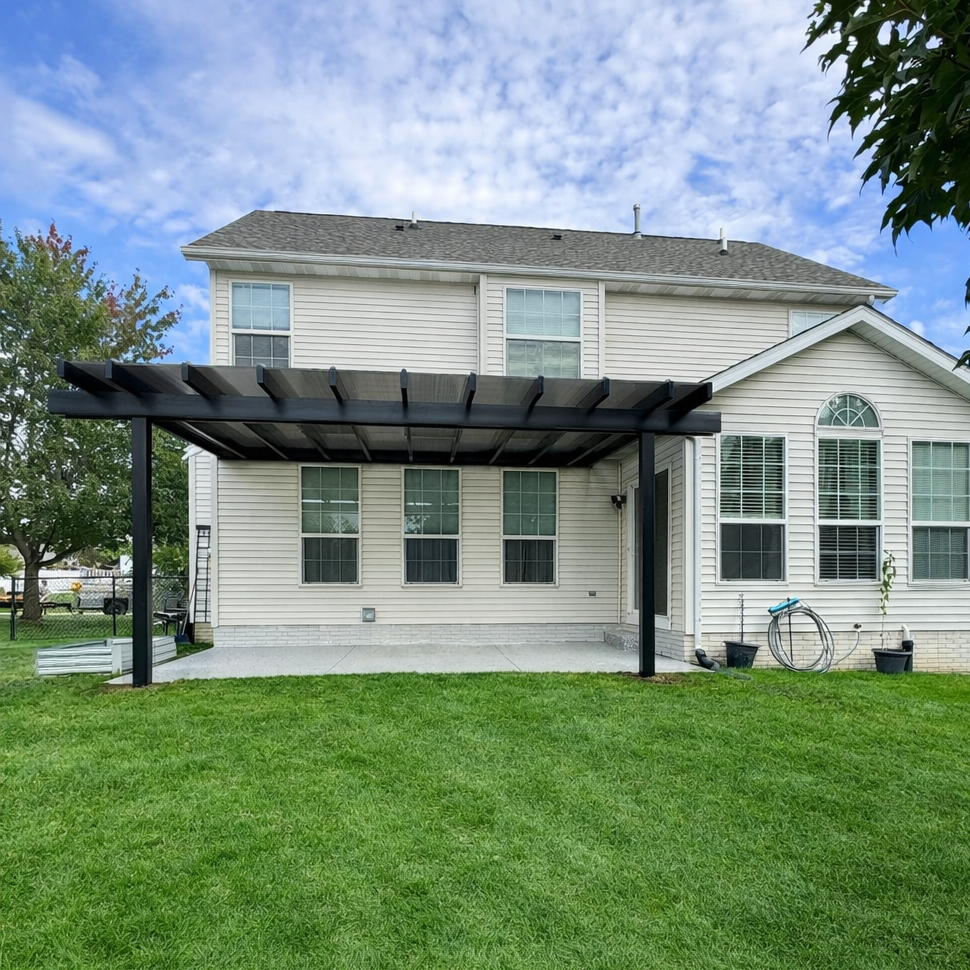 When rain protection is a priority, a rainproof patio cover uses a solid polycarbonate roof instead of slats. These fully covered structures are often described as patio covers rather than traditional pergolas, although they serve a similar role in defining and protecting an outdoor living area.
The roof panels are available in white or bronze. Both provide 100% UV protection and can make the covered patio area up to 15 degrees cooler. These structures carry a lifetime warranty on the frame and a 10-year warranty on the polycarbonate roof.
A slatted pergola is best suited to homeowners whose priority is shade while preserving an open-roof pergola appearance. A solid polycarbonate patio cover is more appropriate when the goal is to create a rainproof poolside area for furniture, dining, or entertaining.
Neither choice uses motorized or moving roof parts. The decision is primarily between filtered or dense fixed shade and complete weather coverage.
Placement determines how useful the shade will be and where posts, footings, and roof spans must fit around the pool. The most effective location is usually based on sun exposure and activity zones rather than simply centering the pergola on the swimming pool.
A pergola can project over part of the water when the site allows the posts and footings to remain in suitable structural locations. This arrangement can shade a specific portion of the pool without enclosing or covering the entire swimming area.
Because pools often have underground plumbing, electrical lines, decking systems, and structural components near their perimeter, footing locations should be evaluated carefully before finalizing post placement.
Positioning a pergola over the pool edge can create shade at steps, seating ledges, or transition areas where swimmers spend time entering and exiting the water. It can also allow most of the structure to remain over the deck while still providing some shade over the pool itself.
Traditional pergolas offer added placement flexibility because posts can be inset up to 36 inches from the corners. Modern pergola posts must remain at the corners.
Many homeowners receive the greatest practical benefit by shading lounge chairs, dining furniture, or conversation seating immediately beside the pool. This creates a comfortable dry area where people can remain part of the pool environment without sitting in direct sun.
Optional fan mounts are available for traditional, modern, and solid-roof patio cover configurations when the pergola will be used as a furnished poolside living area.
When the pool sits close to the home, an attached pergola can cover the transition between the back door and the swimming area. This can visually connect the home, patio, and pool while reducing the number of posts needed along the house side of the structure.
An attached layout should only be used where the home provides an appropriate structural attachment location and where the pergola dimensions work with the existing pool deck.
The pergola should be oriented around where shade is needed during the hours the pool is most frequently used. Morning and afternoon sun arrive from different angles, so the same pergola footprint can cast very different shadows depending on its orientation and location.
Before selecting dimensions, consider where the sun falls during peak swimming hours and which areas of the pool or deck become uncomfortably exposed.
A permanent pergola is one of several ways to create shade around a swimming pool. The right choice depends on whether the homeowner values permanent construction, architectural appearance, maintenance requirements, rain protection, or the ability to move or retract the shade.
A pool cabana is generally more enclosed than a pergola and may include walls, changing areas, storage, or other amenities. A pergola is fundamentally an open-sided shade structure, making it better suited to homeowners who want overhead shade without creating an enclosed building beside the pool.
The pergola's open design also helps maintain sightlines between the home, deck, and swimming area.
A pavilion normally has a fully solid roof, while the term pergola traditionally refers to a structure with an open or slatted roof. Homeowners who want pavilion-like rain protection can instead use a solid-polycarbonate patio cover while retaining the low-maintenance aluminum-reinforced and vinyl-framed construction.
The distinction matters primarily because a slatted pergola provides shade but is not rainproof, whereas a solid roof is designed to keep the space below dry.
A retractable awning extends from a building and uses moving components to deploy or retract fabric shade. A pergola is a permanent framed structure with posts, beams, and rafters. It can therefore define a larger outdoor room independently of an exterior wall.
Sunset's pergolas use fixed roof systems and do not include retractable canopies or motorized mechanisms. This eliminates the maintenance associated with moving roof components but also means the amount of roof coverage cannot be opened or closed on demand.
A shade sail is typically a tensioned fabric membrane supported by posts or attachment points. It can be a simpler shade solution but does not provide the same architectural framework as a permanent pergola.
For homeowners investing in a finished poolscape, an aluminum-reinforced pergola with a premium vinyl exterior is intended to function as a permanent improvement rather than a temporary seasonal shade product.
 A slatted pergola is appropriate when shade and open-air character are the priorities. A solid-roof structure is preferable when homeowners want to protect poolside furniture and living areas from rain as well as direct sun.
The choice should reflect how the space will actually be used. Neither structure is universally better; they address different needs around the swimming pool.
The cost of installing a pergola over a swimming pool depends on more than the basic structure. Overall dimensions, style, roof type, color, post configuration, site conditions, installation method, and any required structural work can all affect the final project cost.
Size is one of the largest variables because larger structures require more material and may require additional posts. Roof type and shade density also matter, as do color and configuration. White vinyl is the most affordable color option, followed by tan, while black is the most expensive.
Traditional and modern pergolas also use different structural layouts and size ranges, so two structures with similar purposes may not have identical pricing.
Larger pergolas generally cost more because of the increased framing, aluminum reinforcement, vinyl components, roof material, and shipping requirements. A solid polycarbonate roof is also a different system from a fixed slatted roof and should be evaluated as a separate product category rather than simply as another shade percentage.
Homeowners should first determine the footprint and performance they need, then compare configurations that meet those requirements instead of selecting a structure by price alone.
Post placement is especially important around swimming pools because the surrounding deck may contain plumbing, electrical systems, drains, reinforcement, or structural elements that cannot be disturbed. Footings and anchors must be appropriate for the pergola and the surface on which it is being installed.
Traditional pergolas allow posts to be located at the corners or inset up to 36 inches, which can provide added flexibility when designing around the pool deck. Modern pergolas require corner post placement.
Sunset Pergola Kits are designed to be DIY-friendly, but homeowners can also hire a contractor for installation. The appropriate choice depends on the homeowner's construction experience, the complexity of the site, the size of the pergola, and the work required for foundations or attachment to the home.
Assembly videos and additional installation guidance are available on the assembly information page.
Traditional pergolas and solid-roof patio covers can be ordered with optional hurricane brackets, which are recommended in areas that may experience winds of 80 MPH or more. Adding the hurricane bracket option includes a lifetime wind damage warranty for the pergola.
Modern pergolas do not offer the hurricane bracket option. Local wind exposure, building codes, and site conditions should therefore be considered when choosing a structure.
Permanent pergola installations may be subject to local building permits, setbacks, pool-barrier rules, utility clearances, structural requirements, or homeowners association restrictions. These requirements vary by jurisdiction and property.
Before excavation or anchoring begins, verify the location of underground utilities and pool systems and confirm applicable local requirements. This is particularly important when posts will be installed close to the pool shell.
A professionally built permanent pergola costs more than an inexpensive temporary canopy, but the comparison should account for useful life and maintenance as well as initial price. Sunset structures use thick aluminum reinforcement and premium extruded vinyl that is colored throughout, eliminating routine painting, staining, and sanding.
They are made in the USA with American-sourced materials and carry a lifetime frame warranty. For homeowners planning a long-term pool and outdoor living environment, this makes the pergola a permanent property improvement rather than a short-lived seasonal purchase.
Yes. A pergola can extend over part of a swimming pool when suitable post, footing, and structural locations are available. Pool plumbing, electrical systems, deck construction, and local building requirements should be considered before installation.
No. Many pergolas cover only part of the pool, the pool edge, or an adjacent lounge area. Partial coverage is often sufficient to create a useful shaded zone.
Sunset's slatted pergolas are available with approximately 50%, 75%, or 90% roof coverage, using fixed angled slats spaced 6, 4, or 3 inches on center respectively. Actual shade on the pool or deck also changes with the angle of the sun.
Slatted pergolas are not rainproof. For complete overhead coverage, choose a solid polycarbonate patio cover, which is designed to protect the area below from rain.
Potentially, but the deck and anchoring conditions must be suitable for a permanent structure. The location of pool plumbing, electrical lines, reinforcement, and other underground components should be verified before installing posts or footings.
Neither is universally better. Freestanding pergolas provide more placement flexibility, while attached pergolas can work well when the pool and patio are directly beside the house.
A vinyl exterior avoids the painting, staining, and sanding required by wood. Sunset's vinyl pergolas use premium extruded vinyl over aluminum-reinforced structural components for a permanent, low-maintenance structure.
Not from Sunset Pergola Kits. The available roof systems are fixed slatted roofs with 50%, 75%, or 90% shade coverage and solid polycarbonate roofs. Motorized, louvered, canvas, and retractable roof systems are not offered.
Traditional pergolas can be configured up to 44' x 44', depending on the freestanding or attached layout and number of posts. Modern pergolas are available in configurations up to 32' x 32', while solid-roof patio covers are available up to 32' x 20'. See the pergola size guide for available dimensions.
Possibly. Permit, setback, structural, electrical, pool-safety, and homeowners association requirements vary by location. Check the requirements that apply to your property before installation.


