

MADE IN THE USA
with American products
w/ American products


Home ▸ Hard Top Pergolas
Hard top pergolas create a permanent covered outdoor space with a solid polycarbonate roof that provides dependable protection from rain and sun. Each structure combines a heavy-duty aluminum-reinforced frame with a maintenance-free extruded vinyl exterior. Available in freestanding and attached configurations, these rainproof pergola kits can be customized for patios, decks, pool areas, outdoor kitchens, and other residential spaces. [read more]


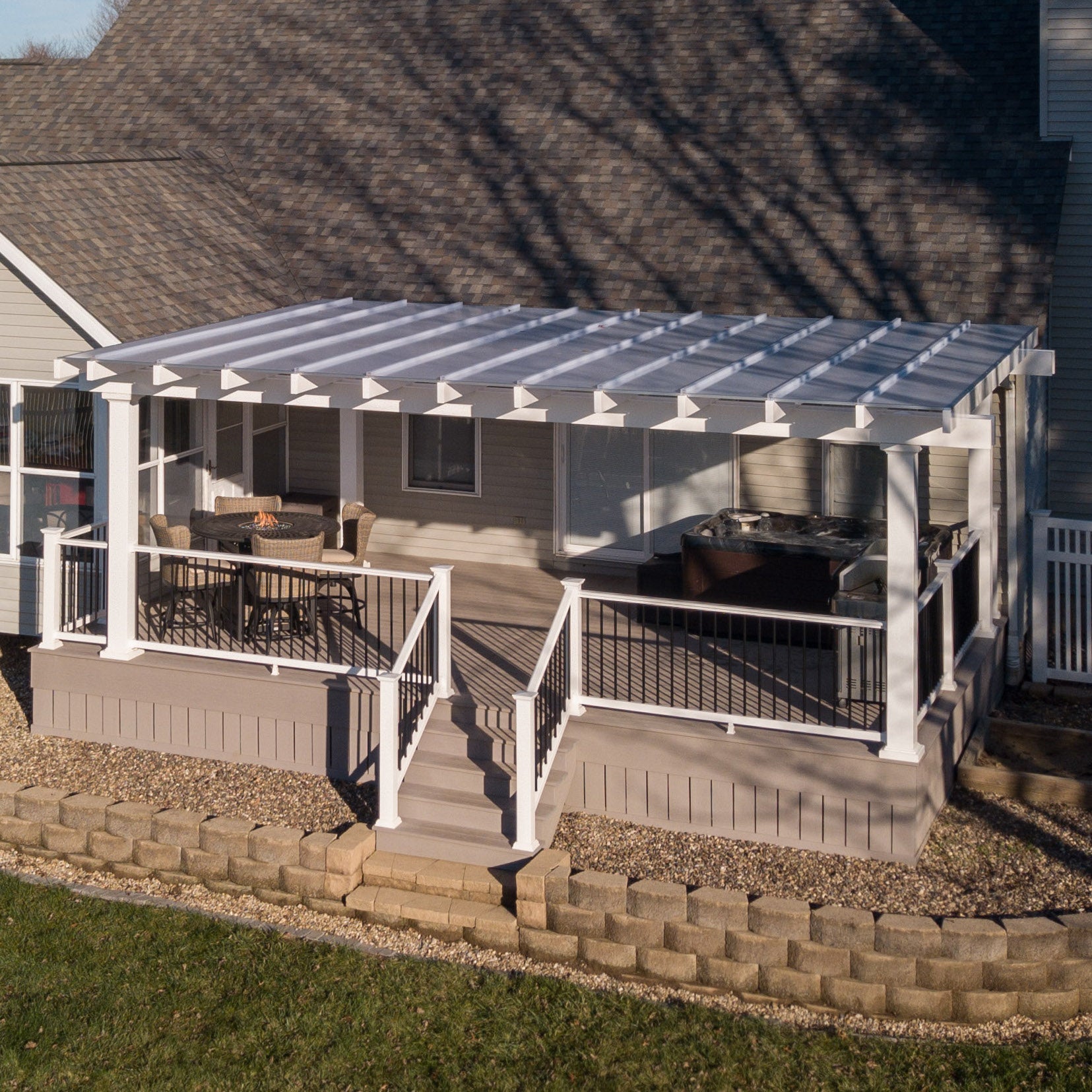
A hard top pergola is a permanent outdoor structure with a fixed, solid roof rather than open slats, fabric, or movable louvers. The hard top pergolas offered here use solid polycarbonate roof panels to create a fully covered, rainproof area over a patio, deck, poolside space, or outdoor living area.
In everyday use, “hard top pergola” generally describes a pergola-style structure with a rigid roof. It may also be called a solid-roof pergola, covered pergola, or patio cover. These terms distinguish it from a traditional pergola whose angled roof slats provide partial shade but do not form a rainproof covering.
A solid polycarbonate roof provides continuous overhead coverage instead of allowing sunlight and rain to pass between slats. This makes the space beneath the structure more practical for outdoor dining, upholstered furniture, grills, hot tubs, and other uses that benefit from dependable coverage.
The roof is fixed rather than adjustable. There are no louvers, motors, retractable fabric panels, or other moving roof components to operate or eventually replace.
A traditional pergola is primarily a shade structure. Its angled slats can provide 50%, 75%, or 90% shade coverage, but gaps remain between those slats. A hard top pergola uses an uninterrupted roof to protect the area below from rain while also delivering consistent shade.
Both terms can be accurate. The structure retains the posts, beams, rafters, decorative ends, and open sides associated with a traditional pergola, while its solid roof performs the practical function of a patio cover. For that reason, our rainproof patio covers are frequently described as hard top pergolas or pergolas with solid roofs.

The primary advantage of a hard top pergola is dependable overhead coverage. Its fixed polycarbonate roof helps turn an exposed patio into a more functional outdoor room without introducing motors, adjustable louvers, or retractable materials.
Solid polycarbonate panels form a rainproof roof, allowing the covered area to remain useful during wet weather. Compared with a slatted pergola, the roof provides better protection for dining areas, patio furniture, outdoor kitchens, hot tubs, and frequently used walkways.
Because the sides remain open, wind-driven rain can still enter around the perimeter. The structure provides overhead rain coverage rather than creating a fully enclosed room.
Both white and bronze polycarbonate roof panels provide 100% UV protection beneath the covered area. Unlike an open slatted roof, a hard top maintains continuous coverage as the sun moves across the sky.
This consistent protection can make the patio more comfortable while reducing direct sun exposure on furniture, cushions, and other items kept beneath the roof.
The polycarbonate roof can make the covered patio up to 15°F cooler. Actual comfort will also depend on the roof color, surrounding shade, time of day, airflow, local climate, and the orientation of the structure.
The open-sided design allows natural ventilation while the roof limits direct overhead sunlight. This combination is useful for dining areas, conversation spaces, poolside seating, and other places where airflow remains desirable.
A fixed roof does not depend on motors, hinges, rotating louvers, or retractable fabric. Eliminating those components simplifies normal ownership and avoids mechanical systems that may require adjustment, repair, or replacement later.
The extruded vinyl exterior also requires no routine painting, staining, or sanding. Normal cleaning is generally all that is needed to maintain its appearance.

A permanent hard top pergola depends on more than its roof panels. The roof, internal aluminum reinforcement, and vinyl exterior work together to provide weather protection, structural strength, and low-maintenance performance.
The fixed polycarbonate roof creates the continuous coverage that distinguishes these structures from slatted pergolas. Polycarbonate is lightweight relative to many solid roofing materials while still providing the rigidity and weather resistance required for a permanent patio covering.
The roof carries a 10-year warranty. It is intended for customers who prioritize reliable shade and rain protection rather than the ability to open and close the roof.
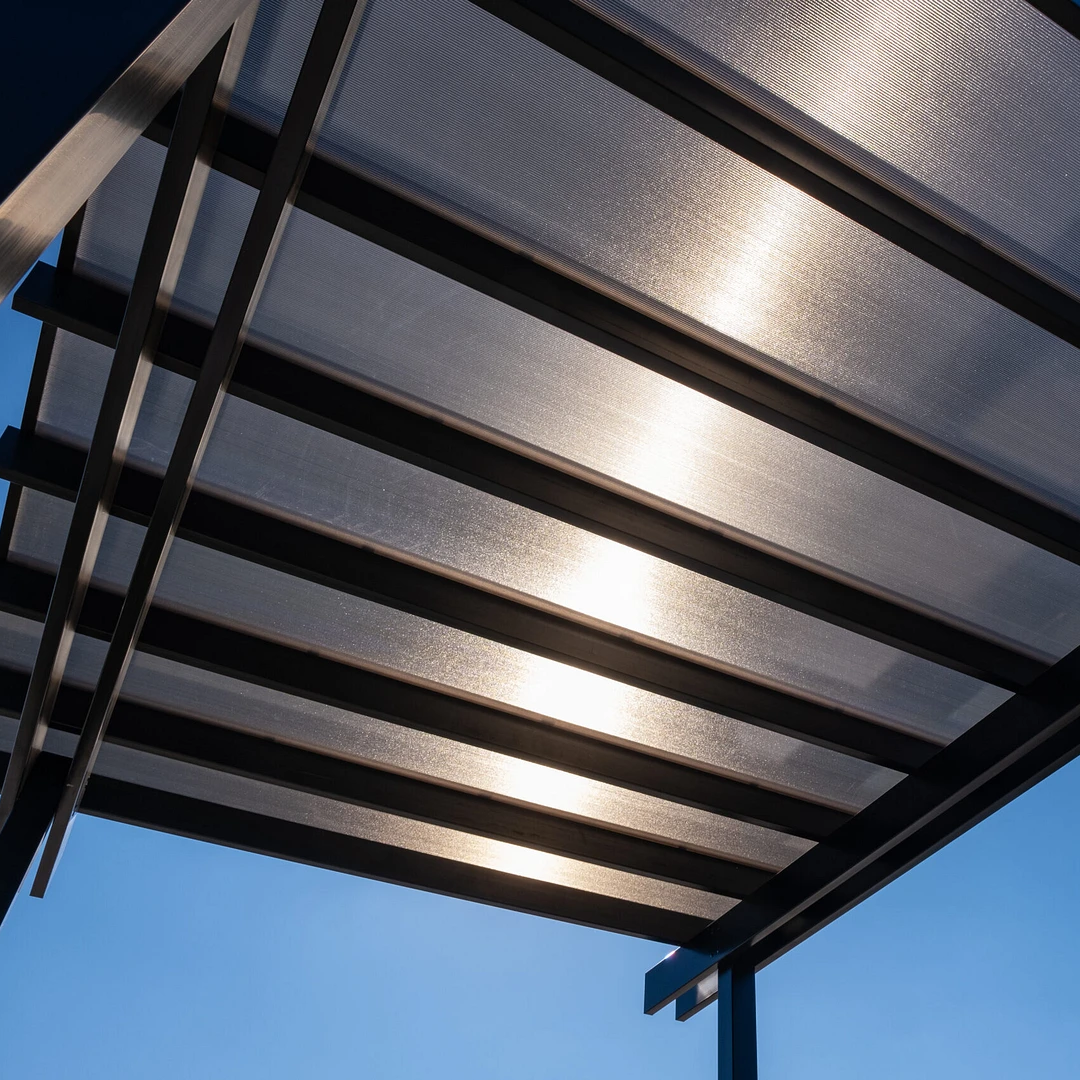
Customers can choose white or bronze polycarbonate panels. Both options provide 100% UV protection and can make the patio below up to 15°F cooler, so the decision can be based on the desired appearance and quality of light beneath the structure.
White panels create a brighter overhead appearance, while bronze panels produce a darker roof profile and warmer visual effect. Neither option is a motorized, retractable, or adjustable roof.
Aluminum inserts reinforce all weight-bearing structural components, including the posts, beams, and rafters. This internal frame provides high strength without the excessive weight of many solid framing materials and permits longer spans between posts.
The aluminum is rust-proof and engineered for demanding permanent installations. Thicker reinforcement also helps the structure resist bowing, bending, and damage during heavy weather.
The aluminum frame is enclosed by premium extruded vinyl that is colored throughout rather than painted only on the surface. Available frame colors include white, tan, and black, with white being the most affordable option and black the most expensive.
The vinyl does not require painting, staining, or sanding. Its thickness and material quality help it resist discoloration, deformation, and cracking in demanding outdoor conditions. Homeowners comparing materials can learn more about our vinyl pergola construction.
The structural frame carries a lifetime warranty, while the polycarbonate roof carries a 10-year warranty. Optional hurricane brackets are recommended in areas that may experience winds of 80 MPH or more; adding them includes a lifetime wind damage warranty on the pergola.
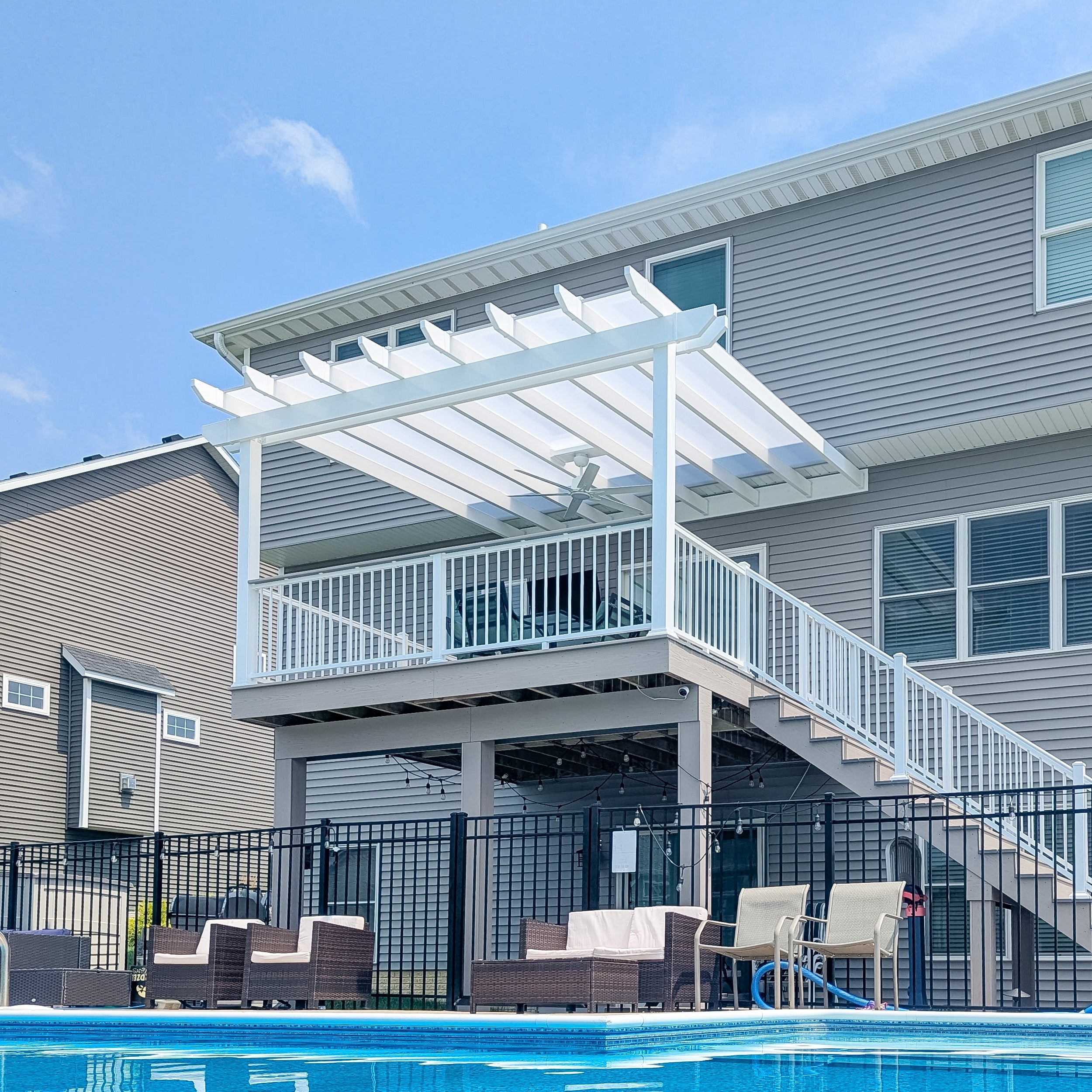
Hard top pergolas are available as freestanding structures or as patio covers attached to a house or other suitable building. The best configuration depends on the location of the outdoor area, the available attachment surface, and how the covered space will be used.
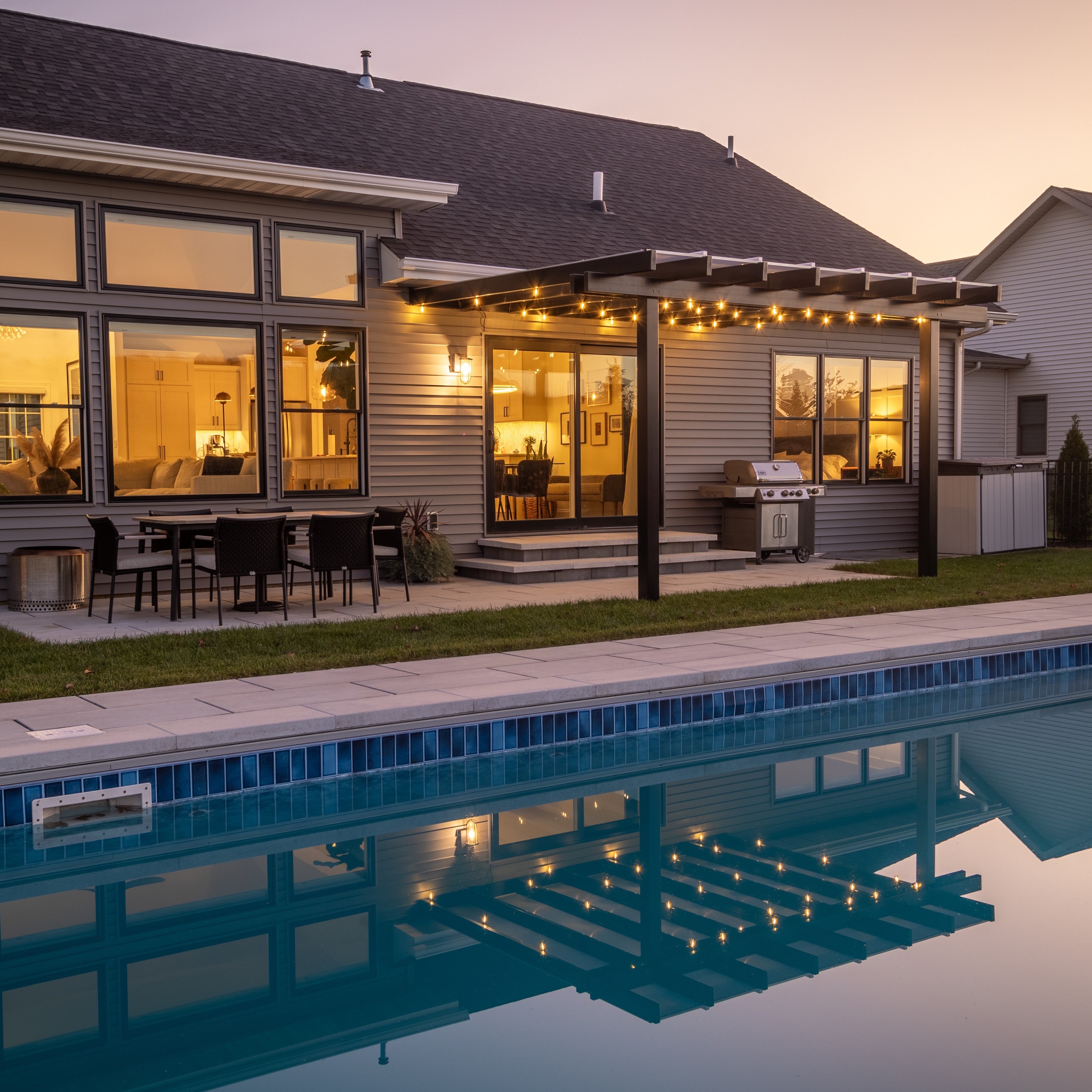
A freestanding structure is supported independently by its own posts. It can cover a detached patio, poolside seating area, hot tub, garden terrace, or another location where attachment to a building is unnecessary or impractical.
The standard four-post freestanding hard top pergola is available in sizes from 8 by 8 feet through 20 by 20 feet. Larger designs measuring 24 to 32 feet wide and up to 20 feet deep use six posts for the required support.
An attached hard top pergola connects to the house or another appropriate structure along one side. This configuration creates covered outdoor space directly outside a doorway and can provide a natural transition between indoor and outdoor living areas.
The two-post attached patio cover is available from 8 to 20 feet along the attachment side and from 8 to 20 feet out from the structure. Wider attached covers from 24 to 32 feet use three front posts and can extend up to 20 feet from the building.
These rainproof models use traditional pergola styling rather than the flush-corner design of our Modern slatted pergolas. The beams and rafters can include overhangs from 0 to 24 inches, and their visible ends can be finished with scrolled, beveled, or flat end caps.
This flexibility allows the structure to complement a range of architectural settings, from detailed traditional homes to properties where a simpler flat-end profile is preferred.
A hard top pergola can shelter a dining table, lounge grouping, outdoor kitchen, hot tub, or combination of activity zones. Freestanding configurations offer more flexibility away from the house, while attached models are particularly useful for covering patios and decks immediately outside the home.
Deck installations require confirmation that the underlying structure can support the pergola and its attachment loads. Whether installed on a deck, concrete patio, or dedicated footings, the structure must be anchored to an appropriate foundation.
Choosing a hard top pergola starts with the usable space rather than the maximum dimensions that will fit. The roof footprint, post locations, furniture plan, drainage, attachment method, and foundation all affect which configuration will function best.
Measure the intended width and depth at several points, especially when the patio borders walls, landscaping, pools, stairs, or roof projections. Note doors, windows, utilities, vents, and other features that could interfere with posts, beams, rafters, or the attached ledger.
Remember that the roof dimensions and post locations are not always identical. Traditional-style hard top pergolas can have beam and rafter overhangs from 0 to 24 inches, and posts can be located at the corners or inset by as much as 24 inches.
Plan around the furniture and activities that will occupy the space. A dining layout requires room for chairs to move behind the table, while lounge areas need circulation around sofas and conversation seating. Outdoor kitchens require additional clearance for appliances, preparation areas, and safe pathways.
Standard hard top sizes range from 8 by 8 feet to 32 by 20 feet, depending on the configuration and number of posts. Browse pergolas by width and depth to compare footprints before finalizing the layout.
The extruded vinyl frame is available in white, tan, or black. White is the most affordable frame color, while black is the highest-priced option. Roof panels are available in white or bronze, allowing the roof and structural colors to be selected separately.
Consider the home’s trim, exterior materials, roof color, and surrounding hardscape when choosing the combination. Because these are permanent structures, the selected colors should work with the property beyond a short-term furniture or décor change.
Post choices include 5-inch square posts with a lower trim ring, 5-inch square posts with upper and lower trim rings, or 7-inch square posts with upper and lower trim rings. Scrolled, beveled, and flat beam and rafter ends provide additional control over the finished architectural profile.
Optional fan mounts can be incorporated when overhead air movement is desired. Hurricane brackets are also available and are recommended where wind speeds may reach or exceed 80 MPH.
A hard top pergola is designed for permanent anchoring. Before ordering, determine whether the installation will use an existing concrete surface, suitable structural deck framing, or new footings. Local building authorities may also require permits, setbacks, engineering documentation, or specific foundation details.
The kits are designed to be DIY-friendly, but homeowners may also hire a qualified contractor. Review the available assembly information and videos when deciding which installation approach is appropriate.
A fixed polycarbonate roof is best suited to homeowners who want dependable coverage without mechanical roof components. Comparing it with slatted, louvered, retractable, and gazebo-style roofs helps clarify what each type of outdoor structure can—and cannot—provide.
A hard top pergola provides a continuous rainproof roof. A pergola with a slatted roof provides partial shade through fixed angled slats but allows rain to pass through the openings.
Choose the solid roof when rain protection and continuous shade are priorities. Consider a slatted design when a more open overhead appearance, filtered light, and partial shade are preferred.
A louvered pergola uses adjustable roof blades that rotate to change the balance of sunlight, ventilation, and coverage. A hard top pergola has a stationary roof that provides the same consistent coverage without motors or movable blades.
We do not offer louvered or motorized roof systems. These hard top kits are intended for buyers who value fixed weather protection, low maintenance, and fewer mechanical components rather than adjustable roof coverage.
A retractable canopy uses fabric that can be extended or withdrawn. Although this provides flexibility, fabric can stretch, fade, stain, tear, or eventually require replacement. It also does not provide the same permanent roof construction as fixed polycarbonate panels.
We do not offer canvas or retractable canopies. The hard top design is intended to remain in place as a lasting part of the property.
Both structures can have rigid roofs, but they often differ in appearance and construction. A hardtop gazebo commonly has a metal roof, a defined central peak, and a pavilion-like form. A hard top pergola retains the open sides, posts, beams, rafters, and optional decorative ends associated with pergola architecture.
Product names vary between manufacturers, so roof material and structural specifications are more useful than the label alone. Shoppers should confirm whether a structure has a solid polycarbonate or metal roof, how it is reinforced, and whether it is intended for permanent installation.
Among the roof types discussed here, a properly installed solid polycarbonate roof is the appropriate choice when dependable overhead rain protection is the main objective. Fixed slats are not rainproof, while retractable fabric and movable louvers rely on additional components and operating mechanisms.
The cost of a hard top pergola depends on its dimensions, attachment method, number of posts, frame color, roof color, structural options, and installation conditions. Evaluating those variables provides a more meaningful comparison than looking only at the advertised price of differently constructed outdoor structures.
Size is a primary cost factor because larger structures require more framing, roofing, and supporting posts. Freestanding and attached configurations also use different structural layouts, while options such as upgraded posts, longer overhangs, fan mounts, and hurricane brackets affect the final price.
White is the most affordable vinyl frame color, followed by tan, while black is the most expensive. Current product pricing should be used when comparing exact configurations.
Four-post freestanding models cover spaces up to 20 by 20 feet. Larger freestanding designs use six posts and extend to 32 by 20 feet. Attached models use two posts up to 20 by 20 feet and three posts for widths from 24 to 32 feet.
Installation expenses can vary with the foundation, site access, height, attachment surface, local permitting, and contractor rates. A simple installation on prepared concrete will have different requirements from a raised deck or a site that needs new footings.
A professional-grade hard top pergola should not be compared directly with a lightweight temporary canopy or an imported structure intended for occasional use. These pergolas use reinforced weight-bearing components, thick extruded vinyl, permanent anchoring, and a fixed roof designed to remain outdoors.
The initial investment reflects a structure intended to add functional covered space and lasting value to the property rather than a product expected to be replaced after a few seasons.
The extruded vinyl exterior does not need painting, staining, or sanding, and the aluminum reinforcement does not rust. Routine ownership generally involves cleaning the vinyl and roof and periodically inspecting anchors, fasteners, and drainage areas.
A fixed roof also avoids the motors, actuators, hinges, and retractable materials found in more mechanically complex systems. Fewer moving components can reduce the number of parts that may require service or replacement over time.
The frame includes a lifetime warranty, and the polycarbonate roof includes a 10-year warranty. Where 80 MPH or higher winds are possible, optional hurricane brackets add a lifetime wind damage warranty to the pergola.
Each kit is made in the USA with American-sourced materials. The combination of heavy-duty reinforcement, maintenance-free vinyl, permanent installation, and warranty coverage is central to its long-term value.
A hard top pergola is a permanent outdoor structure with a fixed, solid roof. Our hard top models use polycarbonate panels to provide continuous shade and rain protection.
The solid polycarbonate roof is rainproof when properly installed. Because the structure has open sides, wind-driven rain can still enter around its perimeter.
The roof is made from solid polycarbonate panels available in white or bronze. Both colors provide 100% UV protection and can make the covered patio up to 15°F cooler.
Yes. Hard top pergolas are available in both attached and freestanding configurations. The attachment surface and foundation must be suitable for a permanent structure.
Freestanding models range from 8 by 8 feet to 32 by 20 feet. Attached models range from 8 by 8 feet to 32 feet along the house by 20 feet out from the structure.
Yes. Posts can be placed at the corners or inset by as much as 24 inches, subject to the selected size and structural configuration.
No. We do not offer louvered, motorized, adjustable, canvas, or retractable roof systems. These hard top pergolas use fixed polycarbonate panels with no moving roof parts.
Yes. The kits are designed for DIY-friendly assembly, although a contractor may be preferable for larger structures, attached installations, or sites requiring new foundations.
Maintenance is minimal. The extruded vinyl exterior requires no painting, staining, or sanding; routine cleaning and periodic inspection of the roof, anchors, and fasteners are recommended.
The aluminum-reinforced frame has a lifetime warranty, and the polycarbonate roof has a 10-year warranty. Optional hurricane brackets add a lifetime wind damage warranty.


