

MADE IN THE USA
with American products
w/ American products


Home ▸ Free-Standing Pergolas
Free-standing pergolas create a permanent outdoor living space without needing to attach the structure to your home. Our free-standing pergolas are built with aluminum-reinforced structural components, a maintenance-free extruded vinyl exterior, and customizable shade or rainproof roof options for long-term backyard use. We offer 3 different styles of stand-alone pergolas. Choose the style you prefer and then select your desired pergola width & depth. [read more]


A free-standing pergola is an outdoor shade structure supported by its own posts instead of being mounted to a house, wall, or other structure. This makes it a flexible option for patios, pool areas, gardens, outdoor kitchens, and open backyard spaces.
 Unlike attached pergolas, free-standing pergolas do not rely on a ledger board or wall connection. The structure is supported by posts, beams, rafters, and either shade slats or a solid roof system, depending on the pergola type.
Free-standing pergolas are commonly used over patios, outdoor dining areas, poolside seating, fire pit spaces, garden walkways, and detached backyard lounges. Because they do not need to connect to the house, they can be placed where they best fit the layout of your yard.
Our free-standing pergolas are designed for permanent installation, not as lightweight temporary canopies. They are built with aluminum-reinforced structural components and a premium extruded vinyl exterior for long-term outdoor use.
The terms “free-standing pergola,” “freestanding pergola,” and “standalone pergola” are often used to describe the same type of structure: a pergola that stands independently on posts without attaching to another building.
Free-standing pergolas are popular because they create a defined outdoor space while giving homeowners more control over placement, size, shade, and overall layout.
Because a free-standing pergola does not need to attach to the home, it can be positioned where it makes the most sense for your property. This is especially useful for large patios, pool decks, garden areas, and detached outdoor living spaces.
A permanent free-standing pergola can help turn an open area into a more usable outdoor room. It gives structure to spaces used for dining, relaxing, entertaining, or adding shade near a pool or patio.
Our traditional and modern free-standing pergolas use fixed angled shade purlins, commonly called roof slats, with 50%, 75%, or 90% shade coverage options. These designs are made to provide meaningful shade while maintaining the open-air look of a pergola.
The extruded vinyl exterior does not require painting, staining, or sanding. It is designed to be easy to clean and maintain, making it a strong fit for homeowners who want a permanent outdoor structure without the upkeep of wood.
A professional-grade free-standing pergola can add long-term value to a backyard by making the outdoor space more functional and finished. It is a permanent structure, not a short-term replacement item.
The main difference between a free-standing pergola and an attached pergola is how the structure is supported. A free-standing pergola stands independently on posts, while an attached pergola connects to a house or structure on one side.
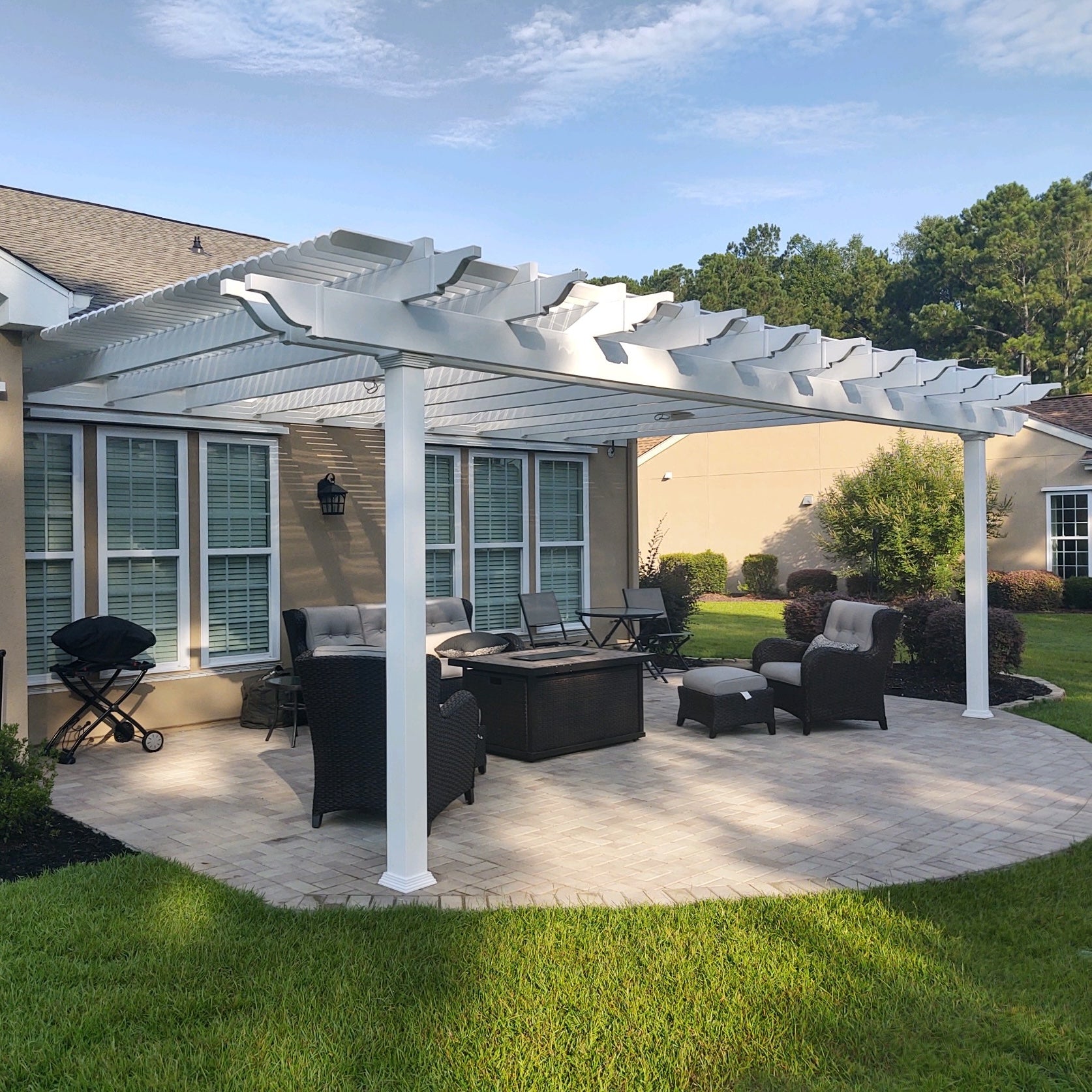 Free-standing pergolas use posts to support the full structure. Attached pergolas use a house or building connection along one side, usually with fewer front posts depending on the layout.
If your goal is to shade a patio directly against the home, an attached pergola may be the better fit. If you want a detached backyard feature, a free-standing pergola usually offers more layout flexibility.
Free-standing pergolas are ideal for open patios, pool areas, outdoor kitchens, garden seating areas, and other spaces away from the house. They are also useful when the home’s exterior wall is not the best location for a mounted structure.
Attached pergolas work well when you want shade directly outside a door, along the back of the house, or over a patio connected to the home. You can browse our attached pergola collection if your project requires a wall-mounted layout.
Neither option is automatically better. The right choice depends on where you want the shade, how your outdoor space is arranged, and whether you want the structure connected to the home or positioned independently in the yard.
Choosing the right free-standing pergola starts with the size of your outdoor space, the style of your home, the amount of shade you want, and how you plan to use the area underneath.
Start by measuring the area you want to cover and thinking about what will go underneath the pergola. A small seating area may only need a compact 4-post structure, while a large dining or entertainment area may require a larger 6-post or 9-post configuration.
You can also use our shop by pergola dimensions page to compare common width and depth combinations.
Traditional pergolas include optional beam and rafter overhangs, decorative end caps, and more post placement flexibility. They work well for classic homes, large backyards, and projects where a more decorative pergola style is desired.
Modern pergolas have square, flush corners with no beam or rafter overhangs and no end caps. They are best for contemporary homes or outdoor spaces where a clean, minimal design is preferred.
Leave enough room under the pergola for furniture, walkways, and comfortable movement. Outdoor dining spaces, lounge sets, fire pits, and poolside seating areas all require different clearances.
Traditional free-standing pergolas can have posts in the corners or inset up to 36 inches, depending on the configuration. Modern pergolas have posts in the corners only, which creates a clean square-cornered layout.
Our pergolas are designed to be DIY-friendly or installed by a contractor. For planning help, see our assembly information and videos.
Free-standing pergolas can provide open slatted shade or, in the case of patio covers, a solid rainproof roof. The right roof style depends on whether your priority is shade, rain protection, or a balance of openness and coverage.
Traditional and modern free-standing pergolas use fixed angled shade purlins, commonly called slats. These slatted roofs are designed for shade, airflow, and visual openness, but they are not rainproof.
You can browse more options in our pergolas with slatted roof collection.
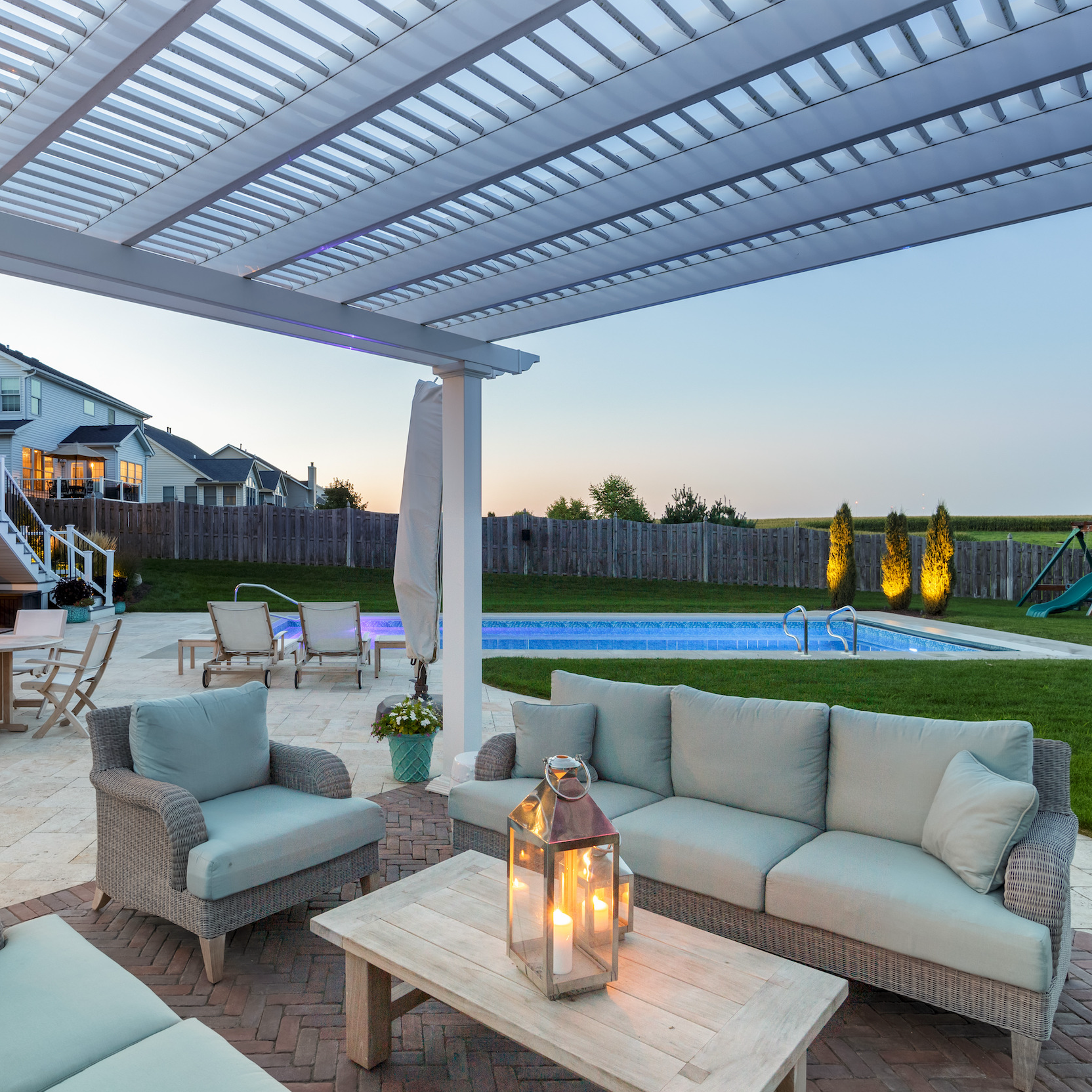 50%, 75%, and 90% Shade Coverage
Shade coverage is based on purlin spacing. A 50% shade option uses 6-inch on-center spacing, 75% uses 4-inch on-center spacing, and 90% uses 3-inch on-center spacing.
Higher shade coverage creates a denser roof pattern and more shade. Lower shade coverage creates a more open look with more sunlight passing through.
For rain protection, choose a free-standing patio cover with a solid polycarbonate roof. These are often called rainproof patio covers, covered pergolas, or pergolas with a solid roof.
Rainproof patio covers are available with white or bronze polycarbonate roof panels. Both roof panel colors offer 100% UV protection and can make the patio up to 15 degrees cooler.
Our free-standing pergolas do not use louvered, retractable, canvas, or motorized roof systems. The designs are fixed, permanent structures with no moving parts to maintain or replace.
Free-standing pergolas can be customized by style, size, color, post design, shade coverage, and roof type. These options help match the structure to your home, outdoor layout, and desired level of shade or coverage.
Our free-standing pergolas are available in white, tan, or black vinyl. White is the most affordable color option, while black is the most expensive.
Each main pergola type uses aluminum inserts in the weight-bearing structural components, including posts, beams, and rafters. The exterior is premium extruded vinyl, colored throughout rather than painted.
This combination gives you the strength of an aluminum-reinforced frame with the low-maintenance exterior of a vinyl pergola.
Traditional pergolas offer 5-inch square posts, 7-inch square posts, or 10-inch round posts depending on the selected design. Modern pergolas use 7-inch square posts, with black modern pergolas using 8-inch square posts.
Traditional pergolas and rainproof patio covers can include scrolled, beveled, or flat beam and rafter end caps. Modern pergolas do not include end caps because they are designed with flush, square corners.
Fan mounts are available as an optional add-on for traditional pergolas, modern pergolas, and rainproof patio covers. This can be useful when planning a seating or dining area where additional airflow is desired.
Hurricane brackets are available for traditional pergolas and rainproof patio covers and are recommended for areas that may experience 80+ MPH winds. Adding hurricane brackets adds a lifetime wind damage warranty to the pergola.
The cost of a free-standing pergola depends on size, roof type, color, post configuration, style, and selected add-ons. Larger permanent structures with stronger materials and more coverage generally cost more than smaller decorative pergolas.
Size is one of the biggest cost factors. A 4-post free-standing pergola is typically more affordable than a larger 6-post or 9-post pergola because it uses fewer structural components and covers a smaller area.
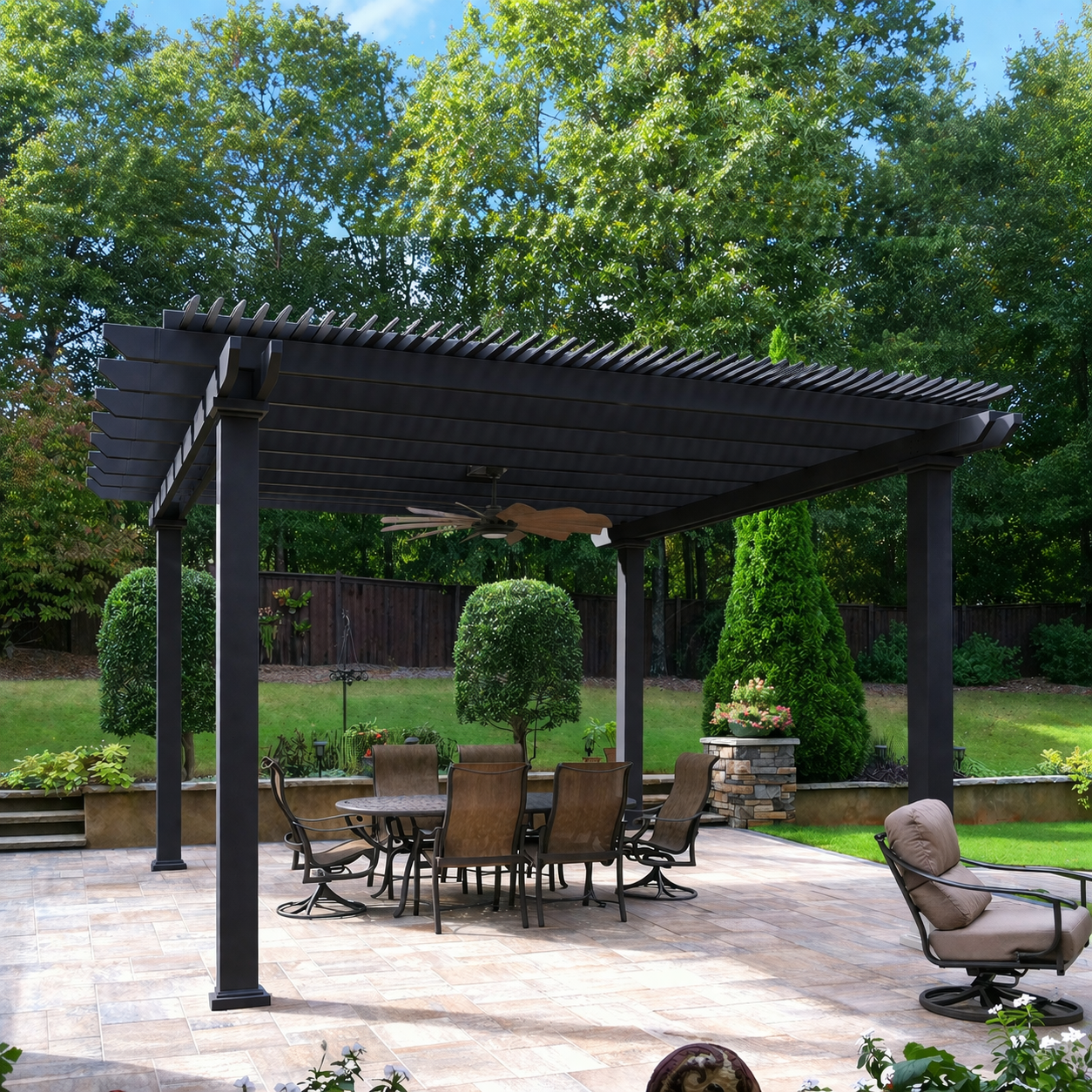 Traditional and modern pergolas use slatted shade roofs, while rainproof patio covers include a solid polycarbonate roof system. The roof type, structure size, and design style all affect the final price.
White vinyl is the most affordable color option. Tan and black are also available, with black generally being the most expensive option.
Optional features such as fan mounts, larger sizes, additional posts, higher shade coverage, and hurricane brackets can affect cost. These options are best evaluated based on your climate, layout, and how you plan to use the pergola.
A permanent free-standing pergola is different from a temporary budget canopy or lightweight imported structure. With aluminum-reinforced components, a maintenance-free vinyl exterior, and a lifetime warranty on the frame, it is designed as a long-term outdoor improvement.
Our free-standing pergolas are built for homeowners who want a permanent, low-maintenance outdoor structure rather than a temporary shade product. They combine aluminum-reinforced strength with a premium extruded vinyl exterior for long-term outdoor performance.
The structural components are reinforced with rust-proof aluminum inserts for strength, stability, and longer spans between posts. This helps the pergola resist bowing, bending, and heavy wind conditions.
The vinyl exterior is thick, colored throughout, and not painted. It is designed to resist discoloration, cracking, deformation, and weather-related wear over time.
Our pergolas are made in the USA with America-sourced materials. They are not cheap temporary imports designed to be replaced after a few seasons.
Traditional pergolas, modern pergolas, and eyebrow pergolas include a lifetime warranty. Rainproof patio covers include a lifetime warranty on the frame and a 10-year warranty on the roof panels.
These pergolas are best for homeowners who want a professional-grade outdoor structure that adds usable shade, improves the backyard, and requires very little maintenance over time. For more real project examples, visit our photo gallery.
A free-standing pergola is an outdoor structure supported by its own posts instead of being attached to a house, wall, or building.
Yes. Our free-standing pergolas are designed for permanent installation, not temporary or seasonal use.
Yes. Traditional and modern free-standing pergolas use fixed angled shade slats with 50%, 75%, or 90% shade coverage options.
No. Slatted pergolas provide shade but are not rainproof. For rain protection, choose a freestanding patio cover with a solid polycarbonate roof.
Traditional free-standing pergolas are available up to 44' x 44' with a 9-post configuration. Modern free-standing pergolas are available up to 32' x 32'.
Free-standing pergolas are available in white, tan, or black vinyl. White is the most affordable color option, while black is the most expensive.
No. The extruded vinyl exterior does not require painting, staining, or sanding.
Yes. The pergolas are designed to be DIY-friendly, though many customers also choose to hire a contractor for installation.
No. We do not offer louvered, motorized, retractable, or canvas pergola systems.
Yes, our free-standing pergolas are made in the USA with America-sourced materials.


