

MADE IN THE USA
with American products
w/ American products


Home ▸ Pergolas Attached to House
A pergola attached to a house creates permanent shade directly off your patio, deck, or outdoor living area. Our attached pergolas are built with heavy-duty aluminum-reinforced structural components and a premium extruded vinyl exterior for long-term durability with virtually no maintenance. We offer 3 different styles of wall-mounted pergolas. Choose the style you prefer and then select your desired pergola width & depth. [read more]


 A pergola attached to a house is a permanent outdoor structure that connects to an exterior wall or other supporting structure, then extends outward over a patio, deck, walkway, or outdoor living space.
Instead of standing independently on all sides, an attached pergola uses the house connection on one side and support posts on the outer side. This creates a more integrated look and helps define the outdoor area directly beside your home.
Attached pergolas are commonly used over patios, decks, outdoor dining areas, grilling spaces, and backyard seating areas. They are especially useful when you want shade close to the home rather than in a separate part of the yard.
The terms are often used interchangeably. A wall-mounted pergola is typically an attached pergola that connects to the house or another structure using a ledger-style connection.
An attached pergola can make your backyard feel more usable, finished, and connected to your home. For many homeowners, it becomes the natural transition between indoor living and outdoor living.
Because it is installed directly off the house, an attached pergola shades the patio, deck, or seating area closest to your main living space. Traditional and modern designs use fixed angled roof slats with 50%, 75%, or 90% shade coverage options.
A house-attached pergola helps turn an open patio into a defined outdoor room. It can make the area feel more intentional for dining, relaxing, entertaining, or enjoying the backyard.
A permanent pergola is not a temporary canopy or disposable backyard accessory. Our pergolas are built with aluminum-reinforced structural components, premium vinyl exteriors, and lifetime warranty coverage on the frame.
The extruded vinyl exterior does not need painting, staining, or sanding. It is designed for homeowners who want the look of a finished outdoor structure without the ongoing upkeep of traditional wood.
Both attached and freestanding pergolas can create shade and structure, but they work best in different spaces. The right choice usually depends on where you want the shade and how you plan to use the area.
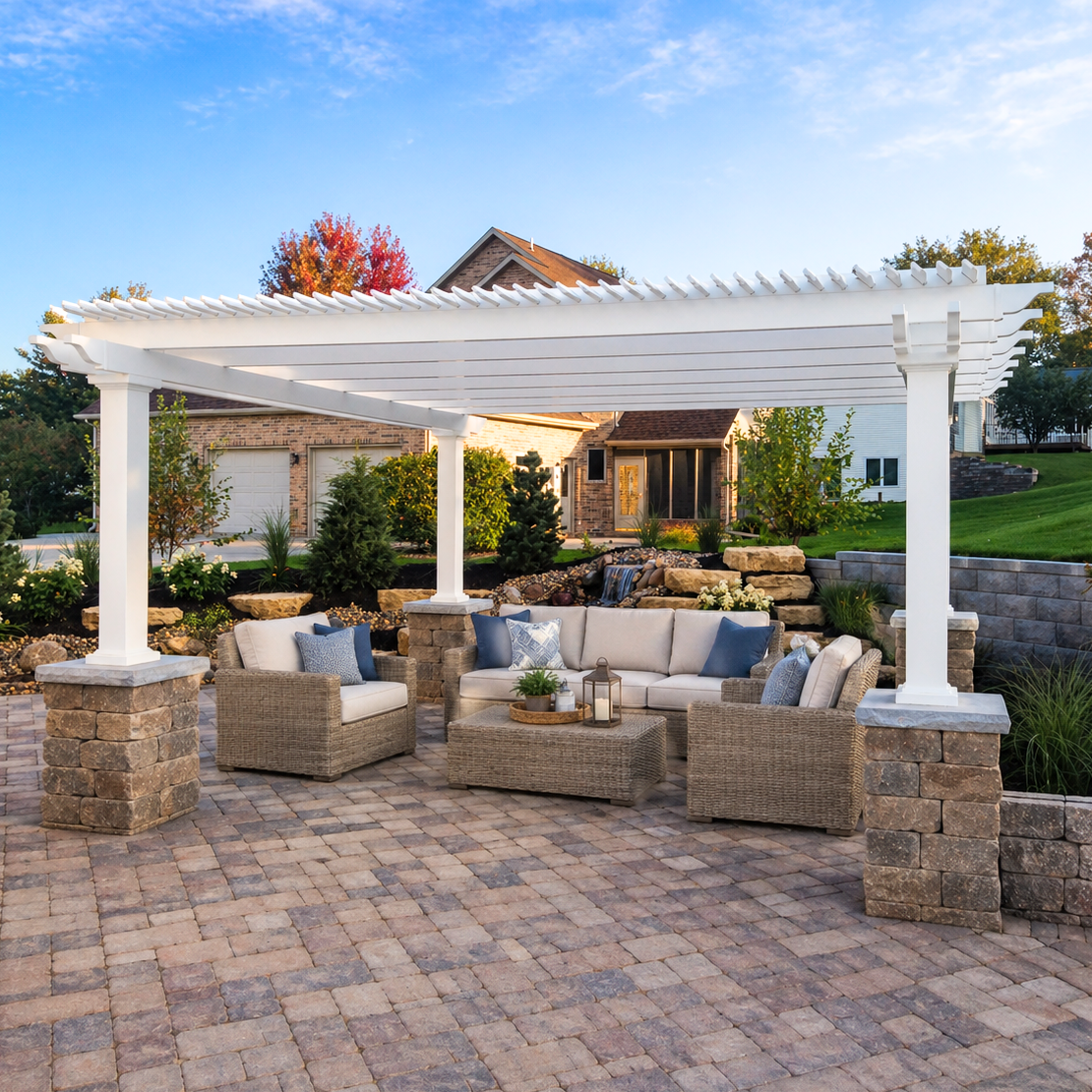 Choose attached for patios and decks near the home
An attached pergola is usually the better fit when the outdoor area is directly beside the house. It creates a built-in look and keeps the shade close to doors, kitchens, dining rooms, or living spaces.
A freestanding pergola works better when the structure needs to stand away from the house, such as near a pool, garden, fire pit, or detached seating area.
Attached pergolas typically require fewer support posts than comparable freestanding designs because one side connects to the structure. Traditional attached pergolas can also allow inset post placement, while modern pergolas use posts in the corners.
Attached pergolas create a seamless architectural extension of the home. Freestanding pergolas feel more like a separate destination within the yard.
The best attached pergola size depends on the width of the area along your house, how far you want the structure to extend outward, and what furniture or activities you want underneath it.
The attached side should be sized to fit the wall, patio, or deck area you want to cover. Traditional attached pergolas are available up to 44 feet wide, while modern attached pergolas are available up to 32 feet wide depending on configuration.
The projection determines how far the pergola extends out from the structure. Smaller projections work well for walkways and compact seating areas, while deeper projections are better for dining sets, lounge furniture, or larger patios.
Before choosing a size, consider the full footprint of your outdoor furniture. Leave enough space for chairs to pull out, people to walk around tables, and doors to swing open comfortably.
If you are comparing dimensions, our shop by pergola dimensions page can help you narrow options by width and depth before choosing a final configuration.
The roof style is one of the most important decisions when buying a pergola attached to a house. Some homeowners want filtered shade, while others want a fully covered roof for rain protection.
 Traditional and modern attached pergolas use fixed angled roof slats. These slatted roofs are designed for shade, not rain protection, and are available in 50%, 75%, or 90% shade coverage.
For a fully covered option, choose a rainproof patio cover. These structures use solid polycarbonate roof panels that provide rain protection, 100% UV protection, and can make the patio up to 15 degrees cooler.
Traditional attached pergolas can include beam and rafter overhangs with decorative end caps. Modern attached pergolas have clean square corners with no overhangs and no end caps.
Our attached pergolas do not use louvered, motorized, retractable, or canvas canopy systems. Instead, they are built as fixed permanent shade structures or solid-roof patio covers with no moving parts.
Material quality has a major impact on how long an attached pergola lasts, how much maintenance it needs, and how well it performs in weather.
Our main attached pergolas use aluminum inserts in weight-bearing structural components, including posts, beams, and rafters. This creates a strong, rust-proof internal frame while keeping the structure lighter than many solid-material alternatives.
The exterior is premium extruded vinyl that is colored throughout, not painted. This helps the pergola resist peeling, repainting needs, and the regular maintenance associated with wood structures.
Wood pergolas can be attractive, but they usually require staining, sealing, sanding, or repainting over time. A vinyl pergola is a better fit for homeowners who want a cleaner long-term ownership experience.
Aluminum reinforcement helps support longer spans, improves strength, and reduces the risk of bowing or bending over time. This is especially important for larger attached pergolas and permanent installations.
The cost of a pergola attached to a house depends on the size, style, roof type, color, post configuration, and selected upgrades. Larger structures and fully covered roof systems typically cost more than smaller slatted pergolas.
 Width, projection, and number of posts are major cost factors. A compact two-post attached pergola will generally cost less than a large multi-post structure designed to cover a larger patio or outdoor living area.
Slatted-roof pergolas are priced differently than fully covered rainproof patio covers. Choosing 50%, 75%, or 90% shade coverage affects the number of roof slats used in traditional and modern pergolas.
White is typically the most affordable vinyl color, while tan and black cost more. Traditional designs may also include choices such as overhang length, post style, and scrolled, beveled, or flat end caps.
Our attached pergolas are designed to be DIY-friendly, but many homeowners choose to have a contractor install them. Installation cost can vary depending on site conditions, wall attachment requirements, permits, and local labor rates.
It is usually called an attached pergola, wall-mounted pergola, or house-attached pergola.
A slatted pergola provides shade but is not rainproof. For rain protection, choose a patio cover with a solid polycarbonate roof.
Yes. Our attached pergolas are designed as permanent outdoor structures, not temporary canopies or lightweight decorative covers.
Most attached pergolas use support posts on the outer side of the structure. The exact number depends on the size and configuration.
Vinyl with aluminum-reinforced structural components is a strong low-maintenance option because it does not require painting, staining, or sanding.
Yes. Traditional and modern slatted pergolas are available with 50%, 75%, or 90% shade coverage.
No. Our pergolas use fixed slatted roofs or solid polycarbonate patio cover roofs with no motorized, retractable, or louvered systems.
Yes. Our pergolas are made in the USA with America-sourced materials.


