

MADE IN THE USA
with American products
w/ American products


Home ▸ 4-Post Pergolas
Explore permanent 4-post pergolas designed to create defined shade and gathering space without relying on a connection to your home. Choose a Traditional or Modern slatted-roof design for 50%, 75%, or 90% shade, or select a solid polycarbonate roof for rain protection. Every structure combines aluminum-reinforced weight-bearing components with a low-maintenance extruded vinyl exterior. [read more]


A 4-post pergola is a freestanding outdoor structure supported by four vertical posts, typically positioned near the corners of a square or rectangular footprint. Unlike a wall-mounted pergola, it does not depend on a house or another building for structural support.
The four posts transfer the weight of the beams, rafters, and roof components to permanent footings or another approved foundation. Correct post placement, anchoring, and site preparation are therefore essential parts of the installation—not optional finishing details.
Sunset Pergola Kits uses aluminum inserts in every weight-bearing post, beam, and rafter of its Traditional, Modern, and rainproof four-post structures. The aluminum supplies structural strength, while the premium extruded vinyl exterior provides the finished appearance and protects against routine exposure.
A four-post design belongs to the broader category of free-standing pergolas. Because all four sides are supported independently, the structure can be placed over a patio, poolside seating area, garden terrace, outdoor kitchen, or another suitable location away from the house.
By comparison, most single-span attached pergolas use a wall-mounted ledger on one side and posts on the outer side. Attached designs can be useful directly outside a door, but they require a suitable building connection and different installation planning.
Four-post pergolas are commonly used to define an outdoor dining room, conversation area, grilling station, hot-tub setting, or poolside lounge. The best size depends on the furniture footprint, walking clearances, roof coverage, and the amount of open space desired around each post.
Four posts are suitable only within the supported size range of the selected model. Traditional freestanding slatted pergolas use four posts from 8' × 8' through 24' × 24'; Modern models use four posts from 8' × 8' through 16' × 16'; and freestanding rainproof patio covers use four posts from 8' × 8' through 20' × 20'. Larger structures use six or nine posts as specified for the product rather than attempting unsupported spans.
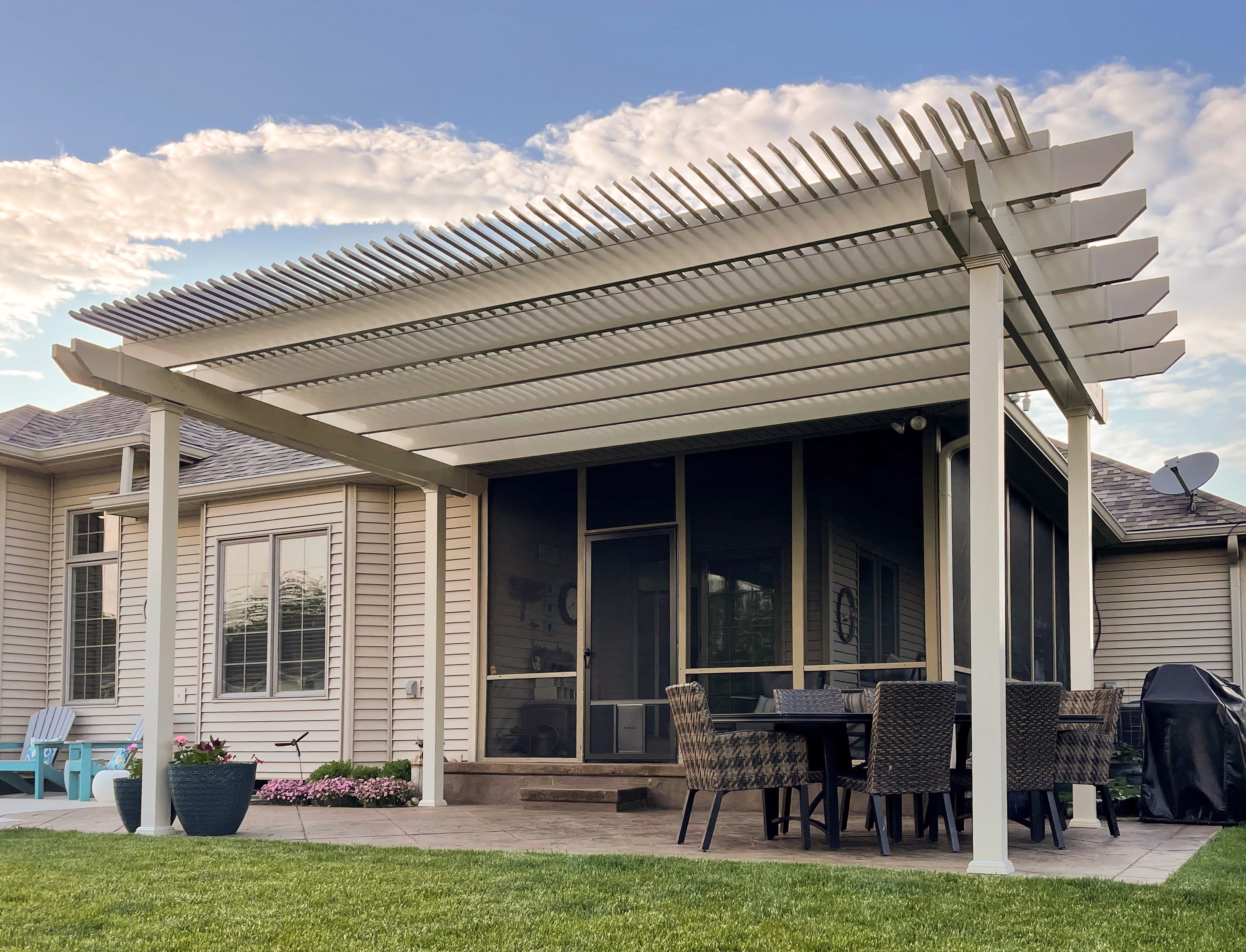
A freestanding four-post design can add useful shade or weather protection wherever the site can support a permanent structure. Its independent frame makes it especially practical when an attachment to the home is undesirable, unavailable, or poorly aligned with the area to be covered.
Because support comes from four posts, the pergola does not have to follow the position, height, or construction of an exterior wall. It can be centered over an existing patio, positioned beside a pool, or used to establish a separate destination elsewhere in the yard.
The posts and overhead frame create the visual boundaries of an outdoor room without enclosing it. This makes a four-post structure useful for organizing dining, seating, and entertaining areas while preserving open views and airflow.
Traditional and Modern models use fixed, angled roof slats designed to provide measurable shade coverage. Depending on the selected spacing, the roof provides approximately 50%, 75%, or 90% shade rather than functioning only as an ornamental framework.
Four-post construction avoids transferring the pergola’s roof load to the home. This can simplify placement decisions when the exterior wall lacks a suitable attachment point, although the posts must still be secured to correctly designed footings or foundations.
These pergolas are intended as professional-grade permanent structures, not temporary seasonal canopies. Their reinforced construction, durable exterior, and usable shade can make an outdoor area more functional while complementing a well-designed home and landscape.
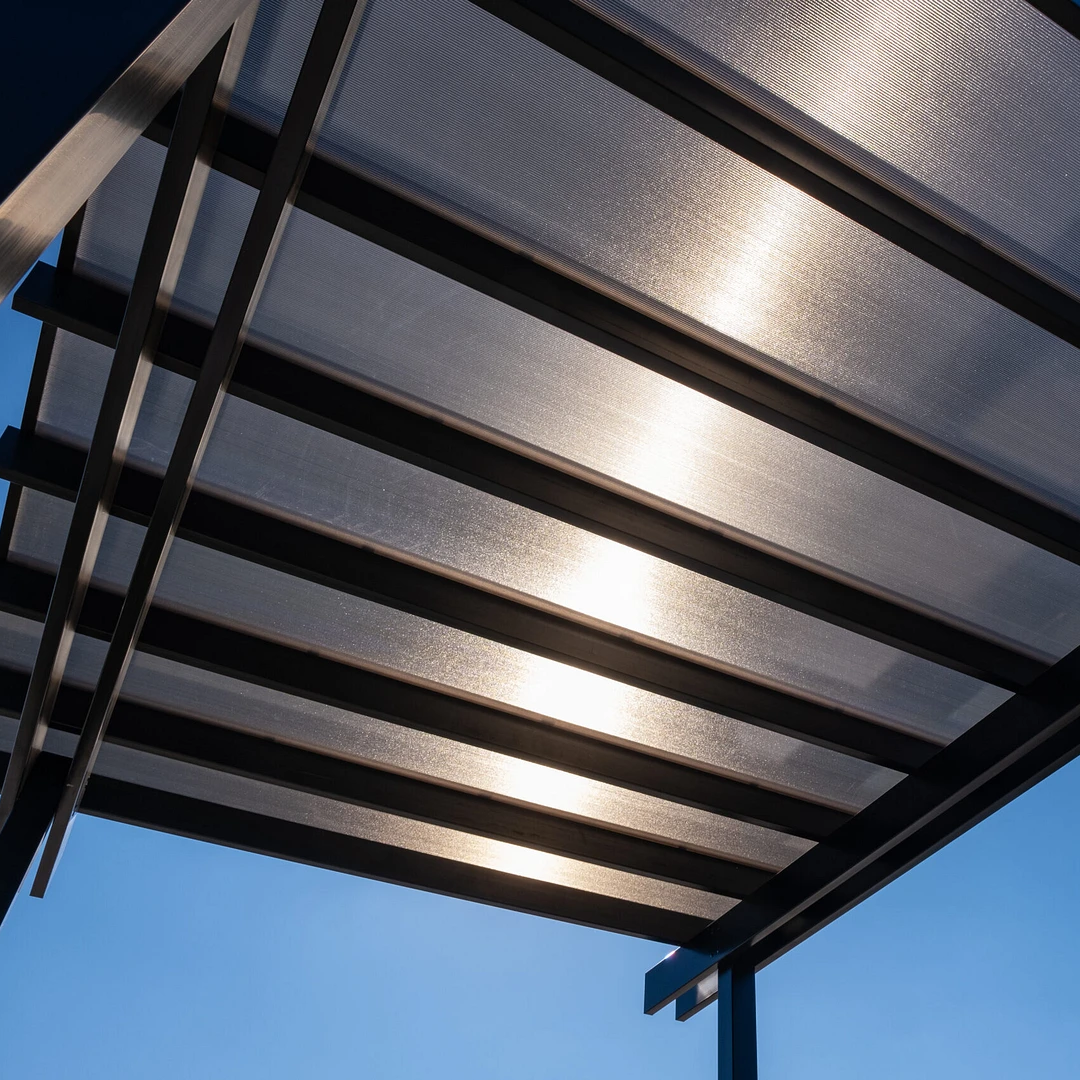
The roof determines whether a four-post pergola provides partial shade or complete overhead coverage. Sunset Pergola Kits offers fixed slatted roofs and solid polycarbonate roofs; it does not offer motorized, louvered, retractable, or canvas systems.
Pergolas with slatted roofs use fixed, angled purlins to reduce direct sunlight while maintaining the characteristic open-roof appearance of a pergola. Purlins spaced 6 inches on center provide approximately 50% shade, 4-inch spacing provides approximately 75%, and 3-inch spacing provides approximately 90%.
The slats do not move or retract, which eliminates motors and moving roof parts that can wear out. Even the 90% configuration remains a shade roof, however, and is not designed to keep the area beneath it dry.
For full overhead coverage, rainproof patio covers use solid polycarbonate panels rather than slats. These four-post models are frequently described as covered pergolas or pergolas with solid roofs, although “patio cover” is the more precise product term.
The solid roof protects the patio from rain and provides 100% UV protection. It can also help keep the covered patio up to 15°F cooler.
Rainproof patio covers are available with white or bronze polycarbonate panels. Both choices provide the same UV protection and rain coverage, so the decision primarily concerns the desired appearance and the character of the filtered light beneath the roof.
Choose a slatted roof when the priority is substantial shade combined with an open-air pergola appearance. Choose a solid polycarbonate roof when dining, furniture, a hot tub, or another outdoor activity requires dependable protection from both sun and rain.
Both roof systems are fixed. Homeowners who specifically want rotating louvers, retractable fabric, or remote-controlled adjustment will need a different product category; these four-post pergolas prioritize durable construction, predictable coverage, and fewer components that require repair or replacement.
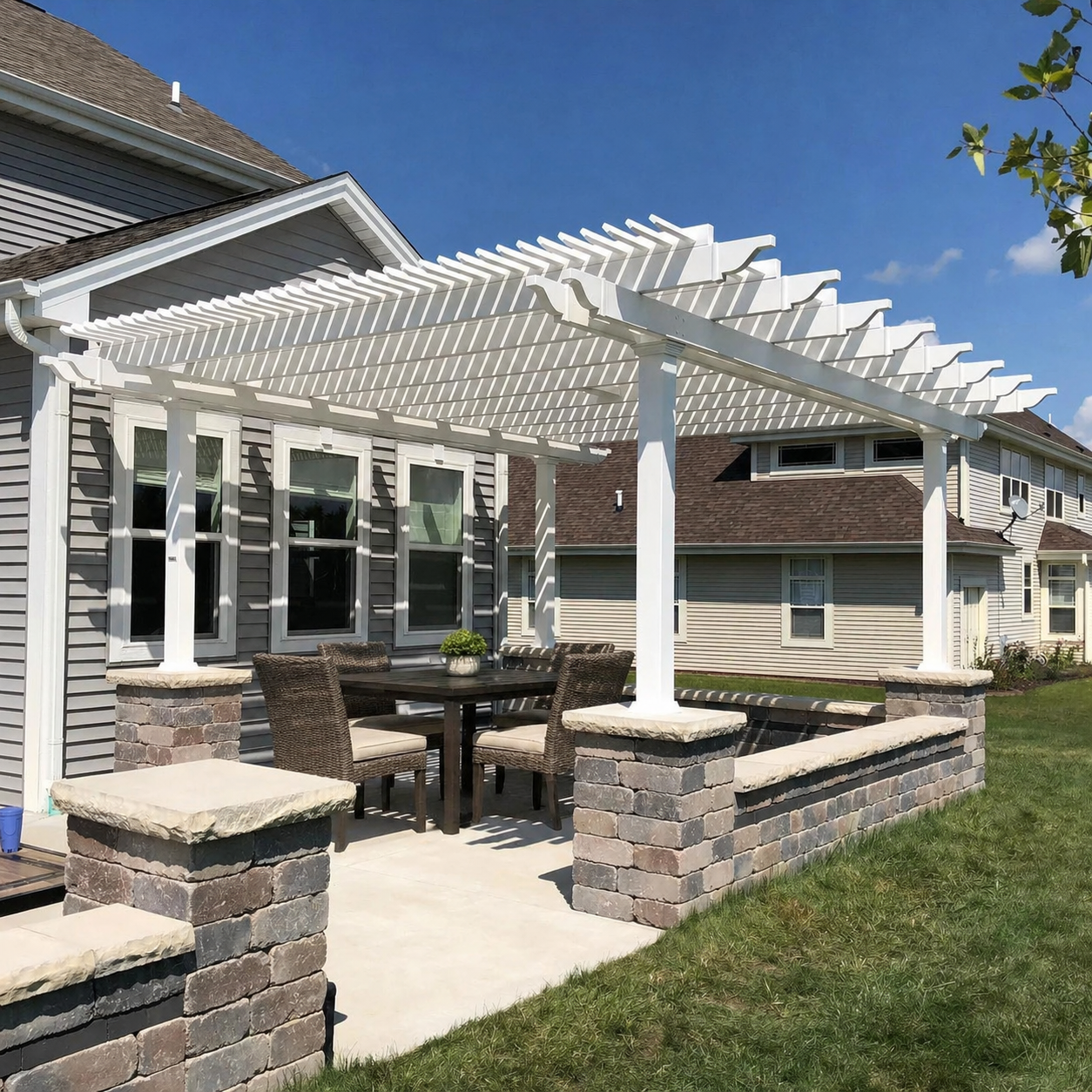
Selecting a pergola involves more than matching its outside dimensions to the patio. The roof style, post locations, overhangs, furniture footprint, and circulation paths all affect how much usable space the finished structure provides.
The Traditional four-post slatted pergola is offered from 8' × 8' through 24' × 24'. The Modern four-post pergola is available from 8' × 8' through 16' × 16', while the four-post rainproof patio cover is available from 8' × 8' through 20' × 20'. Shoppers can use the pergola dimensions guide to explore available width-and-depth combinations.
Measure the complete furniture arrangement rather than the table, sofa, or grill alone. Allow usable clearance for chairs to move, people to walk around the arrangement, and posts to remain outside important traffic paths.
Before ordering, confirm whether the listed dimensions describe the roof footprint, post-to-post spacing, or another product measurement. Overhangs and inset posts can cause the roof coverage and usable space between posts to differ.
The Traditional freestanding four-post pergola can include beam and rafter overhangs from 0 to 36 inches. Posts may sit at the corners or be inset by as much as 36 inches, and scrolled, beveled, or flat end caps provide additional architectural control.
Post choices include 5-inch square, 7-inch square, and 10-inch round profiles, with available trim configurations varying by post. This range makes the Traditional style appropriate when the pergola should coordinate with classic, transitional, or detailed residential architecture.
The Modern freestanding four-post pergola uses flush, square corners with no beam or rafter overhangs and no decorative end caps. Its posts remain at the corners and cannot be inset.
Modern models use 7-inch square posts in white or tan, with an 8-inch square profile used for black. Buyers can choose posts with or without a lower trim ring, depending on the color and desired level of detail.
White, tan, and black vinyl exteriors are available, with white being the most affordable and black the most expensive. Traditional slatted and rainproof models offer scrolled, beveled, or flat end caps, while Modern models use clean flush ends without end caps. Optional fan mounts are available for Traditional, Modern, and rainproof structures.

A permanent four-post structure must do more than look substantial. Its frame, exterior material, anchoring, and model-specific weather options determine how well it performs over time.
All weight-bearing posts, beams, and rafters in these four-post pergolas contain heavy-duty aluminum inserts. This reinforced construction provides strength without requiring closely spaced posts, helping the structure maintain longer clear spans and resist bowing, bending, and breaking.
These are best described as aluminum-reinforced pergolas because the aluminum forms the internal structural frame rather than the visible exterior.
The aluminum frame is covered with thick, premium extruded vinyl that is colored throughout rather than surface-painted. It does not require the recurring sanding, staining, or painting associated with exposed wood, and routine cleaning is generally straightforward.
The vinyl is designed to resist discoloration, deformation, and cracking through changing weather conditions. It also creates a finished architectural appearance without exposing the structural aluminum.
A four-post pergola is not a portable shade shelter. Each post must be anchored to an appropriate foundation based on the site, structure, and applicable requirements. Existing slabs should be evaluated before installation rather than assumed to be suitable.
Because building codes, footing requirements, setbacks, and permits vary, the property owner should confirm local requirements before ordering or beginning site work.
Optional hurricane brackets are available for Traditional slatted pergolas and rainproof patio covers and are recommended where winds may exceed 80 mph. Adding the brackets includes a lifetime wind-damage warranty for the pergola. Hurricane brackets are not offered on Modern pergolas.
Site-specific performance still depends on proper anchoring and installation. Local wind, code, and engineering requirements should be addressed during project planning rather than inferred from the product name alone.
Traditional and Modern pergolas carry a lifetime warranty. Rainproof patio covers include a lifetime warranty on the frame and a 10-year warranty on the polycarbonate roof. The structures are made in the USA using American-sourced materials.
Several outdoor structures can cover the same patio, but they do not provide the same support method, roof performance, or visual character. Comparing those differences is more useful than relying on category names alone.
A four-post freestanding pergola carries its roof independently, allowing placement away from a building or over a patio without an appropriate wall connection. An attached pergola uses the house or another structure to support one side, usually reducing the number of outer posts and creating a direct extension of the building.
The better choice depends on placement and site conditions. Select freestanding construction for flexible positioning and independent support; consider an attached model when coverage should begin at the exterior wall and the building can accept a properly designed connection.
“Gazebo” commonly describes a freestanding structure with a solid pitched roof and, in some designs, railings or an elevated floor. A four-post pergola generally has a simpler square or rectangular footprint and either a fixed slatted roof or a solid polycarbonate patio-cover roof.
Choose based on the required roof function and architectural form, not the label alone. A solid-roof four-post patio cover may satisfy many of the same weather-protection needs as a gazebo while maintaining the cleaner profile of a pergola.
A slatted pergola creates graduated shade while allowing some sun and precipitation through. A pavilion typically has an opaque solid roof intended for full weather protection. A rainproof polycarbonate patio cover occupies a related category by providing complete overhead coverage with a lighter visual profile.
Temporary canopy products generally emphasize low initial cost and seasonal portability. These four-post pergolas are permanent, anchored structures intended for homeowners who prioritize long service life, structural reinforcement, low maintenance, and a design that complements the property.
There is no single price for every four-post pergola because dimensions, roof construction, color, post style, and project conditions differ. A useful comparison should consider both the kit price and the cost of owning and maintaining the structure over time.
Width and depth are primary cost factors because larger structures require more material. Roof type, vinyl color, post profile, trim, end-cap design, fan mounts, hurricane brackets, and other model-specific selections can also change the total.
A slatted pergola and a rainproof patio cover should not be compared on dimensions alone. The solid polycarbonate roof adds a complete weather barrier and has different components, warranty terms, and installation requirements. Select the roof by required function first, then compare appropriate configurations.
Budget separately for footings, anchors, permits, site preparation, equipment, and labor when applicable. The kits are designed to support DIY installation, but a qualified contractor may be preferable for complex sites, larger structures, or projects with demanding local requirements.
The extruded vinyl exterior does not require painting, staining, or sanding. Avoiding those recurring maintenance projects can reduce long-term labor and material expenses compared with a wood structure, particularly over a pergola’s full service life.
These products are intended for buyers seeking a permanent outdoor improvement rather than a $500–$1,500 temporary pergola. When comparing options, consider structural materials, usable shade or rain coverage, supported span, warranty, expected maintenance, and how well the finished structure fits the home—not initial price alone.
A 4-post pergola is a freestanding outdoor structure supported by four vertical posts. It can have a fixed slatted roof for shade or a solid polycarbonate roof for rain protection.
Traditional four-post pergolas range from 8' × 8' to 24' × 24'. Modern models range from 8' × 8' to 16' × 16', and four-post rainproof patio covers range from 8' × 8' to 20' × 20'.
Yes. Larger Traditional and rainproof freestanding models use six posts, while larger Modern and Traditional configurations may use six or nine posts. The required post count depends on the model and dimensions.
Only models with a solid polycarbonate roof are rainproof. Traditional and Modern pergolas with fixed roof slats provide shade but allow rain through.
Slatted models are available with approximately 50%, 75%, or 90% shade coverage. The selected coverage corresponds to 6-inch, 4-inch, or 3-inch on-center spacing between the angled shade purlins.
It may be installed on suitable concrete with the correct anchoring method, but the slab must be evaluated for the structure and local requirements. See the assembly information and videos when planning installation.
Traditional pergola posts can be inset up to 36 inches, and rainproof patio-cover posts can be inset up to 24 inches. Modern pergola posts must remain at the corners.
They use aluminum inserts inside the weight-bearing structural components and premium extruded vinyl on the exterior. The result combines a strong internal frame with a finished, low-maintenance surface.
No. The extruded vinyl is colored throughout and does not require painting, staining, or sanding. It can be cleaned as needed with methods appropriate for vinyl.
Yes. Visit the pergola photo gallery to view completed structures in different sizes, colors, styles, and outdoor settings.


