

MADE IN THE USA
with American products
w/ American products


When comparing a garage pergola vs awning, the better choice depends on what you want the structure above your garage door to accomplish. A permanent slatted pergola can create an architectural focal point, while a fixed or retractable awning may offer different levels of shade and weather protection. The challenge is distinguishing these benefits without assuming every awning performs alike. This guide compares the options by curb appeal, usable coverage, ownership requirements, installation constraints, and cost so you can choose the feature that best fits your garage.
Start by identifying the one outcome your garage upgrade must deliver. A garage pergola and an awning can occupy approximately the same location on a home's façade while serving substantially different purposes.
If your main objective is improving curb appeal, a permanent eyebrow pergola deserves serious consideration. Its horizontal beams, projecting rafters, and open slats create depth and shadow above the garage door without introducing a continuous roof surface.
This can be particularly appealing when the garage occupies a large portion of the home's front elevation. A slatted feature provides architectural detail while allowing portions of the wall and sky to remain visible through the structure.
A fixed awning can also contribute architectural character. For example, a carefully selected metal awning might complement a home's existing rooflines, trim, or contemporary detailing. The distinction is not that pergolas look attractive and awnings do not; it is that their visible shapes, materials, and roof surfaces create different architectural effects.
If the garage door receives uncomfortable afternoon sunlight, shade performance becomes more important than appearance alone.
An open slatted pergola produces alternating bands of sunlight and shade. Their position changes as the sun moves, so the amount of shade reaching the garage door depends on the structure's projection, mounting height, slat orientation, and sun angle.
An awning with an opaque covering may create a more continuous shadow within its effective coverage area. However, that does not guarantee it will shade the entire garage door. Projection, width, mounting position, and the sun's direction still matter.
If reliable rain protection is nonnegotiable, an open slatted garage pergola is not the appropriate solution. Rain passes through its slats.
An awning may be suitable, but only when the particular product is designed and approved for the intended weather exposure. A solid-looking roof does not automatically establish that the assembly will keep a particular area dry.
For example, a fixed metal awning with an appropriate drainage design may be a reasonable candidate for rain protection. A retractable fabric awning, by contrast, may have manufacturer restrictions concerning rain accumulation, wind, or operation during storms.
Before comparing prices or appearances, identify the actual awning under consideration: fixed metal, fixed fabric, or retractable fabric. Then evaluate that product against your highest-priority outcome.
Roof appearance alone cannot tell you how much useful shade or rain protection a garage feature will provide. The most meaningful comparison considers the structure's actual projection, its covering material, and the location where protection is needed.
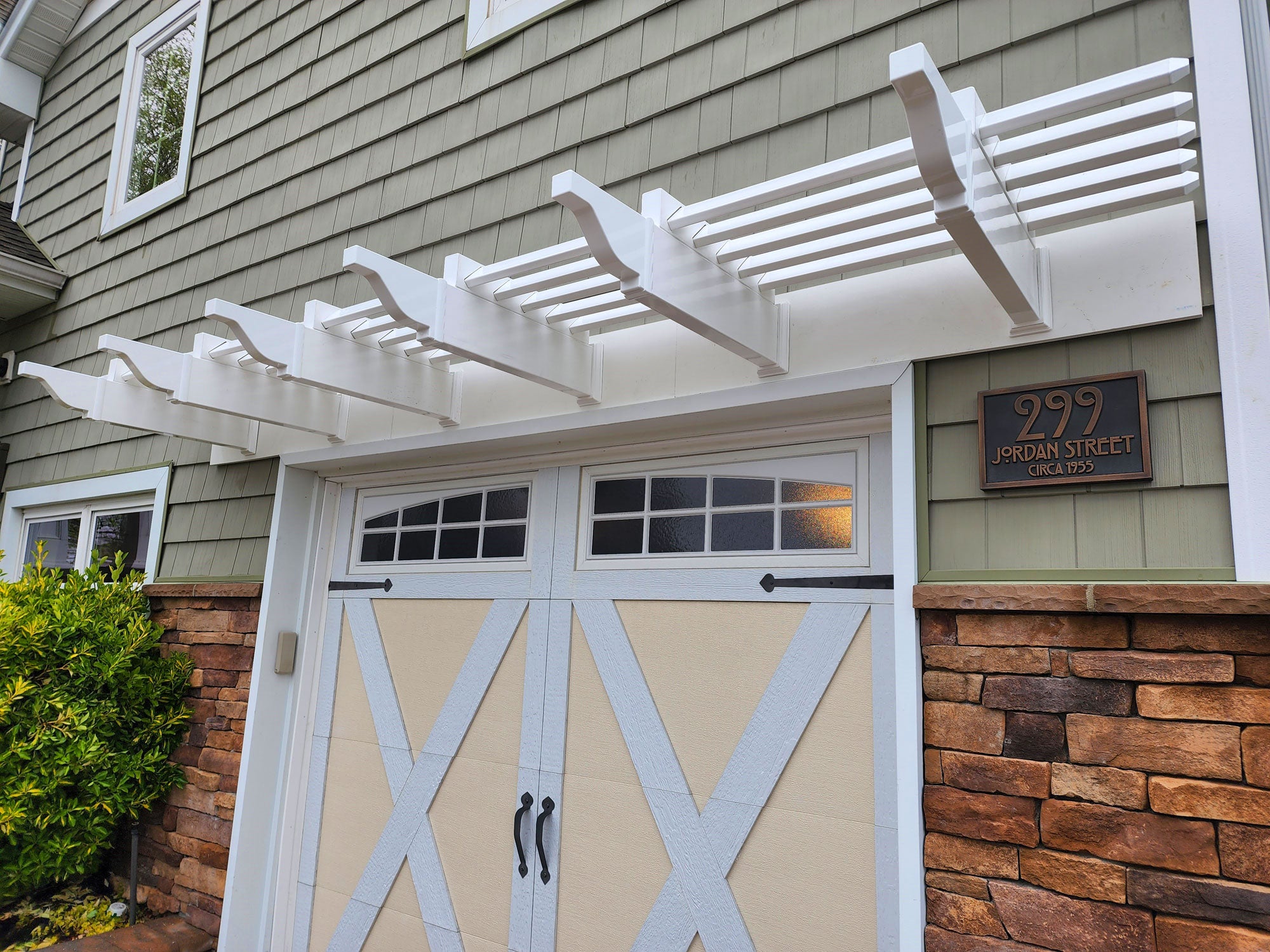
 Sunset Pergola Kits' eyebrow pergolas have 24-inch rafters, with scrolled or beveled end caps extending the overall projection by an additional 9 inches. They feature five fixed, angled shade purlins.
That geometry is intended to create a relatively shallow architectural feature rather than a deep covered area extending into the driveway.
The slats interrupt direct sunlight and produce changing shadows, but the open spaces allow sunlight and rain to pass through. Even where the pergola creates noticeable shade on the wall, it should not be treated as a continuous overhead canopy.
For homeowners interested primarily in decorative shadow patterns and modest localized shade, this may be entirely appropriate. For someone hoping to keep a person standing beside a vehicle dry, it is not.
Awning projection is the horizontal distance the structure extends outward from its mounting surface, although manufacturers may define or measure that dimension differently.
When comparing a garage door pergola or awning, request the awning's installed projection and clarify whether it refers to the frame, fabric, roof panel, or outermost trim.
Then consider three practical questions:
A deeper awning can potentially shade a larger area than a shallow eyebrow pergola, but actual performance depends on its geometry and the garage's exposure.
| Comparison Factor | Slatted Garage Pergola | Fixed Metal Awning | Fixed Fabric Awning | Retractable Awning |
|---|---|---|---|---|
| Roof construction | Permanent open slats | Fixed metal covering; panel and joint design varies | Fabric stretched over a fixed supporting frame | Deployable covering; fabric and mechanism vary |
| Shade behavior | Partial, changing shadow patterns | Potentially continuous shade beneath opaque sections | Depends on fabric opacity and geometry | Depends on fabric, projection, and deployed position |
| Rain protection | Not rainproof | Depends on roof, joints, drainage, and installation | Depends on fabric and approved weather use | Depends on manufacturer-approved conditions and deployment |
| Projection | 24-inch rafters; certain end caps add 9 inches | Product-specific | Product-specific | Product-specific and potentially adjustable |
| Coverage adjustment | Fixed | Fixed | Fixed | Deployable or retractable |
| Best coverage-related fit | Architectural shadows and localized shade | Potential permanent shade or verified rain shelter | Potential permanent shade with fabric appearance | Adjustable shade when deployed |
For awnings, request manufacturer documentation supporting any promised shade, water resistance, or rain-protection performance. In particular, distinguish between a covering that sheds some rain and an installation intended to protect a defined area during wet weather.
Above a prominent garage door, the structure's appearance matters from more than one viewing angle. Evaluate each option from the driveway, the street, and the direction visitors normally approach the home.
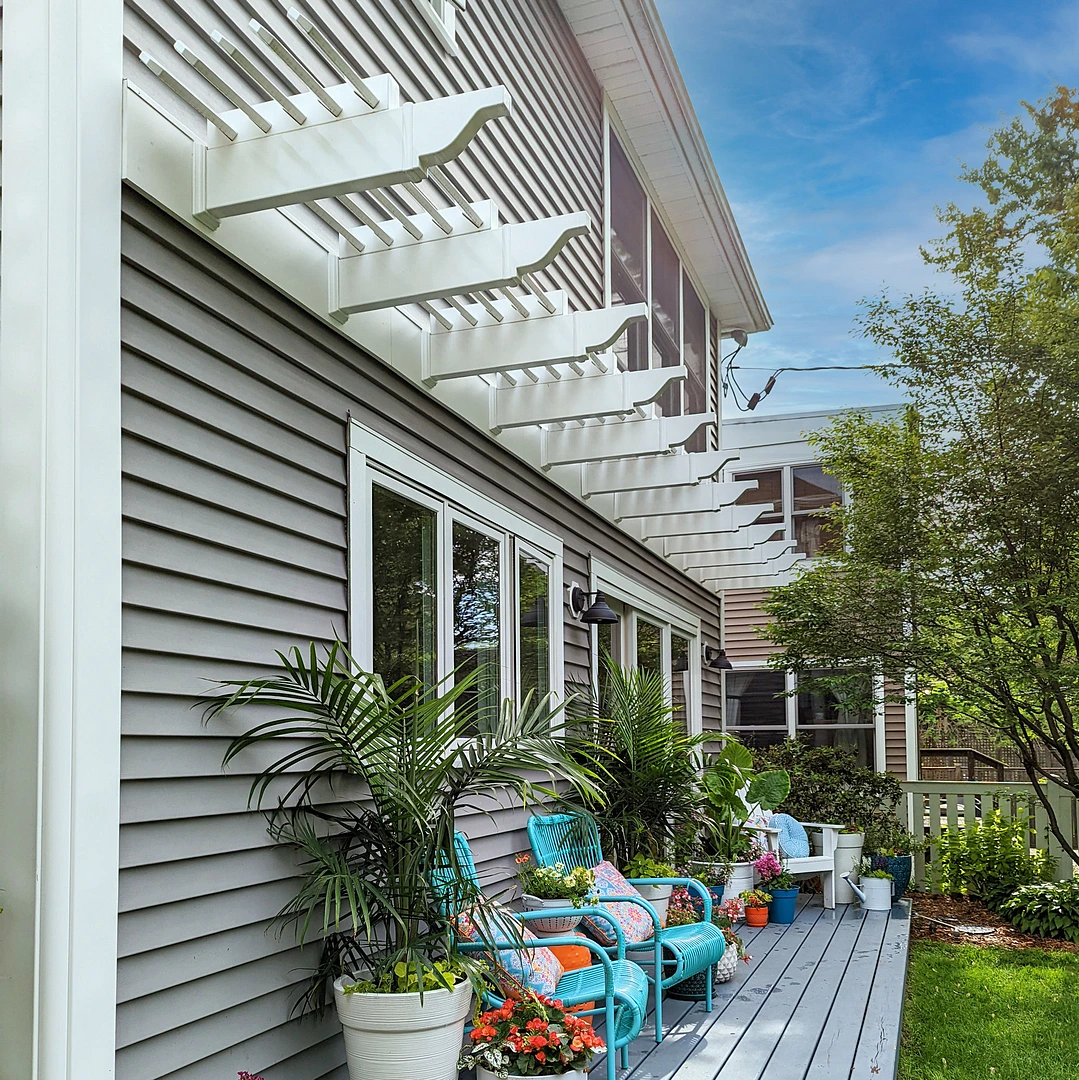 A garage pergola emphasizes the individual rafters and slats. The open spaces preserve visual separation between structural elements, creating a lighter, layered appearance.
A fixed metal awning introduces a more continuous roof profile. Depending on the design, that surface might resemble a small extension of the home's roof or provide a contrasting architectural element.
A fixed fabric awning can create a softer visual effect, particularly when its shape and fabric color coordinate with the home's exterior. However, its visible fabric surface may be a more prominent design feature than the narrow structural members of a pergola.
Neither approach is inherently superior. The important question is whether the feature reinforces the home's existing architecture or introduces a competing shape.
When comparing a pergola vs retractable awning over a garage, examine the awning in both its extended and stored positions.
When deployed, the awning may become a prominent horizontal surface above the garage. When retracted, the fabric and supporting arms may be largely concealed within a housing, depending on the model.
That housing can remain visible, however. Its dimensions, finish, and placement should be included in the visual comparison.
A permanent garage pergola has no equivalent stored position. Its architectural profile remains visible throughout the year.
Compare photographs or renderings of the actual products on the same garage elevation, ideally at the same scale.
Include views with the garage door both open and closed. An open garage door can change the visual balance of the façade and reveal whether the proposed feature conflicts with the opening's proportions or nearby architectural details.
Pay particular attention to the distance between the garage opening and any windows, trim, roof overhangs, or exterior lights above it.
For homeowners prioritizing a permanent slatted appearance, the available eyebrow pergola kits provide a useful starting point for evaluating proportions and finishes.
A fixed garage pergola eliminates the operating mechanism associated with a retractable awning, but every exterior structure still requires appropriate inspection and care. Maintenance comparisons should account for the specific materials and components rather than assume all awnings require the same work.
Sunset Pergola Kits' eyebrow pergolas feature a premium extruded vinyl exterior with aluminum reinforcement inside the rafters.
The vinyl is colored throughout and does not require painting or staining. Its fixed slats also eliminate the motors, folding arms, and deployment mechanisms associated with certain retractable awnings.
Routine cleaning and periodic inspection of the structure and its attachment remain sensible ownership practices. The absence of moving parts does not eliminate the need to check mounting hardware or address damage.
The kits are made in the USA and backed by a lifetime warranty.
A fixed metal awning generally has no deployment mechanism, but its upkeep depends on the metal finish, fasteners, joints, drainage details, and environmental exposure.
Inspecting areas where water or debris can accumulate may be especially relevant. Manufacturer care instructions should determine appropriate cleaning methods and any required maintenance.
A fixed fabric awning also can have no motorized or retractable components. Its maintenance considerations instead center on the fabric, supporting frame, tension, attachment points, and exposure to weather.
Ask whether the covering is replaceable, what replacement involves, and which cleaning products or methods the manufacturer permits.
 A retractable awning adds an operating system that allows the covering to extend or retract. Depending on the product, that may involve manual controls, a motor, articulated arms, or other mechanical components.
These components provide flexibility that a fixed pergola cannot offer, but they also introduce additional manufacturer-specific operating and servicing requirements.
Before purchasing, verify:
Do not assume that every retractable awning has identical wind restrictions or that motorized components inevitably fail within a particular period. Those questions require information about the actual product.
The ownership decision is therefore straightforward: a fixed slatted pergola offers permanent architectural detail without an operating mechanism, while a retractable awning offers adjustable coverage in exchange for its particular operating responsibilities.
Even when two products look equally suitable, the garage's construction and surrounding features can make one installation more practical than the other.
Garage pergolas and awnings must be attached to a suitable supporting structure according to their installation requirements.
Sunset Pergola Kits' eyebrow pergolas attach to the building using an included ledger board. They are not freestanding structures.
Before ordering either product, confirm the following:
For an awning, obtain the manufacturer's mounting and clearance specifications. For a garage pergola, review the applicable kit instructions and confirm the installation details with a qualified installer when necessary.
A fair garage pergola vs awning cost comparison requires current quotes for the specific products and installation conditions.
Request estimates that identify:
Do not assume a garage pergola is automatically less expensive than a metal awning, or that a retractable awning always costs more than a permanent structure. Product specifications and installation conditions can change the comparison substantially.
For the pergola option, the eyebrow pergola product page provides a starting point for identifying the relevant kit configuration. You can also review assembly information when evaluating installation requirements.
Finally, compare the quotes against the outcome each product actually delivers. A lower-priced structure is not better value if it cannot satisfy the garage's essential shade, weather, or appearance requirements.
Once you have identified the specific awning candidate and checked the installation requirements, the final choice becomes considerably easier.
A garage pergola is the stronger candidate when your priorities are:
Sunset Pergola Kits offers eyebrow pergolas in white, tan, and black, with scrolled, beveled, or flat end-cap options. Available lengths range from 4 to 60 feet in 4-foot increments.
These features make the kits particularly relevant when the objective is to complement the home's architecture rather than create a sheltered driveway.
A retractable awning may be preferable when you want overhead shade at certain times but prefer the covering to be stored when it is not needed.
Its advantage is adjustability, not guaranteed superior coverage in every situation.
Verify the deployed projection, resulting shade, stored appearance, operating restrictions, and maintenance requirements before deciding.
If those details remain unavailable, the product has not yet demonstrated that it can satisfy your needs.
If keeping rain off a defined area is essential, prioritize a fixed awning specifically designed and documented for that application.
A metal awning may be a suitable candidate, but its covering, joints, slope, drainage, and attachment details must support the intended performance. A fixed fabric awning should be evaluated against its own manufacturer's specifications rather than assumed to provide the same protection.
The decisive factor is documented performance for the actual installation, not whether the product is described as a canopy, awning, or roof.
Do not make the final purchase decision if important information is missing.
For example, an awning without documented rain-use instructions cannot confidently be recommended for a rain-shelter project. Similarly, a garage pergola should not be selected for a project that requires continuous shade or waterproof coverage.
Sunset Pergola Kits specializes in permanent pergolas and patio covers; it does not offer fabric awnings, retractable coverings, or motorized awning systems.
If the permanent slatted approach meets your requirements, you can compare available eyebrow pergola kits and identify a suitable size and finish.
The best choice between a garage pergola and an awning depends on whether you value permanent architectural detail, adjustable shade, or documented weather protection most. An open slatted pergola is well suited to enhancing the garage façade, while a properly specified awning may be better for continuous or adjustable coverage.
Compare actual dimensions, installed appearance, maintenance obligations, and complete project quotes before committing. If a permanent slatted feature is the right fit, Sunset Pergola Kits' eyebrow pergola collection is a practical next step. If weather coverage is essential, continue evaluating awnings with verified specifications for that purpose.
Yes. Retracting an awning removes much or all of its extended covering from view, but the housing and mounting components may remain visible. Their appearance depends on the particular model. A garage pergola remains permanently visible.
Yes. A fixed fabric awning can use a stationary frame without motors or retractable mechanisms. Its maintenance requirements concern the fabric, frame, and attachments rather than a deployment system.
No. Rain protection depends on the awning's roof design, joints, slope, drainage, projection, and installation. Verify the manufacturer's intended weather use rather than assuming every metal covering is rainproof.
No. Advertised projection describes a dimension of the awning, not a guaranteed dry area. Wind-driven rain, runoff, side exposure, and installation geometry can reduce effective protection.
No. Wind limitations depend on the specific awning, its construction, mounting system, and manufacturer instructions. Fixed and retractable awnings should be evaluated individually rather than assigned one universal wind rating.
Yes. Comparing both positions helps reveal changes in façade appearance and potential clearance or access conflicts. Use matched views of the proposed pergola or awning on the actual garage whenever possible.
No. Sunset Pergola Kits' eyebrow pergolas have an extruded vinyl exterior, aluminum reinforcement inside the rafters, and an open slatted design. An exposed metal awning typically presents a different surface, profile, and architectural appearance.


